
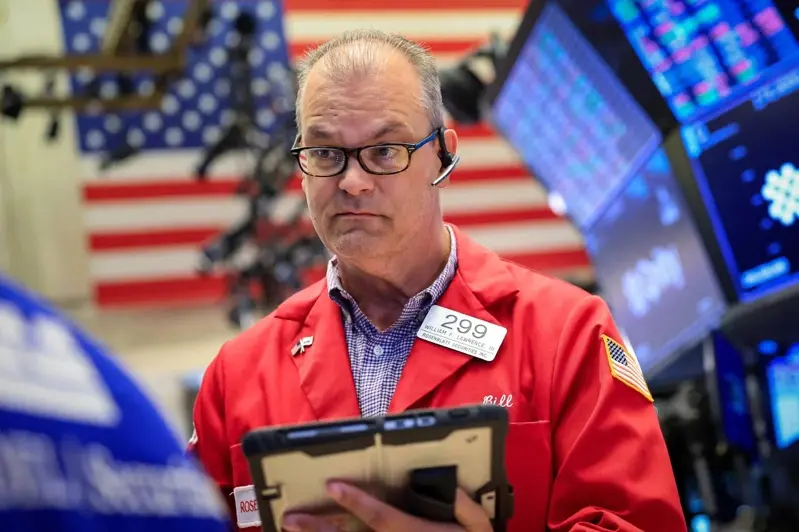

With chip stocks dominating the market, the US stock market faces its first crucial test in the second half of the year: can the AI rally withstand the profit-taking test, and can funds smoothly shift from the already high-performing semiconductor stocks to broader sectors such as industrials and financials? In the first full trading week of July, investors will focus on the Federal Reserve (Fed) meeting minutes and the second-quarter earnings season, both of which could determine whether this rotational rally continues.
U.S. stock markets were closed on Friday for the Independence Day holiday. The Philadelphia Semiconductor Index fell 11% for the second consecutive day on Thursday, and dropped 4.4% for the week. TSMC ADR, however, maintained a 0.4% weekly gain. The Dow Jones Industrial Average closed at a record high.
Chip stocks experienced increased volatility, prompting investors to question whether the AI rally had overshot its mark and whether rotating funds could support the broader market.
Technology and semiconductor stocks have been the main drivers of the US stock market rally in recent months, but they have also experienced the most significant pullback recently. Chip stocks like Micron and Intel, which rose the most sharply, have also fallen the most dramatically. Market expectations for profits in the AI supply chain are rising higher and higher, and Wall Street’s overall profit forecasts are being revised upwards rapidly accordingly. Bloomberg data shows that analysts predict S&P 500 companies’ profits could grow by 25% over the next year, the largest upward revision since the post-pandemic recovery.
Ben Inker, co-head of asset allocation at GMO, warned that the upward revisions to earnings forecasts for the next two years are “extremely high,” unlike anything seen outside of the post-crisis recovery. He fears the market will eventually realize that these forecasts will not come true.
The challenges facing AI concept stocks extend beyond their high share prices; they also include whether capital expenditures can translate into actual profits. Analysts at Capital Economics warn that AI-related stocks may be approaching a tipping point, with profit expectations and capital expenditure assumptions becoming unsustainable. A correction could trigger a broader market pullback. Michel Lerner, head of investment analysis at UBS’s HOLT platform, also stated that the pricing of AI supply chain stocks already reflects market expectations of companies maintaining above-normal excess profits, potentially creating a “profit bubble.”
However, Wall Street hasn’t turned pessimistic yet. The key is that funds haven’t completely withdrawn from the stock market; instead, they’re starting to look for the next wave of opportunities beyond chip stocks. Healthcare, industrials, financials, and consumer discretionary stocks have performed well in recent months, with small-cap stocks becoming a market highlight. The Russell 2000 index surged about 22% in the first half of the year, marking its best first-half performance since 1991 and significantly outperforming the Nasdaq. Joshua Schachter, chief investment officer at Easterly Snow, said investors are thinking about “where the next round of excess returns will come from.” He recently took profits on some of his semiconductor and AI positions and shifted his investments to healthcare, industrials, and consumer discretionary stocks.
Small-cap stocks are benefiting from a resilient U.S. economy, lower oil prices, and a slowing but not stalled job market. Francis Gannon, managing director of Royce Investment Partners, points out that analysts predict Russell 2000 companies will see 54% earnings growth by 2026, more than double the expected growth for Russell 1000 large-cap stocks. He says, “The earnings potential for small-cap stocks is very strong, and it’s only just beginning.”
However, the rebound in small-cap stocks also has its concerns. Some of the gains were still driven by a few semiconductor and AI infrastructure stocks, suggesting that the small-cap index may also be dragged down by a shift in confidence in AI.
The Fed meeting minutes will influence interest rate expectations next week. New Chairman Walter Watney chaired his first meeting since taking office, emphasizing that inflation remains above the Fed’s 2% target and downplaying market reliance on forward guidance. “Now that we have a new sheriff, the market doesn’t know how he’ll lead, so it’s watching the minutes closely,” said Larry Tentarelli, chief technical strategist at Blue Chip Daily Trend Report.
June job growth fell short of market expectations, temporarily easing concerns about a September rate hike. However, if the Fed meeting minutes show an overall hawkish stance from officials, Treasury yields could rise again, further pressuring high-priced tech stocks. James Ragan, co-chief investment officer at DA Davidson, said that if the Fed becomes more restrictive and begins a tightening cycle, it poses a risk to both the stock market and valuations.
Earnings season presents another test. Delta Air Lines and PepsiCo will be the first to report next week, potentially providing clues about consumer spending. Keith Lerner, chief investment officer at Truist Advisory Services, said, “If earnings are the North Star of this bull run, the most important task of this quarter’s earnings reports is to prove that the earnings trajectory for this year remains valid and that the upward momentum can continue into next year.”