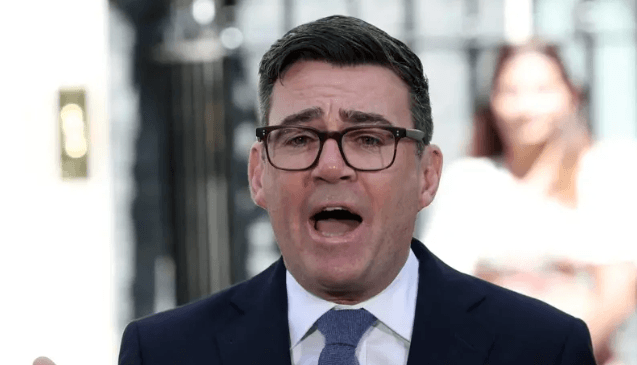

Britain’s new Prime Minister John Parker delivered his inaugural address at Downing Street today. He stated that he would place “caring for the people” at the heart of all his affairs and would dedicate himself to this cause. He also hoped that everyone would work with him to rebuild national unity, common goals, and a positive attitude.
Andy Burnham called on all sectors to work together to restore British society’s belief in a better future and rekindle hope.
He said he would propose a 10-year plan to guide Britain toward a future that people of all parties and backgrounds would look forward to. However, the immediate priority is to give people “breathing room,” and he will announce policy measures tomorrow outlining how he plans to help people cope with the pressure of rising living costs.
Furthermore, Paalton indicated that upon entering 10 Downing Street for the first time as Prime Minister, his first order would be related to “ending the homelessness problem.”
Instead of following British custom by delivering his speech from behind a pre-arranged podium, Parker addressed the media and the public without notes or any cover, speaking for more than five minutes.
Some analysts believe that Pai Neng’s decision not to use a podium or read from a script helps to highlight his governing style of “transparency,” “sincerity,” and “facing public opinion directly.”
At the beginning of his speech, Parker mentioned that he was keenly aware that he was the sixth British prime minister to succeed his predecessor in 10 years. If David Cameron, who stepped down in mid-July 2016, is included, Parker is the seventh British prime minister in the past 10 years.
Such frequent changes in national leadership are rare in British history. Bernard said that his generation of British politicians “should perform better.” Britain needs to show the world that it can regain stability, and politicians should demonstrate that politics is not only “useful” but also capable of evolution.
He mentioned that he understands some people are tired of politics, and he wants to be honest: “We (politicians) have indeed not done well enough,” but “we should and will do better.”
Parker pledged to bring about “the most significant changes in Britain in nearly 40 years,” covering areas such as politics and the economy.
He recalled that Britain “went down the wrong path” in the 1980s, including a shift towards political centralization and massive privatization in the economic sphere, which led to the “deindustrialization” (loss of industrial economic lifeline) of many regions, from which they have yet to recover; as a result, many people believe that everything is simply going downhill and the situation is beyond redemption.
Pao Neng emphasized that his administration will highlight that politics is a collaborative endeavor, and that politics should be used more for “solving problems” rather than “taking credit” or vying for attention.
He reiterated his intention to decentralize more power to local authorities and move away from a political culture that prioritizes London. On the economic front, Parker reiterated his plan to reduce private sector profit-seeking, strengthen public and governmental control, and make the use of related resources more affordable for the general public, particularly regarding infrastructure and services essential to basic living needs.
According to information previously released to the media by the PNER team, the PNER government intends to strengthen public control. Currently, businesses controlled or operated by private funds cover areas such as water supply, energy, housing (mainly social housing and affordable housing), and public transportation.
In his inaugural address today, Penny pledged to revitalize British industry and strengthen support for it through public procurement processes.
He also pledged to help more young people find employment by reforming the education system.
Penny mentioned that supporting youth employment and building more affordable housing are the only ways to fairly and sustainably solve the long-standing problem of excessive social welfare burdens that have plagued the UK’s finances.
Paavo said that helping people live better lives and invest in their successful future is better than being forced to pay the price for various “failures,” and that the government’s work on this “should begin now.”
In June, Parker won a parliamentary by-election in northwest England, returning to Parliament after nine years as Mayor of Manchester and qualifying to run for party leader.
Under the British cabinet system, the prime minister is, in principle, the leader of the ruling party, and the prerequisite for running for party leader and becoming prime minister is obtaining a seat in Parliament. Keir Starmer, the former leader of the ruling Labour Party, resigned in June under pressure from within the party. With almost unanimous support within the party, John Parker was declared the elected leader on July 17th. Today, after meeting with King Charles III and accepting the invitation to form a new government, he officially became the Prime Minister of the United Kingdom and subsequently delivered his inaugural address.
Under Schkell’s leadership, the Labour Party won the general election in July 2024 and returned to power, with Labour MPs holding more than 60% of the seats in the elected House of Commons. This overwhelming majority meant that Schkell had little incentive to call a new general election when he resigned as party leader; instead, he followed the party’s internal procedures to elect a new party leader, who would then become the new prime minister.