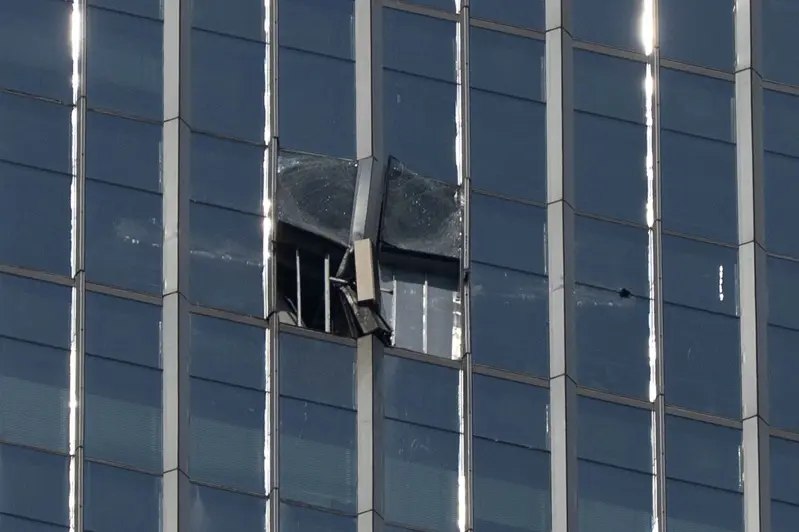

The incident on the evening of the 26th in Beijing, in which a light aircraft crashed into the CITIC Tower (China Zun), has left three questions unanswered, despite the official Chinese statement released the following day: Who was the pilot of the light aircraft? What was his motive? And how did a light aircraft manage to navigate the complex network of restricted areas in Beijing’s central restricted zone?
Who is the pilot? The name circulating online is: “Liu Junhua”.
According to a BBC Chinese report, the official Chinese statement regarding the pilot of the two-seat, single-engine light sport aircraft only stated one sentence: “There was only one pilot on board, who died on the spot.” The statement did not mention the pilot’s gender, age, or name.
However, one name had already spread online on the day of the incident: “Liu Junhua.” The Financial Times pointed out that late that night, at the flight school where the plane took off, several people dressed in black searched a black SUV in the parking lot, and public records show that the registered owner of the car was named Liu Junhua.
The name “Liu Junhua” quickly spread on social media on the day of the incident and was linked to the collision. Public information shows that CITIC Wealth Management, a subsidiary of CITIC Bank under CITIC Group, happens to have a female manager named Liu Junhua.
However, the day after the incident, CITIC Wealth Management published an article on its WeChat official account, which specifically mentioned that “on June 27, 2026, Liu Junhua, General Manager of the Separate Account Investment Line of CITIC Wealth Management, shared the company’s development strategy and provided an in-depth interpretation of the company’s practical path and implementation results in empowering business quality improvement and upgrading through cultural construction.” Therefore, whether this Liu Junhua is the same person as the previous Liu Junhua remains unresolved.
What was the motive for the plane crash? Was it an accident or intentional?
The second key question remains: was the collision between the light aircraft and the “China Zun” tower intentional or accidental? FlightRadar24.com, a widely used flight tracking platform globally, told the New York Times that the aircraft involved was “usually used for pilot training east of Beijing,” and that its flight that day was “abnormal.” When asked whether it was accidental or intentional, Petchenik said, “I don’t think we can rule out any possibilities at this time.”
Hong Kong’s Ming Pao quoted aviation enthusiasts who speculated that the pilot may have turned off the aircraft radio without authorization. Furthermore, there are no visual navigation charts in the area where the incident occurred, suggesting the pilot may have used the Beijing-Qinhuangdao Expressway as a visual reference point, flying from Tongzhou all the way to China Zun. However, there is currently no direct evidence to answer this question.
According to a Chinese flight learning website, the Aurora SA60L is a light aircraft with simple controls, but it is a single-engine aircraft. In the general aviation field, engine failure in a single-engine aircraft is almost impossible to handle at low altitudes, and the pilot’s options are extremely limited. Pilot incapacitation, such as cardiac arrest or carbon monoxide poisoning, is not uncommon in light aircraft accidents. The aircraft may continue flying on its original course until it collides with an obstacle.
How was the penalty area breached? Only 6 kilometers from Zhongnanhai.
Furthermore, while this incident cannot be compared to the 9/11 attacks in the United States in 2001, its unbelievability is no less: in the heart of a city with the strictest airspace control in all of China, just 6 kilometers from Zhongnanhai and atop Beijing’s tallest building, a small plane flew through the city and crashed into Beijing’s most iconic skyscraper.
Flying over Beijing isn’t as simple as it seems. A well-known term in China’s civil aviation industry is the “Beijing Big Turn.” Commercial flights taking off or landing at Beijing Capital International Airport or Daxing International Airport must make a near 90-degree turn in the air to deliberately avoid the airspace above Beijing’s urban area. The airspace above Beijing’s urban area is a no-fly zone; this is written in every air traffic control manual in China.
Starting in May of this year, controls were further tightened: Beijing completely banned the sale of drones, prohibited bringing drones and their components into Beijing, and required permits for all outdoor flights. Even kites and sky lanterns were banned. In other words, Beijing’s skies were closed not only to airplanes, but to everything that could fly.
It has been pointed out that this aircraft precisely addresses a recognized challenge to airspace security in various countries: “low, slow, and small.” Flying at an altitude below 1000 meters, at a speed below 200 kilometers per hour, and with a radar cross-section of less than 2 square meters, it is difficult for traditional radars to detect. The Aurora SA60L perfectly meets all three conditions.