
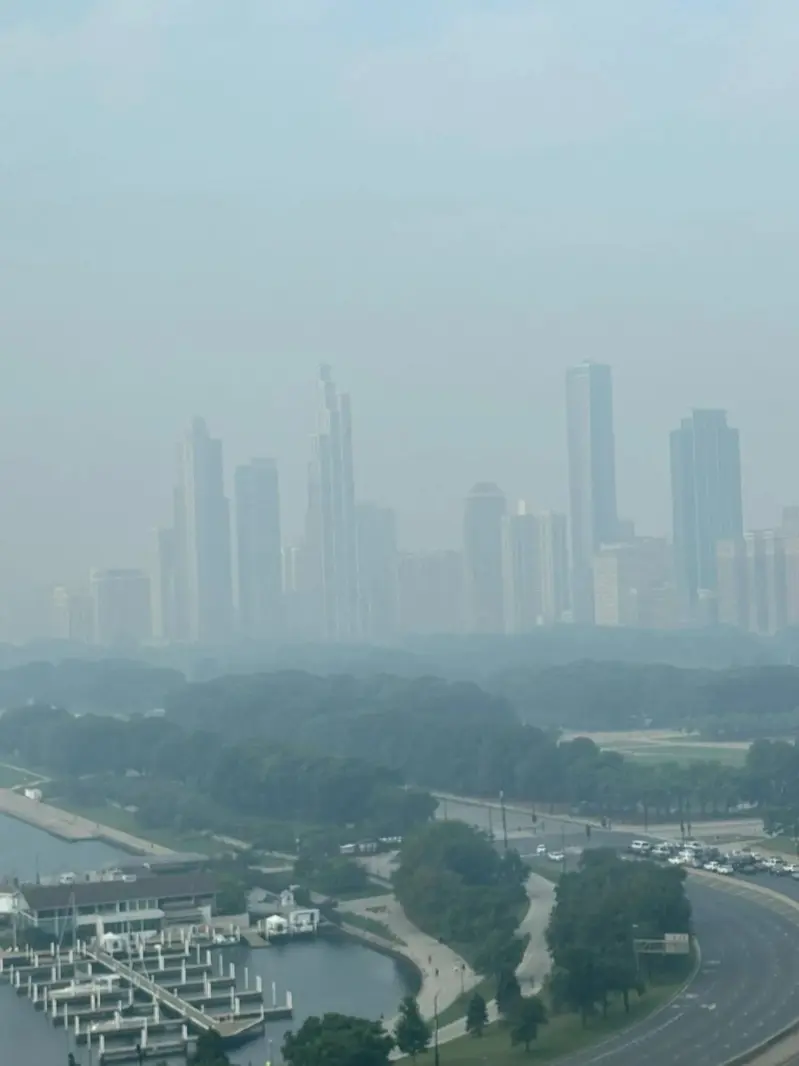

Chicago was shrouded in acrid smoke on the 16th due to the southward spread of smoke from the massive wildfires in Canada . Many residents smelled a strong burning odor early in the morning, and the air was thick with haze. The government warned that air quality had deteriorated to “very unhealthy” or even “dangerous” levels, urging residents to avoid prolonged outdoor activities. The official air pollution warning remains in effect until midnight on the 17th.
This marks the first time since the COVID-19 pandemic that Chicago has closed all its beaches and 50 outdoor swimming pools due to air pollution. Suburban beaches, including Evanston, were also closed. The Chicago Park Authority canceled all outdoor events that could not be moved indoors, and Chicago Public Schools (CPS) moved all summer classes and activities indoors in accordance with extreme heat policy.
The U.S. National Weather Service reports that more than 800 wildfires are currently burning in Canada, many of which remain uncontrolled, with some near the U.S.-Canada border. Driven by strong winds, large amounts of smoke have drifted south to the Chicago area, and combined with summer ozone pollution, this has caused a sharp deterioration in air quality.
The Illinois Department of Environmental Protection (EPA) has declared “Air Pollution Action Day” for Chicago and northern Illinois and extended the air pollution alert until the 17th, advising residents to reduce outdoor activities and increase their rest time.
On the 16th, Chicago’s Air Quality Index (AQI) hovered between “very unhealthy” and the highest level, “hazardous.” According to data from nearly 300 monitoring stations across the city, almost all neighborhoods reached the “hazardous” level by evening, with no area spared. Although the city’s monitoring system does not include ozone concentrations, ozone was also a significant factor contributing to the worsening air pollution that day.
Experts point out that wildfire smoke contains a large amount of PM2.5 fine particulate matter, which can penetrate deep into the lungs and enter the bloodstream after inhalation. Prolonged exposure may increase the risk of asthma, heart disease, and stroke. Pregnant women, children, adolescents, the elderly, and those with respiratory diseases or weakened immune systems are at particularly high risk.
According to data from a Swiss air quality monitoring company, Chicago was once again ranked as one of the world’s most polluted cities on the 16th, taking turns with Detroit, Minneapolis, and New York at the top of the pollution list.
Official air pollution warnings remain in effect until midnight on the 17th. Experts point out that in recent years, climate change in Canada has led to higher spring temperatures and drier forests, resulting in earlier and larger wildfires. Chicago has been frequently affected by dense smoke in recent summers, which may be gradually becoming the new normal.
Doctors advise the public to stay indoors as much as possible, keep doors and windows closed, and wear N95 masks when necessary to reduce the risk of inhaling harmful particles. Jack Zhao, a pulmonary intensive care physician at Rush Copley Medical Center, stated that prolonged exposure to wildfire smoke is “like continuous smoking,” and could have long-term adverse health effects.