
AI summary
Summary of article:
The share of Asians in Harvard’s class of 2030 is at a record high of 43.2%, while the proportion of African Americans continues to decline, raising renewed questions about admissions fairness; The school emphasizes that statistical methods have changed and careful comparisons are needed.
Harvard University (Harvard University) announced the latest statistics for new students in the class of 2030 (referring to those graduating in 2030) on the 27th.Asian The proportion of students is 43.2%, a record high, exceeding the previous class’s 41%. It is the third consecutive year of increase after the federal Supreme Court banned universities from using race as a factor in admissions in 2023.
Compared with 2014, when Asian freshmen accounted for about 19%, the proportion has now more than doubled, once again drawing attention to the fairness of admissions to top universities in the United States.
According to official information from Harvard University, 43.2% of new students in the class of 2030 are Asian.African American 9.3%, Hispanics 11.4%, Native Americans, Native Hawaiians and other Pacific Islanders about 2%. Another 9% of students did not declare their ethnic identity. Harvard does not release a separate percentage of white students.
The Harvard Crimson reported that the proportion of Asian students increased from 37% in the Class of 2028 to 41% in the Class of 2029, and then to 43.2% this year; African-American students showed the opposite trend, from 18% in the Class of 2027, to 14%, 11.5% and 9.3% this year. The number of Hispanic students this year is 11.4%, about the same as last class.
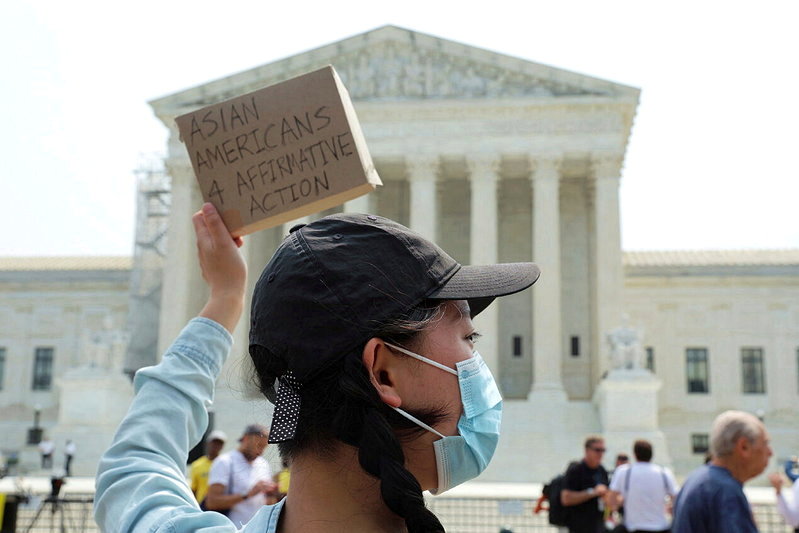
The change comes after the Supreme Court ruled in June 2023 that Harvard and the University of North Carolina’s system of using race as an admissions process was unconstitutional. The case was publicized by Students for Fair Admissions (SFFA), which accused Harvard’s admissions system of being unfair to Asian applicants. After years of litigation, this ultimately led American universities to adjust their admissions policies.
According to a report by the conservative website “Washington Free Beacon”, Edward Blum, president of Students for Fair Admissions, said that when the organization filed a lawsuit against Harvard in 2014, the number of Asians among admitted new students was about 19%, and now it has increased to 43%. He argued that this is strong evidence that Harvard has used race as a significant factor in admissions over the past few decades.
Bloom pointed out that the Supreme Court decision does not require Harvard to increase Asian students, nor does it require fewer white, black or Hispanic students, but the school does need to stop treating applicants differently based on race. He also called on Congress to require universities to disclose the academic qualifications and admissions data of applicants from different ethnic groups to confirm whether schools are actually complying with the law.
However, Harvard officials said the 43.2% statistic only covers US citizens and permanent residents who voluntarily declare their ethnicity. Students can also choose multiple ethnic identities, so the proportions in different categories may overlap.
Additionally, Harvard will change its ethnic statistics data starting with the class of 2028, and will use students who have declared ethnic groups as the basis for calculations. This is different from the previous calculation method for all newbies. Cross-year comparisons should be interpreted with caution.
Harvard received a total of 55,104 applications for admission this year, an increase of 15% from last year, and 2,037 people were admitted. Ultimately, 1,648 people were admitted, with an acceptance rate of approximately 3.7%. Newcomers to the United States come from 50 states and 86 countries. 17% are first generation college students in their families. 39% receive enough financial aid to cover full tuition. The other 22% of students receive full subsidies for tuition and living expenses.
Harvard has a relatively high proportion of Asian students compared to other top universities. Information compiled by the Washington Free Beacon shows that 31% of Stanford University’s Class of 2025, 23% of Princeton University’s Class of 2030, 27% of Yale University’s Class of 2030 and 38% of MIT’s Class of 2029 are Asian. However, each school’s statistical year and ethnic classification methods are different and cannot be used directly as a basis for fair comparison. Entry.
On the other hand, the Trump administration filed a lawsuit in February this year over Harvard’s refusal to provide applicant-level admissions information, hoping to obtain relevant records to investigate whether the school has complied with the Supreme Court ruling.
The Harvard Newspaper reported that the lawsuit does not directly accuse Harvard of racial discrimination. Some Republican members of Congress are also pushing for the College Admissions Accountability Act, advocating the establishment of an oversight mechanism dedicated to investigating illegal discrimination in higher education.
Summary FAQ
-
Because the number of Asian newcomers is 43.2%, which is not only a record high, but also higher than the previous class, it shows that there are still significant changes in Harvard’s racial composition after the Supreme Court banned racial admissions.
-
The core of the controversy is whether Harvard has used race to influence admissions in the past, specifically whether Asian applicants have been treated unfairly. The Supreme Court has ruled that the related practices are unconstitutional, and the outside world is still concerned about whether the school has actually made adjustments in accordance with the law.
-
Harvard reported that the percentage is limited to 43.2% of US citizens and permanent residents who voluntarily declare their ethnicity, and many ethnicities are optional; The basis of calculations has also changed since the Class of 2028, so cross-year comparisons may not be directly equivalent.