
AI summary
Summary of article:
The New York City government announced that it will renovate Third Avenue in Brooklyn’s Sunset Park, which will be constructed in phases by the end of 2028 to reduce the risk of crashes through pedestrian safety islands, intersection improvements, and bicycle lane design.
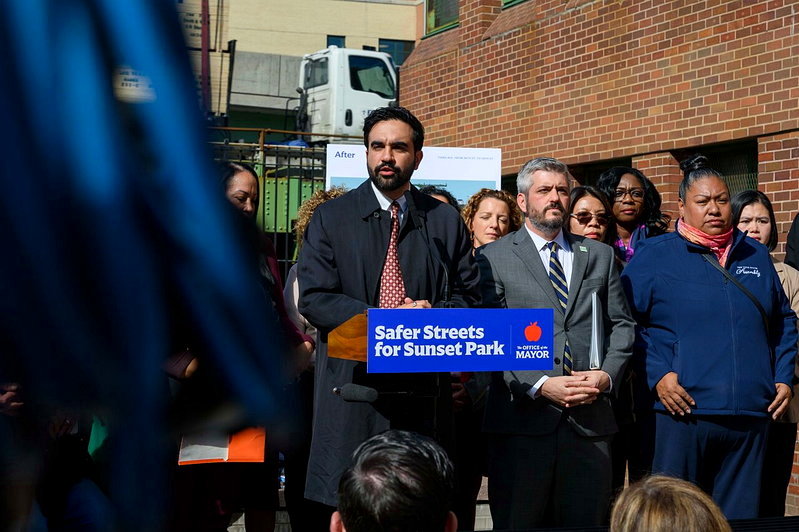
mayor of new yorkMandani on the 28thbrooklyn (Brooklyn)sunset park It was announced that the city Department of Transportation (DOT) will redesign a more than two-mile stretch of Third Avenue from 62nd Street to 20th Street early next year. It will add pedestrian safety islands, improve intersections, and install two-way physically separated bicycle lanes in this section. It is expected to be completed by the end of 2028. The avenue, located under the Brooklyn-Queens Expressway (BQE), has taken the lives of 17 people over the past 10 years, including a pair of Chinese men, as well as NYU Langone nurse Jiayi Zheng and Korean nurse Clara Kang. The local community has been fighting for renewal for many years, but a “street slimming” plan proposed by former Mayor Adams (Road Diet) was shelved due to opposition from the business community. In response, Mandani told this newspaper in an interview after the press conference that the city government would move protected bicycle lanes to the central separation island to ensure businesses can continue to park trucks and cars.
That day, Mandani held a press conference with City Transportation Director Mike Flynn, State Senator Andrew Gounardes, State Representative Marcela Mitanes, City Council Member Alexa Aviles, and several community organizations. Currently, pedestrians have to walk 150 feet to cross Third Avenue, which is equivalent to half an American football field, and the fast-moving traffic passing by is fraught with dangers, Mandani said.
The current plan of the city government and the Municipal Transportation Bureau will reduce the crossing distance by half after the new pedestrian safety island and sidewalk and expansion of the central separation island. The Municipal Transportation Bureau reported that similar road improvements have been proven to reduce deaths and serious injuries of all road users by 30%.
The city will also install a two-way bicycle lane separated from parking spaces between Second Avenue and Fourth Avenue on 60th Street, connecting the protected bicycle lane on Fourth Avenue to the Brooklyn Waterfront Greenway on Second Avenue, and improving safety around two nearby schools.
According to the city government’s schedule, the renovation project will be carried out in two phases: in 2027, construction on Third Avenue from 62nd Street to 43rd Street and from Second Avenue to Fourth Avenue on 60th Street will be constructed first; In 2028, the reconstruction of Third Avenue from 43rd Street to 20th Street will be completed. It is expected to be fully completed by the end of 2028. The city will also study a future extension of Third Avenue from 62nd Street to 65th Street, as well as the section from Prospect Avenue north to Carroll Street in Gowanus.
Flynn said the 60th Street intersection below the press conference site is one of the most dangerous intersections on Third Avenue. Over the past five years, there have been 72 injuries, including five serious injuries and one death.
According to the schematic map released by the city government, taking the section from 36th Street to 54th Street as an example, Third Avenue has a total width of 150 feet. It currently has three 12-foot-wide traffic lanes in each direction, one 13-foot-wide parking lane, and a 52-foot-wide parking island in the center. After renovation, the two-way traffic lanes were reduced to two 11-foot lanes, and the parking lane was reduced to 10 feet. The free space was established with 10-foot-wide one-way protected bicycle lanes on both sides of the central separation island, separated from traffic flow by three- and four-foot buffer zones. The Municipal Transportation Bureau will also re-plan the parking space on the central separation island and replace it with paid parking spaces.
In an exclusive interview with this newspaper after the meeting, Mandani said that although the city government will promote two projects of repairing the middle section of Third Avenue and BQE at the same time, even if the two programs partially overlap, both projects will continue to move forward. For this, the construction will be done in phases. Improvement measures will be implemented as soon as possible, section by section, in more than 40 blocks covered under the scheme, so that people can get benefits as soon as possible instead of “two years of building and two years of waiting”. He said that as the project progresses, people will see “immediate results almost every quarter.”
Asked whether there would be transitional safety measures such as signals and lighting during construction, Mandani said that was the intention of the phased construction. He reiterated that after the renovation, the distance for pedestrians to cross Third Avenue will be reduced to about half the current width of an American football field, protected bicycle lanes will be installed, and the central pedestrian separation island will be expanded.
Regarding the former city government’s “street slimming” plan, Mandani pointed out that the Adams City Council has never put forward a final plan. In preliminary planning at the time, the protected bicycle lane was located close to the curb, raising doubts in the business community about the use of curb space.
“We listened to the concerns and moved the protected bike lane to the center divider.” Mandani said this adjustment is very important because it does not sacrifice the safety of cyclists, the location of the bike lanes remains unchanged, while ensuring that cars and trucks can still use the curb while responding to the needs of businesses on the street.
The plan was stalled due to opposition from the business community. When asked about the current progress of communication with the Chamber of Commerce, Mandani said that the city government takes the opinions of businesses seriously, which is also the reason for adjusting the location of the bicycle lanes. “Negotiations are still ongoing.” He said that by continuing the dialogue, the city will ensure immediate safety improvements for New Yorkers.