
AI summary
Summary of article:
The condition of a public pier in Bosfica, California, has been deteriorating since a portion of it sank in June. In hopes of preventing damage to the pier and surrounding infrastructure before the winter storm, the city government spent approximately $6 million to make emergency reinforcements.
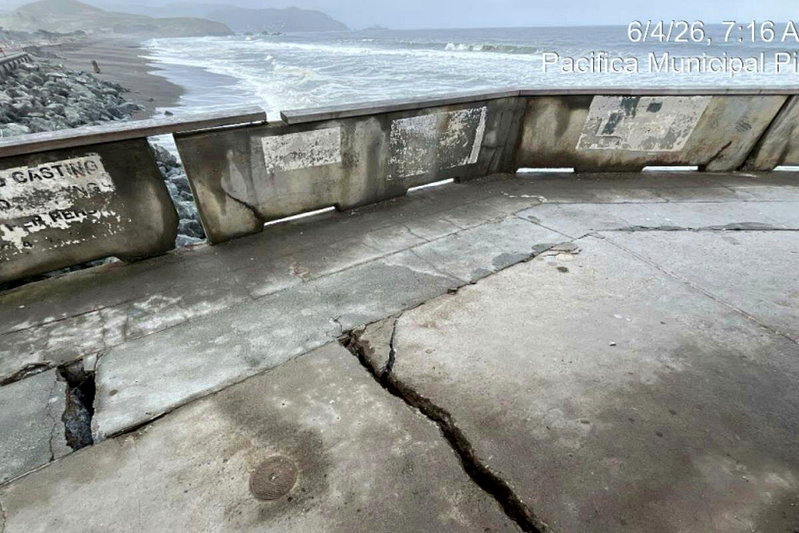
California In the coastal city of Pacifica, a public pier suddenly sank in June this year and continued falling towards the Pacific Ocean in the following days. After months of preparation, the local government launched an emergency reinforcement project worth approximately 6 million yuan. The construction team began transporting large equipment on the 22nd in preparation to stabilize the pier ahead of the expected rainy winter. The city government stressed that the project aimed to prevent the pier from completely collapsing into the sea and that the pier would not be reopened to the public.
According to the reporter’s observation, construction workers have been moving some components of the crane to Beach Avenue in front of the pier since last week, and about 20 engineering vehicles and equipment have also arrived at the site.
A portion of the pier adjacent to the concrete walkway is sinking sideways. The construction team plans to install large piles to push the sunken sections back into place. Before piling, workers must first assemble two 400-ton cranes to lift the necessary equipment to the construction site.
Bosfica City Manager Sean Charpentier said the pier is an important local asset and the winter storm could cause further damage to it. City officials said that in addition to the safety of the pier, the project also concerns the safety of surrounding roads and underground pipelines.
There are water and sewage lines just down the road next to the dock. Officials warned that a complete collapse of the pier structure could cause serious damage to the underlying roads and critical infrastructure.
For frequent visiting residents, the pier is also part of daily life. Ms. Chen, a Chinese, said: “Since the pier collapsed and closed, there are fewer residents than before to walk and fish here. If the pier could not be saved and was eventually demolished, I can’t imagine what it would be like. After all, that pier has been in most people’s memories for almost a lifetime.”
Mr. Zhang, a longtime resident of the nearby city of Dali, said the El Nino phenomenon is going to affect the Bay Area and the entire West Coast. Seeing the oceanfront homes in Long Beach, South Carolina being swept into the ocean, it really worries the entire Bosfica. “If there is no immediate reinforcement, the pier may not be able to survive this winter.” Mr. Zhang said.
The city government said the temporary reinforcement project is expected to cost about $6 million, and the city council will pay for it from reserve funds and insurance funds. City officials also plan to apply for state emergency funds to cover related expenses.
Summary FAQ
-
As the pier continues to collapse toward the Pacific Ocean since the bridge head collapsed in June, if not dealt with before the winter storm, the entire structure could become further unstable or even collapse into the ocean, causing more damage.
-
The city government estimates that the temporary reinforcement project will cost about 6 million yuan. The city council will first use reserve funds and insurance funds to pay for it, and then apply for emergency funds from the state government to cover the expense.
-
Because water supply and sewage pipelines are buried beneath the roads adjacent to the pier, once the structure collapses completely, it will not only destroy the pier, but may also damage roads and critical underground infrastructure.