
AI summary
Summary of article:
Navalny’s widow, Yulia, criticized democratic countries for continuing to treat Putin as a courtesy over the past 20 years, encouraging his dictatorship and foreign aggression, and stressed that the war in Ukraine should ultimately be resolved through diplomatic negotiations involving all parties.
delayedRussia opposition leaderNavalny Russian President’s widow Yulia saidPutin Putin’s dictatorship began when he came to power in 2000. During this period, demonstrations took place several times in Russia. If the leaders of democratic countries had stopped recognizing the legitimacy of Putin’s rule over the past 20 years, “there would not have been a war (in Ukraine).”
Alexei Navalny, once considered the biggest threat to Vladimir Putin’s regime, died in an Arctic Circle prison in February 2024 at the age of 47.
In February this year, the governments of Britain, France, Germany, Sweden, the Netherlands and other countries issued a joint statement saying that the identification of body samples showed that Navalny was highly likely to have been poisoned by epibatidine, a deadly toxin that “does not exist naturally in Russia.” The United Kingdom and other countries have warned that Russia may remain in possession of chemical weapons that violate international conventions.
When Putin directly commented publicly on Navalny’s death in March 2024, he noted that his death was “tragic”, but it was not the first time someone died in prison. “Don’t people die in prison in the United States?”
During his meeting with Putin in St. Petersburg, Russia on the 21st of this month, US President Donald Trump’s special envoy for “peacekeeping missions” Steve Witkoff called Putin a “humanitarian” and wanted to pay tribute to Putin.
Putin agreed to release Stephen Hubbard, a 70-year-old US citizen accused of supporting the Ukrainian war. According to media reports, former prisoners revealed that Hubbard was repeatedly targeted and abused in prison because he was an American.
Yulia Navalnaya is currently the President of the Human Rights Foundation (HRF), a non-profit organization headquartered in New York.
HRF teamed up with Action for Democracy (A4D), another nonprofit organization headquartered in Chicago, to establish the “AuthCollab Index” real-time monitoring database, which collects millions of real-time updates of data in more than 100 languages on how authoritarian regimes expand their influence through cooperation in information dissemination, military, finance and other areas and support friendly political forces in various countries.
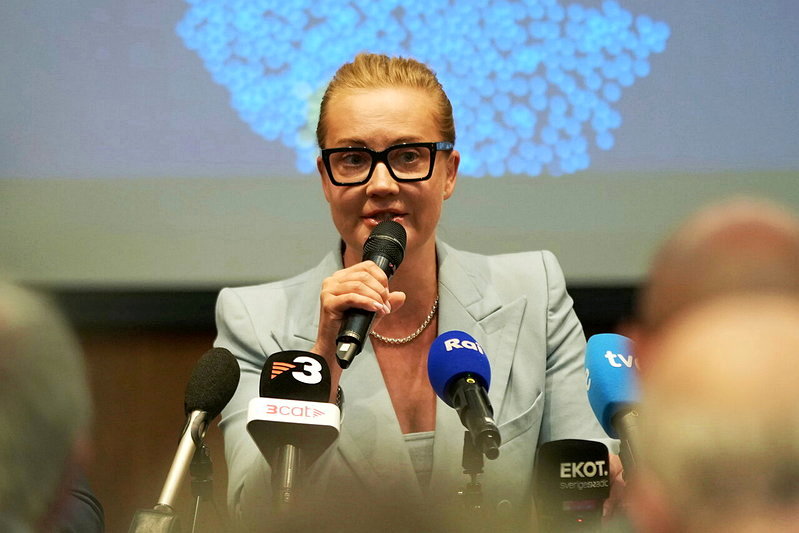
Yulia participated in the AuthCollab Index new report conference in London on the 27th and delivered the opening speech. He did not accept any interviews and tentatively answered only three questions.
Yulia said Putin killed her husband; For them, calling Putin a “humanitarian” was “nonsense”, not to mention that Putin started the war against Ukraine and what he did also harmed Russia.
He noted that Putin’s dictatorship can be traced back to 2000, and before a full-scale war broke out in Ukraine in 2022, Putin was treated politely around the world and invited to attend various summits for 22 years. Leaders of democratic countries including European countries do not shy away from shaking hands with Putin.
Meanwhile, within Russia, various repressions never stopped. Navalny was first arrested in 2011 and has since faced multiple trials and prison sentences from authorities. Yulia reported that at least in early 2010, mass demonstrations took place in Russia and many people were arrested.
Yulia said that if the democratic countries of that time had stopped recognizing Putin as the legitimate leader of Russia and stopped giving Putin fair treatment, there would not have been a war in Ukraine.
Russia launched full-scale aggression against Ukraine in February 2022, but in 2014 it illegally annexed Ukraine’s Crimean Peninsula (Crimea) and began a military occupation of eastern Ukraine.
Russia currently occupies about 20% of Ukraine’s territory, and in October 2022, it incorporated into the Russian constitution and territorial jurisdiction those four regions of eastern Ukraine that have not yet been fully annexed. It violates international law and ignores several bilateral agreements with Ukraine dating back to the 1990s relating to the delimitation of borders and maintaining “territorial integrity” and highlighting principles such as “sovereign equality” and “peaceful resolution of differences”.