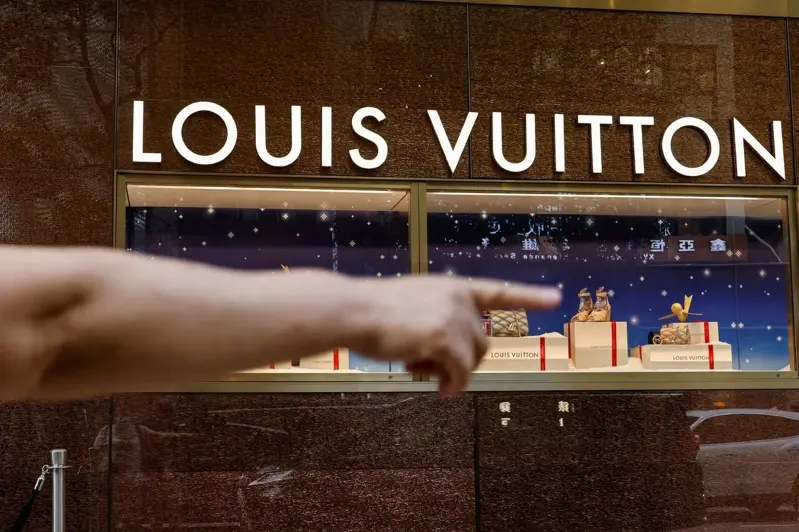

After international luxury brand Louis Vuitton (LV) won a trademark infringement lawsuit against Chinese tea brand Jasmine Milk Tea, receiving 10.3 million yuan (approximately US$1.52 million) in damages, it sparked outrage among Chinese netizens. Further investigation revealed that LV had initiated nearly 1,700 trademark lawsuits in China over the past five years, even suing the State Intellectual Property Office. This has drawn widespread condemnation from Chinese public opinion and netizens, leading to a nationwide online boycott of LV. Reports indicate that the long queues at LV stores in Shanghai and other cities have disappeared, and resale prices have plummeted. British media described LV as “winning the lawsuit but losing the public eye,” facing a secondhand trial after the legal ruling.
According to the BBC, on June 29, the Suzhou Intermediate People’s Court ruled in the first instance that the Chinese tea brand Jasmine Milk White infringed on seven of Louis Vuitton’s “four-leaf clover” graphic trademarks, ordering its parent company to pay a total of 10.3 million yuan in economic losses. Three days later, details of the judgment were disclosed by the media and went viral, with related topics quickly garnering over 400 million views. The trending topic became “Jasmine Milk White lost the lawsuit but won public support.” Netizens also dug up “treasure flower” patterns on Tang Dynasty architecture and artifacts, comparing them one by one with Louis Vuitton’s four-leaf clover graphic, arguing that this is a traditional Chinese public cultural symbol.
As a result, more and more consumers lined up to buy Jasmine Milk White to express their support, and this wave of enthusiasm ignited social media. Many netizens also dug up the astonishing scale of LV’s rights protection efforts in China, with 1,691 trademark rights lawsuits filed in China in the past five years, including 56 new lawsuits in 2026 alone. The list of defendants includes department stores, property management companies, technology companies, and community stores, with claims ranging from tens of thousands to hundreds of thousands of yuan. LV has even sued the State Intellectual Property Office six times. This case, involving a trademark administrative dispute, was publicly heard in the Beijing Intellectual Property Court on July 16. The plaintiff was Louis Vuitton Malletier (the parent company of the LV brand). No verdict was announced that day.
However, anger over LV’s frequent protests continued to escalate online, with a large number of netizens launching a boycott of LV and criticizing them as “LV has gone completely mad,” “Is this robbery? Chinese products have become their patent?”, “Isn’t it not far from being completely banned in China?”, “Is LV going to give up on the Chinese market?”, “Their behavior is really too ugly, I will never buy from them again,” and “They just want to monopolize Chinese cultural symbols.”
Public opinion criticized LV for “winning the lawsuit but losing public support,” a move akin to a “lower-dimensional attack.” Following the public outcry, LV’s official accounts on various platforms went silent for nearly half a month, with nearly 10,000 comments accusing LV of appropriating its culture and engaging in unethical practices. These complaints garnered over 100,000 likes.
According to Dahe Daily, following the online boycott, the queues and waiting crowds that were once common at many LV stores in downtown Shanghai are now nowhere to be seen. In the resale market, many popular LV bags are experiencing a significant price reduction. The Carryall small handbag, a recent bestseller, has an official price of 23,000 yuan, but a brand new one on online shopping platforms has dropped to 19,000 yuan. The Neverfull small handbag, once considered a commuter essential, has an official price of 14,400 yuan, but an 85% new one on the same platform has dropped to 4,219 yuan, only 30% of its original price.
Several secondhand luxury goods stores said that LV’s market value has been declining recently. One store owner said, “LV’s reputation is so bad now. There are too many customers coming to us to sell their LV products. We can’t keep up with the demand.”