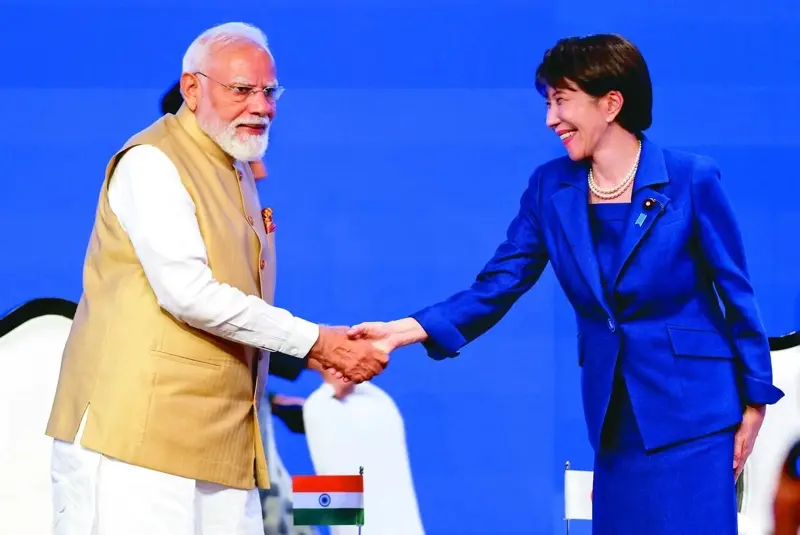

Japanese Prime Minister Sanae Takaichi visited India from October 1st to 3rd, holding talks with Indian Prime Minister Narendra Modi on October 2nd. This was her first visit to India since taking office last October. Japanese media outlets, including Kyodo News, reported that her trip was aimed at strengthening Japan-India cooperation on security issues, including economics and security, specifically targeting China. Following the meeting, the two leaders issued a joint statement and held a joint press conference.
The two leaders last met in November last year on the sidelines of the G20 summit in Johannesburg, South Africa. This “Gaumo Summit” is also the 16th annual Japan-India summit, a regularly held mechanism that allows the top executives of the two countries to take turns hosting bilateral summits.
Kao Chi said that next year marks the 75th anniversary of the establishment of diplomatic relations between Japan and India, and she hopes to create a future for both countries through “government-civilian cooperation.” Modi said that by combining Japan’s precision technology with India’s software capabilities, they can hopefully develop world-class artificial intelligence (AI). The two addressed each other as “brother and sister,” with Modi calling Kao Chi “my beautiful little sister” and Kao Chi calling Modi “my brother.”
The joint statement focuses on strategic partnerships, economic and energy security, and investment and innovation cooperation. Regarding strategic partnerships, it will promote the Free and Open Indo-Pacific vision, unveiled in 2016 by the late Japanese Prime Minister Shinzo Abe, Kaohsiung’s political mentor, and deepen maritime security cooperation, as well as the “two plus two” meeting between the foreign and defense ministers to be held this year.
Regarding economic and energy security, in addition to expressing concerns about economic coercion, the importance of a level playing field was emphasized, and cooperation will be undertaken to ensure energy resilience, including strengthening energy reserves. In terms of investment and innovation cooperation, efforts will be made to assist Japanese SMEs and startups in investing in India, promote the introduction of Japan’s new E10 series Shinkansen bullet trains to India, and ensure a supply network for “trustworthy AI.”
Sections of India’s first high-speed rail line are scheduled to open next year, almost a decade after construction began. New Delhi considers it a major milestone in the modernization of India’s railways. The first line is 508 kilometers long and is located on the west coast of India. It is called the Mumbai-Ahmedabad High-Speed Rail Corridor. Ahmedabad, the capital of the state of Guchard, is also Modi’s hometown.
Following the meeting between Kaohsiung and Modi, private enterprises from both countries held an economic forum, exchanging approximately 130 bilateral cooperation documents. These included Fujifilm’s plan to establish a semiconductor materials factory in India and Suzuki’s plan to build a biogas plant in India. The total investment by Japanese companies in the Indian market will reach 2 trillion yen (approximately US$12.4 billion). Representatives from over 150 Japanese companies and the Japanese financial sector attended the forum, along with Kaohsiung Mayor Modi and Prime Minister Narendra Modi.
On June 2, Chinese Foreign Ministry spokesperson Guo Jiakun criticized Kaohsiung City for frequently mentioning the new version of the Free and Open Indo-Pacific concept, saying that it was “talking about freedom and openness while thinking about confrontation and conflict.”