
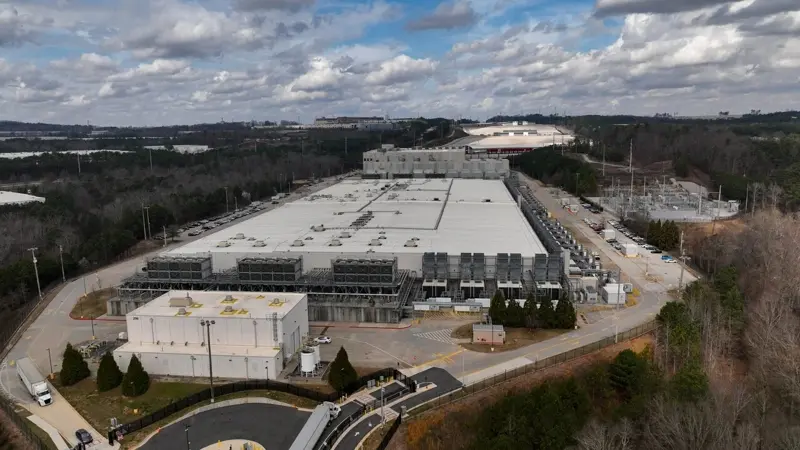

Although President Trump’s trade war has subsided and gasoline prices have finally fallen, the large-scale construction of artificial intelligence (AI) data centers is beginning to drive up prices for everything from smartphones to electricity, and is triggering a new wave of inflation.
Analysts surveyed by FactSet estimate that the world’s top five hyperscale cloud providers (Alphabet, Amazon , Meta, Microsoft, and Oracle ) will spend $741 billion this year, a surge of nearly 75% over last year. Columbia University economist Stijn van Nieuwerburgh stated that based on published and planned development projects, AI-related spending could reach approximately $8 trillion by the end of 2032, nearly five times the value of New York City’s real estate market.
Driven by this enormous demand, many AI-related components are seeing price increases. And because these components are used for purposes beyond AI, the price hikes are impacting a wider range of economic sectors, including various consumer electronics products that use memory and storage chips. Nintendo, Microsoft, and Sony have all raised prices on their game consoles; Apple recently also increased prices on several products, including iPads and Macs.
Inflation data has begun to reflect price pressures. Labor Department data shows that in May, the Consumer Price Index (CPI) for computer software and accessories rose by about 15% year-on-year, while the wholesale electronic components and accessories rose by 27% year-on-year. Besides chips, many other materials needed for the construction and operation of data centers are also widely used in the overall economy, potentially driving up costs for various businesses, which may ultimately be passed on to consumers.
In addition, Goldman Sachs economists predict that by the end of 2030, data center electricity demand will account for nearly half of the increase in total U.S. demand, and therefore estimate that consumer electricity prices will rise by about 6% each year in the next two years.
The Commerce Department released personal consumption expenditure (PCE) data on May 25, a measure of inflation favored by the Federal Reserve. The core PCE deflator rose 3.4% year-on-year in May, reaching a near three-year high. The Fed’s inflation target of 2% has not been achieved for over five years.
Everscore ISI strategists point out that the impact of AI construction on prices may be fundamentally different compared to last year’s tariffs and this year’s soaring fuel prices.
Tariffs and oil price fluctuations are one-off shocks that will only lead to temporary price increases, but the impact of AI on demand will likely last for years.
However, economists do not believe that AI development will trigger a surge in inflation in the US after the pandemic lockdowns, and that products like smartphones and games only account for a small portion of annual consumer spending. According to the Labor Department, electricity costs also account for only about 2.5% of consumer spending.