
AI summary
Summary of article:
Exit polls from the Israeli parliamentary elections show that both camps are on equal footing. President Herzog will decide who has the authority to form the cabinet, but no matter who leads it, he will face difficult cross-party negotiations in the future.
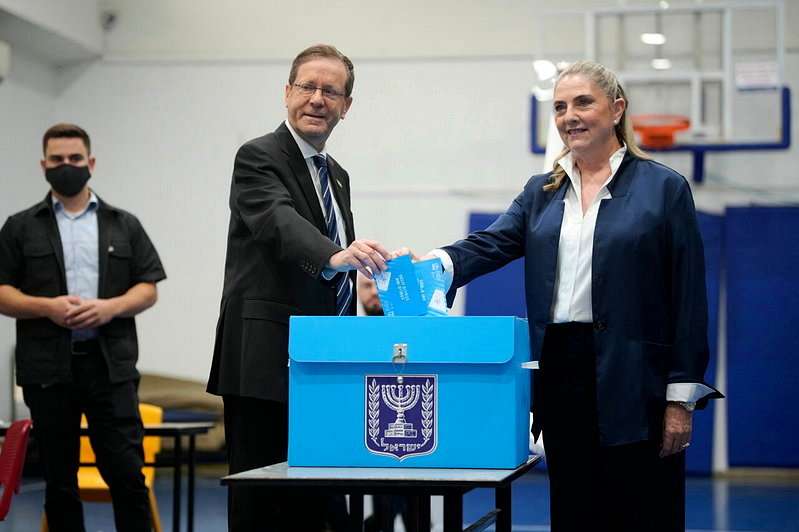
new York Times report,israel Local parliamentary elections were held on the 27th. Initial exit polls showed that the current Prime Ministernetanyahu The far-right camp led by the president is evenly matched with the center-right opposition, and neither party has been able to secure a majority of seats in Congress. With the election deadlocked, the key to who will become the next prime minister will fall to Israeli President Isaac Herzog. The Israeli President usually plays a ceremonial role, but after being elected by Congress, he has significant power to appoint the Prime Minister and form the cabinet. Herzog must now decide whether the election results reflect people’s hope that Netanyahu will remain in power or whether they are demanding regime change.
According to exit polls, the ruling camp led by Netanyahu and the opposition camp led by Eisenkot are expected to win about 51 seats, while Arab parties are expected to win about 18 seats, the Associated Press reported. Since there are 120 seats in the Knesset, at least 61 seats are needed to achieve a majority. This time the turnout reached 77.7%, which is higher than 70.6% in 2022. Hundreds of thousands of votes from Israeli soldiers, diplomats stationed abroad and other specific categories of voters still remain to be counted. Relevant vote counting work may continue until the 29th, and the final results are not expected to be announced until a few days later.
Israel adopts a parliamentary cabinet system, in which voters vote for political parties in congressional elections rather than directly selecting the prime minister. After the election, the President elected by Congress convenes the leaders of all parties to hear the candidates recommended by all parties for Prime Minister, and then appoints one of them to form the government. The nominee will have to seek support from other political parties to form a coalition government that can receive a vote of confidence from Congress before formally assuming power.
The leader of the party getting the most votes cannot be the Prime Minister. The President may appoint the leader of the largest party to form the Cabinet, or he may choose other candidates who have a better chance of forming a governing coalition. In 2009, then-President Peres appointed Netanyahu to form a government. Although the right-wing United Party he led at the time received fewer votes than the centrist Kadima party, Netanyahu eventually became prime minister.
Herzog’s decision is particularly sensitive because the current government led by Netanyahu is the most right-wing ruling coalition in Israel’s history and has been criticized in recent years for violence against Palestinians by Jewish settlers in the West Bank and abuses at Israeli detention facilities. Herzog has also repeatedly criticized the increasing brutality of Israeli society. Additionally, Netanyahu was on trial on corruption charges. US President Trump asked Herzog to grant amnesty, but Herzog refused, insisting that Israel is a sovereign country that adheres to the rule of law.
On the other hand, Eisenkot, a prominent opposition leader, was chief of staff of the Israeli army and his son was killed in the Gaza war. He promised to establish a national commission of inquiry into the Hamas attack on Israel on October 7, 2023, in contrast to Netanyahu, who has long refused to establish an independent investigative commission and is unwilling to take responsibility for related mistakes.
However, even if Herzog appoints Eisenkot to form a cabinet, this does not mean that the opposition will definitely succeed in governing. If the centre-right opposition is to win a parliamentary majority, it may have to seek the support of Arab parties. Arab parties are expected to win the most seats ever in this election, but opposition leaders have not yet agreed to form a coalition with them, and Netanyahu has actually ruled out the possibility of co-governing with Arab parties. Whoever Herzog ultimately appoints to form his Cabinet may face difficult inter-party negotiations.
Summary FAQ
-
Because exit polls showed that both Netanyahu’s camp and the center-right opposition won only 51 seats, still far from the 61-seat majority in parliament, making it difficult for both parties to form a government alone.
-
Israel adopts a parliamentary cabinet system. After the election, the President listens to recommendations from all parties and then appoints one person to form the Cabinet. Therefore, even if he does not get the most votes, he may be appointed because he is better able to form a coalition.
-
The opposition may have to enlist the support of Arab parties to win a majority, but relevant leaders have not yet agreed to cooperate. At the same time, Netanyahu has refused to co-govern with Arab parties, making negotiations more difficult.