
AI summary
Summary of article:
This report states that the Fed believes that the AI \u200b\u200bboom is not immune to interest rate hikes. As the technology industry relies more on external financing, interest rate constraints may deepen, which will also affect the extent of interest rate increases in the future.
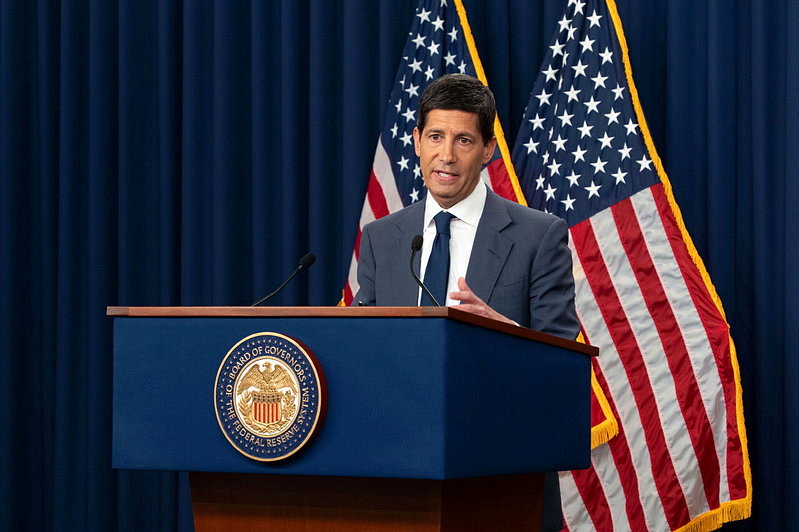
Chairman of the Federal Reserve (Fed)Vashu It is believed that increasing interest rates also affect AI investment. After the interest rate hike in September, investors have become more cautious, and the credit spreads of some assets have also increased significantly. Wall Street Journal reporter Timmy Ross, known as the “Fed’s mouthpiece”, analyzed that the technology industry is becoming more and more dependent on external financing.interest rate The greater the impact, the more it will affect how much the Fed will have to raise interest rates.
The Fed on Wednesday maintained its target range for the federal funds rate at 3.75% to 4%. Washington did not explicitly say whether interest rates would be raised in December, but at the press conference he repeatedly raised concerns about AI investment, financing costs andinflation connection between.
WashU: The impact of interest rates is widespread
“The popular narrative has been going around for some time that rising interest rates won’t impact AI because investors expect very different returns,” Washer said. “I have always been skeptical of this approach. The impact of interest rates is widespread, and almost everything is affected directly or indirectly.”
He said there have been signs since the beginning of September that interest rates are playing a role both inside and outside the technology industry. “Investors have begun to choose investment targets more judiciously. Credit spreads on some assets have widened or even widened significantly.”
“So, going back to your question about new technologies and this investment boom: Do interest rates have an impact? I think they do have an impact, and I don’t think they can operate independently of the overall economy,” Washer said.
Timiros pointed out that in the past, AI investment was considered insensitive to interest rates, mainly based on two assumptions: the expected returns in the technology industry are much higher than the cost of capital, and the industry believes that it is a winner-take-all competition and should be the first to invest. However, as companies are turning to issuing bonds and selling shares rather than using their own cash to raise funds, rising interest rates may also place greater constraints on investment.
If AI is not afraid of rising interest rates, other industries may be affected first
Timiros analyzed how sensitive AI investments are to interest rates, which will impact how high the Fed needs to raise interest rates.
If the AI craze is not tempered by rising borrowing costs, the Fed may have to further suppress interest rate-sensitive sectors such as housing, commercial real estate, small businesses and low- and middle-income households to dampen overall demand; But these sectors are not necessarily the main source of inflation in the first place.
He quoted Jonathan Pingle, US chief economist at UBS, as saying that the Fed simply needs two sets of interest rates, one to deal with the AI craze and the other to apply to other economic activities.
On the other hand, if AI investment is more sensitive to interest rates than the market imagines, the Fed may need to raise interest rates less frequently to stimulate demand and minimize harm to other industries and households.
The pressure may fall first on businesses with weak financial resources
Timiros reminded that just because the overall AI craze appears to be unaffected, it does not mean that industry players can afford to raise interest rates. As data center construction becomes increasingly dependent on debt, higher interest rates will work through the credit markets, hitting the weaker players first and then the cash-rich tech giants.
This makes it even more difficult to understand the impact of policy: each interest rate increase may not have much of an impact at first, but the pressure gradually accumulates until a certain link suddenly fails, and the decline in spending may be greater than the Fed models predict.