
AI summary
Summary of article:
Hong Kong media analyzed that Mbappé touched a sensitive red line in China when he talked about Mao Zedong memes and called him a dictator; And when the official emphasized the origins of the Long March and Mao and Xi, it was met with sharp reaction.
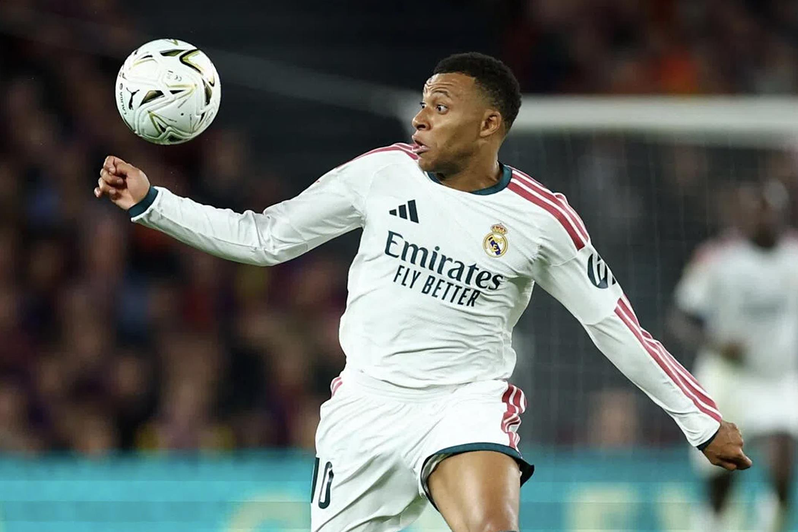
french starmbappe In an interview, he mentioned that he liked “Mao Zedong face-changing memes” and also referred to Mao as a “dictator”, which caused a scandal in China for “insulting China”. Hong Kong media analyzed that comments related to Mao Zedong have become “a red line in the new era” in China, especially recently.Communist Party of China To commemorate the 90th anniversary of the Long March, Chinese officials emphasized that the establishment of the “Maoist Corps” during the Long March was of decisive significance to the victory of the Long March, and then called for the new Long March to support the “Xi Corps”. Therefore, Mbappé’s words at this time “hit at gunpoint.”
Ming Pao’s “China Insight” column on the 29th analyzed that Mao Zedong was the main founder of the Communist Party of China and the People’s Republic of China, and was nicknamed “Mao Taizu”. However, the outside world has produced polarized assessments of Mao. Some considered him “the savior of the people”, while others believed that he initiated political movements such as the Anti-Rightist Movement, the Great Leap Forward and the Cultural Revolution during his rule, which left many wounds. In October 1980, the Central Committee of the Communist Party of China held a meeting of 4,000 cadres to discuss the “Resolution on Some Historical Issues Since the Founding of the People’s Republic of China” (draft). At that time there were many differences of opinion within the party regarding the evaluation of Mao.
The article quoted Chinese legal scholar Guo Daohui, who was then the secretary of China’s National People’s Congress Group, and who wrote an article in “Yanhuang Chunqiu” in 2010 to disclose the details of the above meeting. Many experienced cadres have spoken “reborn after the disaster” and “disgraceful” words. For example, General of the Communist Party of China Zhang Aiping said that Wang Ming would always mention Greece, and Mao Zedong would always mention Qin Shihuang. Economist Sun Yifang said that Mao Zedong read a lot of books bound by thread and used the power of emperors, generals, and prime ministers in feudal society to fight within the Party. Fang Yi, the former Vice Prime Minister of China, was the most furious, saying that “even Zhu Yuanzhang is not as good as him” because the “History of the Ming Dynasty” only says that Zhu Yuanzhang “lacked his sacred qualities”.
The article reported that Deng Xiaoping later made the final decision, emphasizing that “Comrade Mao Zedong’s mistakes cannot be overwritten. Overwriting will defame Comrade Mao Zedong, which means defaming our party and our country.” Therefore, the “Historical Resolution” still insists that Mao Zedong’s achievements come first and his mistakes come later. Despite this, Mao Zedong was highly criticized in Chinese society for more than 30 years, and the official “turned a blind eye”, which was why Guo Daohui’s article was published.
According to the analysis in the article, since the 18th National Congress of the Communist Party of China (2012), “the supreme leader has gone back to his roots” and believes that the previous ideologies were “loose and loose” and he firmly opposes “de-Maoization”, pointing out that if Mao Zedong was “completely negated, the world would be in chaos.” In Mao Zedong’s second birthday speech, he “respected Mao very much” and pointed out for the first time that Mao Zedong was “the great founder of China’s socialist modernization campaign.” In October 2013, “China Social Sciences Journal” published a signed article “Mao Zedong is not a dictator” to correct Mao Zedong’s name. The new edition of “A Brief History of the Communist Party of China”, launched on the occasion of the 100th anniversary of the founding of the Communist Party of China, no longer has a separate chapter on the Cultural Revolution, and downplays the mistakes of the beginners.
The article listed that in China in recent years, comments related to Mao Zedong have become “a red line in the new era”, and “Yanhuang Chunqiu” is subject to purification, existing only in name; In 2015, CCTV host Bi Fujian was accused of “insulting Mao” at a private dinner and lost his job; In August this year, Gao Qin, a dissident artist living in the United States who had “insulted Mao”, was sentenced to three years in prison for “violating the honor of heroes and martyrs.” Against this background, it is not difficult to understand why Mbappé was completely blocked and criticized verbally and in writing.
Summary FAQ
-
During an interview, he mentioned that he liked “Mao Zedong’s face-changing memes” and also called Mao Zedong a “dictator”. Both of these statements were considered highly offensive in Chinese public opinion and soon sparked the “offending China” controversy.
-
The article believes that in recent years, Mao Zedong’s evaluation of China has been regarded as a political red line. Especially in an environment where the official emphasis is on “Mao’s origins” and “Xi’s origins”, any negative statement is more likely to be transformed into a political incident.
-
The article reminds that the evaluation of Mao within the Party after 1980 was relatively complex. However, after the 18th National Congress, the official emphasis was on “correcting the source” and opposing “de-Maoization”. It also cites cases such as Bi Fujian and Gao Shen, which show that the risks of contextual speech have increased significantly.