
AI summary
Summary of article:
South Korea has stepped up commercial and diplomatic engagement with Russia under the leadership of Lee Jae-myung, raising questions in Europe about whether Seoul will remain a reliable like-minded partner.
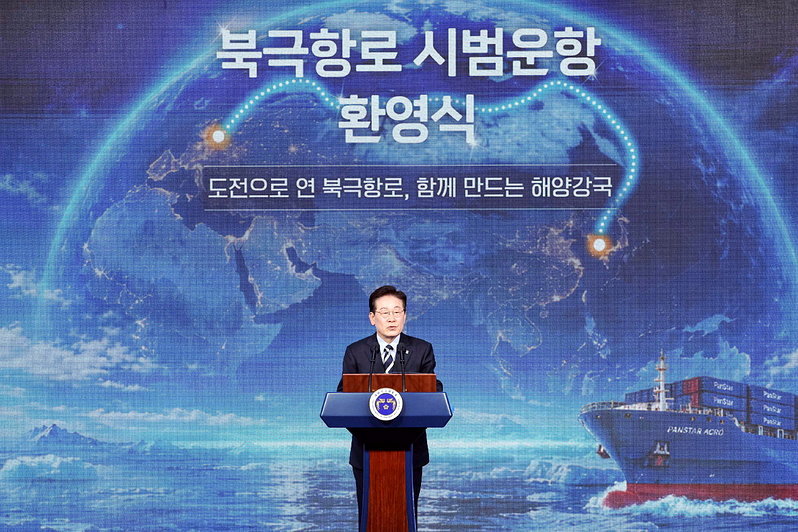
south korea chairmanli zaiming In October, the crew of the container ship “Panstar Acro” that completed an Arctic voyage was enthusiastically welcomed back home, but European diplomats stationed in South Korea were not so enthused. In the eyes of European officials, relations with the Kremlin are also deepeningnorth korea While continuing the partnership and its war against Ukraine, the visit symbolizes Seoul’s diplomatic and commercial tilt toward Moscow.
The Financial Times reported on the 28th that this was the first time that a South Korean container ship sailed along the Northern Sea Route (Northern Sea Route) to the Russian Arctic coast. Compared with travel to Europe via the Suez Canal, the Northern Sea Route can shorten the journey by up to 10 days, but it also requires extensive cooperation with Moscow. Additionally, reports in October indicated that South Korea sent more than 176,000 metric tons of fuel, mostly diesel, to Russia in July and August, some transported by tankers sanctioned by the United Kingdom and the European Union, further deepening concerns among European officials.
Some European diplomats viewed South Korea as a democratic country with “similar ideals” and similar economic and security interests to Europe, but relations between South Korea and Russia have led them to question whether South Korea is still a reliable partner. A European diplomat stationed in South Korea said: “The South Koreans are not really ‘similar in philosophy’. They believe that the war in Ukraine will not last forever, and hope that trade exchanges with Russia can be resumed as soon as the war ends.”
European doubts about Seoul’s attitude toward Russia existed long before Lee Jae-myung became president. Europe is particularly dissatisfied with South Korea’s poor enforcement of export controls on computer numerical control (CNC) machine tools that can be used to produce ammunition. Some observers pointed out that the European side’s skepticism has further increased after Li Zeming takes office in June 2025.
Mason Ritchie, a professor of international politics at Hankuk University of Foreign Studies, said relations between South Korea and Russia have been “quietly improving” since the fall of 2025. Officials such as National Security Office Director Wi Sung-rok, as well as people close to Foreign Minister Cho Hyun, appear to be losing influence over Lee. In contrast, Song Yong-gil, a special adviser on peace diplomacy appointed by Lee Jae-myung in October, has long advocated strengthening ties between South Korea and Russia. Rich believes that Song Yong-gil and others “appear to be people the President is willing to listen to on Russian issues.”
Russian Deputy Foreign Minister Rudenko said in October that Moscow had received expressions from South Korean officials that they expected relations to normalize after the end of the war in Ukraine, TASS reported. At the same time, relations between Seoul and Kiev have deteriorated due to the revelation in September that two North Korean prisoners of war were transferred from Ukraine to South Korea. Lee Jae-myung accused Uzbekistan of violating confidentiality agreements regarding the handover of prisoners of war and demanded an apology. South Korea recalled its ambassador to Uzbekistan in October.
“Some people are concerned that South Korea is leaning too heavily toward Russia, which is inconsistent with the facts. As a responsible member of the international community, the South Korean government supports and participates in global efforts to end the war and restore peace in Ukraine,” South Korea’s Foreign Ministry said in a statement to the Financial Times.
Sam Kim, a researcher at the Asan Institute for Policy Studies, warned that South Korea’s “inclination” toward Russia should not be overestimated. He believes that the Lee Jae-myung government “no longer adopted so-called ‘value diplomacy’, but instead adopted a more pragmatic and interest-oriented policy.” He said South Korea has long viewed Russia as a powerful neighbor that it cannot ignore or easily oppose, a view reflected in Seoul’s attitude toward Moscow.
Kim Se-mi pointed out that South Korea’s foreign policy has long been based on the “four major powers” of the United States, China, Japan, and Russia as the framework of its thinking, but she also questioned whether this traditional diplomatic thinking is still applicable today. He believes that when dealing with the current relationship between South Korea and Russia, “we must first recognize that Russia is helping to strengthen North Korea’s military capabilities, and this is increasing the security threats faced by South Korea.”
Summary FAQ
-
Mainly due to South Korea’s changes in Arctic routes, fuel shipments and normalization of relations with Russia, the European side is concerned that Seoul will gradually put commercial and diplomatic interests ahead of sanctions in the context of the Russia-Ukraine war.
-
That includes a South Korean container ship sailing through Russia’s Northern Sea Route for the first time, the delivery of more than 176,000 metric tons of fuel to Russia from July to August, and the Lee Jae-myung government’s pragmatic stance on normalizing ties with Russia, all seen as signs of a downward trend.
-
South Korea’s Foreign Ministry said relevant concerns were inconsistent with the facts, stressing that Seoul still acts as a responsible international member, supports and participates in efforts to end the war in Ukraine and restore peace, and advocates practical interest-oriented diplomacy.