
AI summary
Summary of article:
The United States and China are intensively negotiating investment and trade ceasefire arrangements before APEC, trying to complete the institutionalization of investment committees, and at the same time trying to maximize their interests with bargaining chips such as rare earths, Boeing and components.
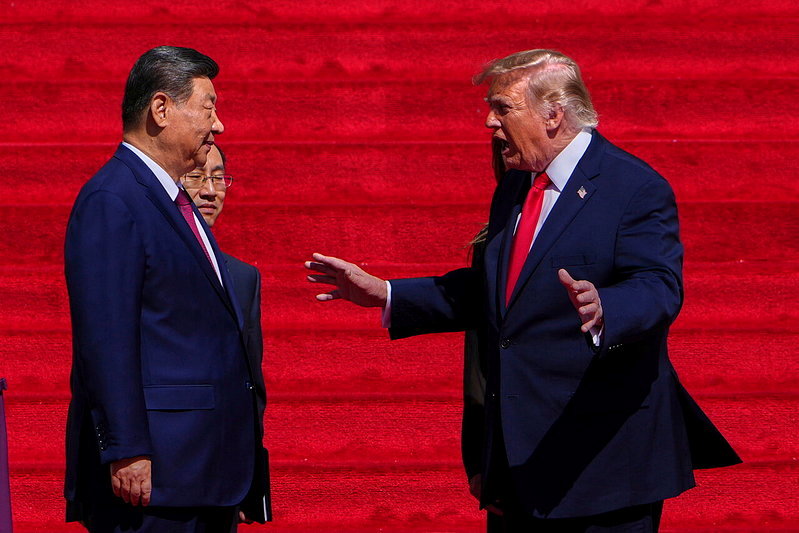
US President Trump and Chinese President Xi Jinping will hold the Asia-Pacific Economic Cooperation (APEC) meeting in Shenzhen in November.APEC ) Will meet again during the summit. This will be the second meeting between the two within two months and the third this year. The South China Morning Post exclusively reported on the 20th that the United States and China are rushing to finalize a specific investment agreement before the summit, and at the same time, they are competing for bargaining chips to expand the trade agreement.
According to reports, the US-China Investment Board meeting was held in Beijing in Maysichuan zihui One of the key results was announced, but the process has stalled due to domestic opposition to Chinese investment in the United States, particularly in the automobile manufacturing industry. The two sides discussed the issue again in Washington in September, but still could not reach an agreement. Multiple sources revealed that since the Sichuan-Xi meeting in September, considerable progress has been made in the Investment Committee talks, but intensive consultations will still be needed in the coming weeks to overcome obstacles to the institutional structure and economic agreement negotiations.
In comparison, a similar trade board has been institutionalized following talks in Washington in September. A source said the negotiating team is modeling the organizational structure of the investment committee and the terms of reference on the newly established trading platform.
The United States and China are exploring potential investment opportunities within both countries, according to people familiar with the matter. However, because Chinese investment involves politically sensitive issues, negotiations still focus on investment projects in the United States. The two sides are discussing an initial list of projects for Chinese companies to consider investing in non-sensitive industries in the United States, including electric vehicles, battery energy storage and power equipment infrastructure.
However, two sources said there may still be political and commercial risks for Chinese companies in these sectors, and so the negotiating team does not rule out turning to the consumer goods industry. Another source said US business leaders are concerned about Chinese companies intensifying competition in the domestic market and continuing opposition to the investment committee. He said that most of the easily resolved issues had been dealt with, while the remaining issues were quite “thorny” and still had “major shortcomings”.
Despite opposition from American automakers and members of Congress, Trump has repeatedly proposed the idea of allowing Chinese companies to set up factories in the United States. However, the two sources believe that given the political reality of US-China relations and the uncertainty of Washington’s policies, Chinese companies are unlikely to make large-scale, long-term investments in the United States, no matter what industry they invest in.
Apart from investment issues, the extension of the trade ceasefire is also the focus of talks between the two sides. The trade agreement, signed in Busan, South Korea last year, was extended for only two months from September to January 2027. The United States and China are trying to use their respective bargaining chips to maximize their interests when extending the agreement, three sources said. China takes controlrare earth supplies, the United States holds the bargaining chip for exports of jet engines and aircraft components. A source revealed that although the two sides have not threatened to restrict relevant supplies, they still hope to continue to remind the other party of the bargaining chips they have.
Two sources said China was “disappointed” that the agreement was extended for only two months, but it also saw the shorter period as an opportunity to strengthen its negotiating position on purchase commitments, particularly Boeing aircraft orders. Washington hopes to use it to increase pressure on Beijing to increase supplies of rare earths and increase purchases of US agricultural products.
During Trump’s visit to China in May, Beijing agreed to buy 200 Boeing aircraft, but the deal has not yet been implemented. One source said that although relevant talks were moving in a “positive direction”, the chances of an agreement being announced during the APEC summit appeared slim. Another source said Beijing is using the Boeing order as a bargaining chip in trade ceasefire talks. Another source revealed that China considers key minerals as its “most effective economic weapon” and is therefore unwilling to increase supplies.
However, three sources said both sides realize they have no choice but to extend the agreement, but negotiations may not be completed in time for the APEC summit and will extend until the Group of 20 (G20) summit in December.
Summary FAQ
-
On the one hand, both sides want to finalize the specific structure and project list of the investment committee, and on the other hand, they also want to extend the trade armistice. The overall goal is to achieve publicly announced results before the summit.
-
The main obstacle is the political backlash against Chinese investment in the United States. In particular, the automobile manufacturing industry and the business community are concerned about intense competition. Even though investment in non-sensitive industries has been discussed in the United States, there is a large gap in the system and distribution of benefits.
-
China controls the supply of rare earths, while the United States controls exports of jet engines and aircraft components. Beijing also uses the Boeing order as a bargaining chip, and Washington hopes to take advantage of the opportunity to ask China to increase supplies of rare earths and buy American agricultural products.