
AI summary
Summary of article:
This article points out that Trump retreated in red states before the election, polls and forecasting models were all in favor of the Democratic Party, and economic inflation and anti-Trump sentiment became major factors, making it difficult to overcome the loss for the Republican Party’s culture war and district redistricting.
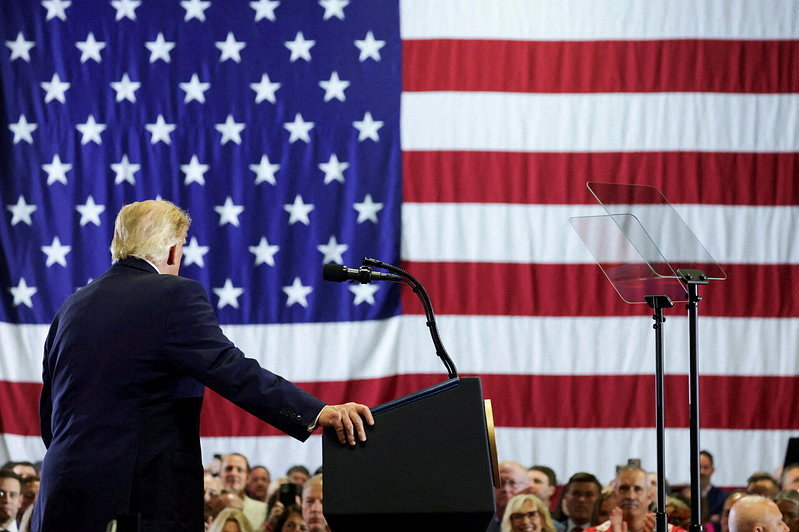
In the final weeks of the election, Trump made successive trips to Mississippi, Texas, Ohio and South Carolina to support the election, and made final campaign arrangements in Florida, Kansas and Iowa – all red states that Trump will win by large margins in 2024. In contrast, swing states like Pennsylvania, Wisconsin and Arizona, which were close in the last election, were not included in Trump’s sprint program. In the final stages of the election, Trump’s strategy of “standing on the front lines and returning to red states” was tantamount to acknowledging the seriousness of the current situation.
The polling data is becoming clearer: the RCP compiled several pre-election surveys.democratic party support average leadrepublican party 8.2 percentage points; The latest Cook Political Report estimates it will get a net gain of 12 to 25 seats in the House of Representatives; Sabato’s Crystal Ball of the University of Virginia rated 225 seats as “Democratic” and 17 seats as “tie-breaking”; The Decision Desk model predicts that the Democratic Party has an 80% chance of winning the House of Representatives and a 60% chance of controlling the Senate. In the gubernatorial elections of 36 states, 22 states are in favor of the Democratic Party. PolyMarket and Kalshi estimate that the markets will overestimate the Blue Team’s Congress victory rate.
At the center of this political storm is undoubtedly the public’s dissatisfaction with Trump. In Pew’s latest survey, 44% of registered voters saw the vote as an “anti-Trump” statement; Among Democratic supporters the figure was as high as 84%. By comparison, only 19% of voters said they would vote “in support of Sichuan”, and only 48% of supporters of Republican candidates said so. Trump failed to unite allies and unite opponents.
The most important election issue this time is economic prices. The tariff war started by Trump and the Iran war have not yet been dealt with. These two major foreign strategic moves have been delivered to countless Americans through rising import prices and energy inflation to put a strain on their lives. A Pew poll found 84% of voters believe economic issues are “very important” in this election; An AP-NORC poll in October also showed that 79% of voters disapprove of the way Trump is handling the cost of living.
Paradoxically, white workers and rural voters, who form the base of Sichuan fans, are groups that are particularly sensitive to price inflation. The rate of whites without college degrees who approve of Trump’s policies has also fallen from 63% early last year to 45% in October this year, CNN polls show. According to a rural poll released by AP-KFF in September, Trump’s approval rating was 48%, and about 40% approved of his economic performance, which is also lower than Trump’s previous vote rates in rural areas, which often ranged from 60% to 70%.
Facing headwinds on the people’s livelihood and economic battlefield, the Republican Party counterattacked by attacking “anti-leftism, anti-immigration and anti-transgender” issues, labeling its opponents “communists and socialists” in an effort to steer the election toward the social and cultural front and mobilize its conservative base. According to AdImpact cited by Inside Elections, the Republican Party spent 442 million yuan on ads related to “immigration, border, crime” and more than 200 million yuan attacking opponents’ attitudes on transgender issues, far exceeding the Democratic Party’s corresponding advertising budget.
However, the vigorous anti-immigration campaign has alienated some Latino voters who used to support Sichuan. Trump once won 48% of the Latino vote in 2024, but in this year’s Pew survey on congressional voting intentions, only 24% of Latinos supported the Republican Party and 51% supported the Democratic Party.
Recently, the issue of “anti-corruption” has emerged, but the red and blue camps have different focuses on “corruption”: Democrats criticize Trump’s comrades for rent-seeking, entanglement of interests between the rich and the government, and strengthening the sense of relative deprivation due to value issues; Republicans emphasize welfare fraud and government waste under Democratic rule (such as Minnesota). In a recent Harris poll published by The Guardian, 40% of respondents believed financial corruption was worse in the Republican Party, and 21% thought the Democratic Party was worse. The AP-NORC poll also found that nearly 60% of American adults believe Trump “could profit illegally or unethically from the presidency.” This round of “anti-corruption” denialism has had different effects on perceptions on both sides.
As far as the district redistricting pushed by the Republican Party is concerned, this time it did not yield the expected benefits. The initial plan was to distribute advantageous vote positions among different constituencies to gain a few more seats; But if the margin of safety is reduced too much, when public opinion changes, it will lead to a stalemate and a partial response in many constituencies. According to Reuters data, 9 of the 16 districts redrawn by the Republican Party have favored the Democratic Party or are deadlocked; The Cook Political Report estimates that this wave of redistricting of red and blue districts could ultimately give the Republican Party a net gain of only 3 seats.
The success of the Democratic Party in this campaign was relatively easy due to its strategic success. For example, the main focus of election campaigns has shifted from the abstract “defense of democracy” to the more specific cost of living. Enrollment and issuance strategies can also be adapted to local conditions. They can also counter the “socialist and communist” labels imposed on their opponents through joint statements. But strictly speaking, the Democratic Party has not yet provided a strategically distinct approach that American voters can expect.
This is a campaign driven by negative narratives. The Republican Party’s “anti-left, anti-immigration” conservative narrative cannot compensate for the damage Trump has done to the economy and people’s livelihoods; The Democratic Party has rallied as “anti-Trump”, but failed to answer “what to do next”. The red tide recedes and the blue fog fades; While the tide recedes and the fog increases, the future of the United States remains uncertain.
Summary FAQ
-
Trump focused his final campaign on red states such as Mississippi, Texas and Ohio, but did not deal with swing states such as Pennsylvania, Wisconsin and Arizona. This shows that he has adopted a contraction strategy of returning to defense and abandoning the front line, and also shows that he is not optimistic about the election.
-
The average RCP poll shows the Democratic Party leading by 8.2 percentage points. The Cook Political Report predicts a net increase of 12 to 25 seats in the House of Representatives. Decision Desk estimates that the Democratic Party has an 80% chance of winning the House of Representatives and a 60% chance of taking control of the Senate. The prediction market also favors the blue team.
-
After losing points for the economy and people’s livelihood, the Republican Party began to mobilize conservatives on anti-immigration, anti-left, and anti-transgender issues and ran a large number of related ads. However, it also alienated some Latino voters, and overall Trump’s negative perception of prices and cost of living is still difficult to reverse.