
AI summary
Summary of article:
The US defense intelligence agency released clear photos of China’s space planes and satellites docking, saying China is developing reusable space planes and rockets that can be used in military and counter-space operations.
The US Defense Intelligence Agency (DIA) recently released a clear photo showing a Chinese space plane docking with a satellite in space. It is believed to be an image of China’s secret experimental reusable space aircraft “Shenlong” carrying out a mission.
Voice of America (VOA) reported that this satellite photo was taken by the American commercial satellite company Vantor (formerly Maxar Technologies) in 2024 and was included in the 2026 edition of the “Security Challenges in Space” report released by the Defense Intelligence Agency on the 26th of last month.
This unclassified report assesses the scope and breadth of threats from hostile forces facing the United States in the space domain and explains how China,Russia ,iran Andnorth korea Space defense and military objectives, including related strategies, plans and intentions.
As can be seen from this satellite image, the Chinese unmanned space plane is docking with a satellite with open solar panels, and the payload bay door of the space plane is open.
The Defense Intelligence Agency featured this photo in a section titled “Major Space Developments by 2040,” which refers to the Reusable Space Vehicle (R-SLV).
The report notes that the United States is currently the only country with an operating R-SLV program, and China is expected to become the second such country. “Space launch companies in the People’s Republic of China are seeking the R-SLV to help Beijing achieve its broader military, civilian and commercial goals in the space sector.”
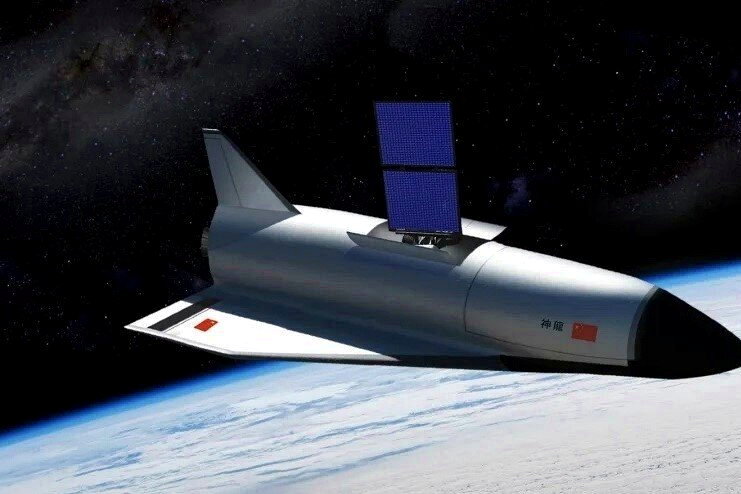
In addition to reusable launch vehicles, space planes also offer similar reusability and increased maneuverability, making them more suitable for certain missions than traditional satellites, the report said. “China currently has two main space plane models: ‘Shenlong’ and ‘Tengyun’,” the report said.
According to VOA, this report from the Defense Intelligence Agency describes three missions of the Chinese space plane: the first mission was carried out in 2020 and lasted 2 days; The second mission is scheduled to launch in August 2022 and operate in orbit for 276 days; The third mission is scheduled to launch in December 2023 and operate in orbit for 268 days.
Recently, Chinese official media reported that the fourth launch was carried out in February this year.
The report did not say whether the space plane seen in the photo was “Shenlong” or “Tengyun.” However, the outside world generally believes that this space aircraft launched vertically by the Long March rocket is the reusable unmanned space aircraft “Shenlong”. As for “Tengyun”, which China officially calls “Tengyun”, which uses a relatively new level of launch technology, it is still in the early experimental stage.
Some observers have compared the Shenlong to the X-37B, an autonomous, reusable unmanned space combat aircraft developed by Boeing for the US military.
Aviation news website The Aviationist reported that before the Vantour images were made public, public images available to the outside world were limited to blurry images taken by ground telescopes and computer-generated diagrams with Chinese labels.
David Shedd, former acting director of the US Defense Intelligence Agency, told VOA that the photo released by the Defense Intelligence Agency “highlights that China is actively trying to increase its offensive and defensive posture in space.”
He said, “These advances by the People’s Republic of China in space remind us that the United States must continue to take aggressive action in response to China’s significant advances in space capabilities, which have the potential to not only threaten, but threaten, U.S. satellite systems for defense and commercial purposes.”
The Defense Intelligence Agency reports that the People’s Liberation Army may view counter-space operations as a means to deter and deter other countries from intervening during regional military conflicts. As Chinese defense scholars once pointed out, other countries’ reconnaissance, communications, navigation and early warning satellites may become the target of attacks, thereby disabling the enemy’s eyes and ears.