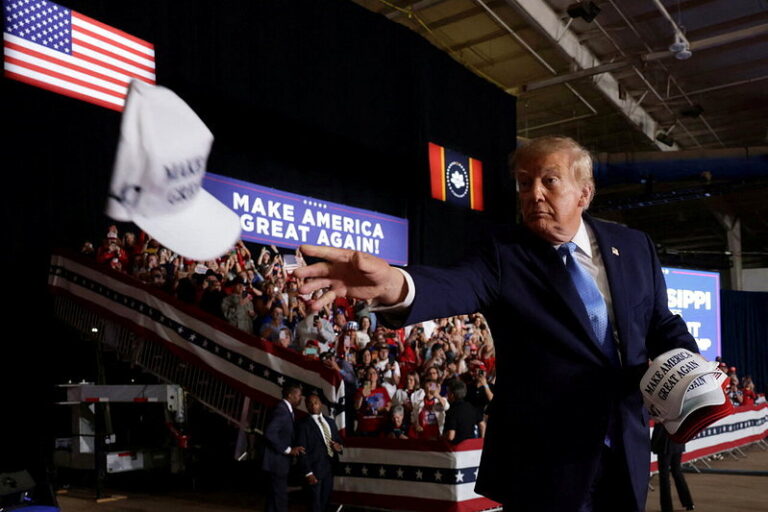
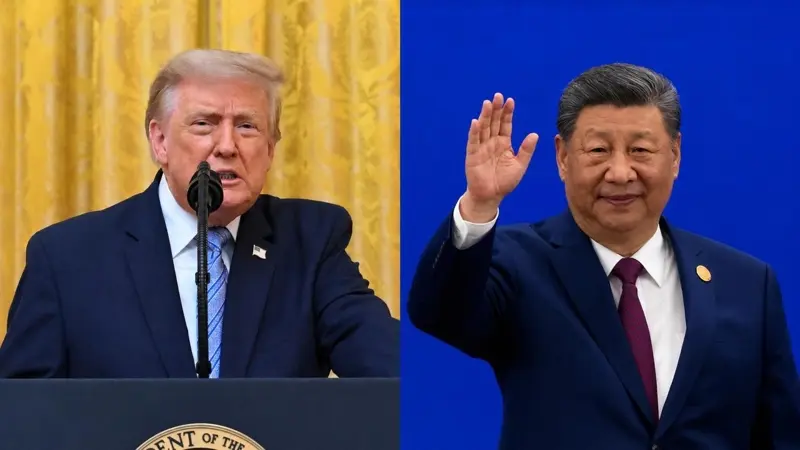

As US President Trump accused China of interfering in the US election in Washington , Chinese President Xi Jinping declared in Shanghai on the 17th that Beijing aims to become a responsible global leader in artificial intelligence (AI). CNN points out that the stark contrast between the two messages highlights the escalating technological competition and distrust between the US and China, with AI becoming a new core element of their rivalry.
Trump accused China of illegally obtaining 220 million U.S. voter profiles and incorporating this data into broader election manipulation efforts; China has denied these claims. Minutes after Trump’s speech, Xi Jinping addressed the opening ceremony of the “2026 World Artificial Intelligence Conference,” telling senior tech executives, researchers, and industry professionals that AI must develop in a “positive, benevolent, and beneficial direction for humanity,” and that precise and effective regulation must be implemented to prevent it from spiraling out of control.
Xi Jinping also opposed “generalizing the concept of national security” in the field of AI, or placing the security of one country above the security of others, clearly alluding to US policy. Beijing, on the other hand, advocates that AI should be a “global public good” and is willing to cooperate with other countries. Prior to the conference, China also established the “World Artificial Intelligence Cooperation Organization” (WAICO), composed of 29 countries, including Russia, Indonesia, and Pakistan, demonstrating Beijing’s intention to dominate global AI rules.
Chen Shu, Chairman of the Digital Division of the Asia Group, stated that Xi Jinping views AI as a tool to win over allies and compete with the United States; this is not merely a technological race, but also “AI diplomacy.” China believes it missed the opportunity to set global internet rules in the past and is unwilling to be absent again in the AI era.
US companies currently hold a broad lead in model capabilities, training technology, and hardware, but the gap is narrowing. China, on the other hand, is adopting a different strategy, focusing on robotics, automation, and global adoption. Companies like DeepSeek and Zhipu have already reduced the performance gap with US companies, and their open-source model and lower costs are attracting more users.
However, security concerns have risen simultaneously on both sides. Washington accuses Chinese entities of massively using cutting-edge U.S. models to “distill” smaller models and also worries that foreign actors are using AI to find vulnerabilities in critical U.S. infrastructure. Chinese regulators, on the other hand, have warned that Anthropic’s Claude Code tool poses a serious “backdoor” risk; Anthropic denies this, claiming the mechanism is only used to track platform abuse. Reuters also reported that Beijing is considering restricting overseas access to China’s most advanced AI models.
Trump and Xi Jinping agreed to begin an AI dialogue following their summit in Beijing in May. Xi’s attendance at the World Artificial Intelligence Congress since its inception in 2018 demonstrates Beijing’s high regard for AI and its desire to expand its international influence through Chinese models. However, participation from US companies at the Shanghai conference remains limited, and major Western countries are unlikely to join WAICO, a Chinese-led organization with responsibilities encompassing AI promotion, governance, and security.
Western analysts worry that China may use the establishment of global AI standards to export its strict media and internet control systems overseas. Cui Aoluo, a partner at DGA-Albright Stonebridge Group, stated that the US should establish a credible bilateral dialogue with Beijing to discuss the governance of cutting-edge AI models, but both sides still need to overcome bureaucratic obstacles and deep-seated distrust.