
AI summary
Summary of article:
A Spanish high-speed train collides and derails near Toledo, killing 68 people and injuring hundreds. Survivors described the scene as resembling a slaughterhouse. The incident also drew renewed attention to railway maintenance funding and safety management.
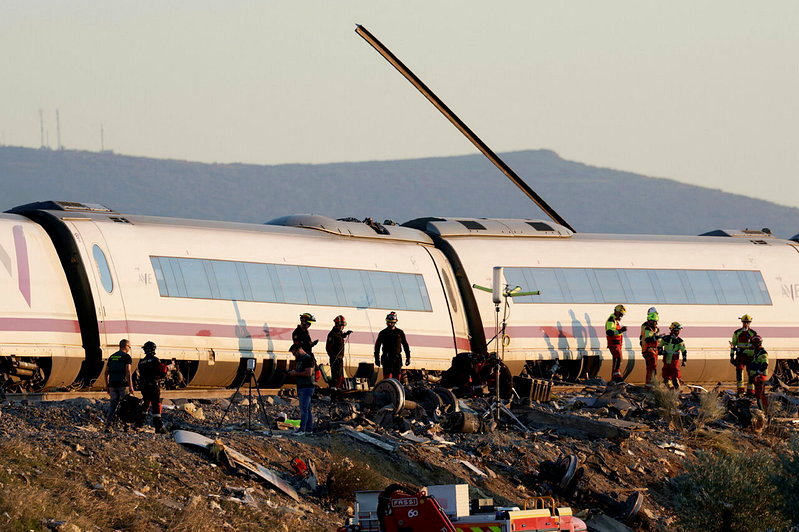
new York Times According to reports, what happened in Spain on 28thhigh speed rail A train collision occurred when a high-speed rail train collided with another train near Toledo, causing some carriages on both trains to derail. The death toll has risen to 68 and hundreds have been injured. It is the deadliest rail accident in Spanish history. Surviving passengers recalled that the violent impact caused the carriage to immediately collapse into chaos, with the rail even piercing the carriage straight through “as if it were cutting meat.” There was silence for some time at the accident site because the passengers were either dead or so injured that there was no need to call for help.
The accident occurred at 8:54 a.m. on the 28th when an AVE high-speed train of Spanish state-owned railway company Renfe collided with a high-speed train heading south to Seville and operated by private operator Irio from behind, causing some carriages to derail. After the incident, wires were broken and telephone poles fell. The derailed train was almost shattered to pieces. Burnt wheels, smoking metal and crushed objects were scattered everywhere.
Passenger Fernando Seco, 62, recalled that he took the high-speed train from Madrid back to Sevilla at 8 a.m. that day. About half an hour after departure, the train stopped due to traffic jam. Soon it started up again and gradually accelerated, but suddenly and violently collided with the train in front. He and other passengers ran from the carriage in panic and saw that the train carriage in front had fallen down the embankment, and a steel guardrail “was completely pierced from the bottom to the top of the carriage, as if it were cutting flesh.”
Seko and other survivors ran for cover and found the dead and wounded “trapped among twisted metal and debris.” He reported that at first the scene was unusually quiet; Screams were no longer heard until survivors used the train wreckage to create makeshift stretchers and pull the injured out of the debris. At that time, a doctor on the train rushed forward and set up a temporary emergency treatment area in the nearby forest.
Another 77-year-old passenger, Antonio de la Corte, was napping in the third car down the Renfe train. Suddenly, a loud “bang!” woke him up. He suddenly jumped forward and injured his knee. His brother traveling with him also suffered head injuries. He said a steel rail entered the vehicle like a barbeque spit, killing the passenger sitting on the right side on the spot.
Another passenger, Sebastian Herrero, 46, said he saw “several people with broken noses and broken arms” at the scene, the BBC reported, citing Spain’s “El Mundo.” He recalled: “The collision was very, very violent. At that time, the whole person was thrown into the air for about 4 to 5 seconds. It felt like it was a lifetime.” Even after the incident, many passengers are in shock. One of them was interviewed by a local TV station and could not stop himself from crying when he remembered the scene of a woman dying during pregnancy.
After news of the accident spread, Yahadi Mohammed Mouloud, a 41-year-old resident of the nearby town of Jevons, immediately arrived at the scene carrying bottled water. He described the scene before him as a “massacre”, with some people missing limbs and a bloodied woman searching for her brother. Maudru usually took this railway to Madrid for business, but after seeing this tragedy, he only said: “I will never dare to take that train again.”
In January this year, a high-speed train in Spain derailed and collided with an opposing train, killing 46 people. Now, less than a year later, another major accident has been reported, which has also drawn attention to the issue of railway maintenance funding.
Reuters reported that European Commission data showed Spain has about 4,000 kilometers of high-speed rail network, with an average annual investment of about 1.5 billion euros from 2018 to 2022, the highest among European countries. However, most of the funds are used to build new lines, and only 16% is invested in maintenance, renovation and upgrade projects. Furthermore, the number of railway accidents in Spain is projected to increase from 45 in 2016 to 69 in 2025.
Summary FAQ
-
The accident happened near Toledo. A Renfe high-speed train collided with a southbound Ireo train, derailing and seriously damaging some carriages. Currently, 68 people are known to have died and hundreds more are injured.
-
Several survivors said that the impact was so strong that passengers were thrown and the carriage immediately derailed; Some people also saw the rails being pierced from the bottom to the top of the carriage, and the scene looked like a ruin of shredded metal.
-
Because there was a major derailment accident in Spain in January this year, and now there are reports of mass casualties; Furthermore, maintenance funds are mostly used for new lines, and only 16% is invested in maintenance and upgrades, raising safety concerns.