
AI summary
Summary of article:
Scholars believe that Trump’s suspension of arms sales to Taiwan will only make Beijing believe that pressure is effective, and instead weaken Taiwan’s defense bargaining with the United States. To stop China, arms sales will have to be accelerated.
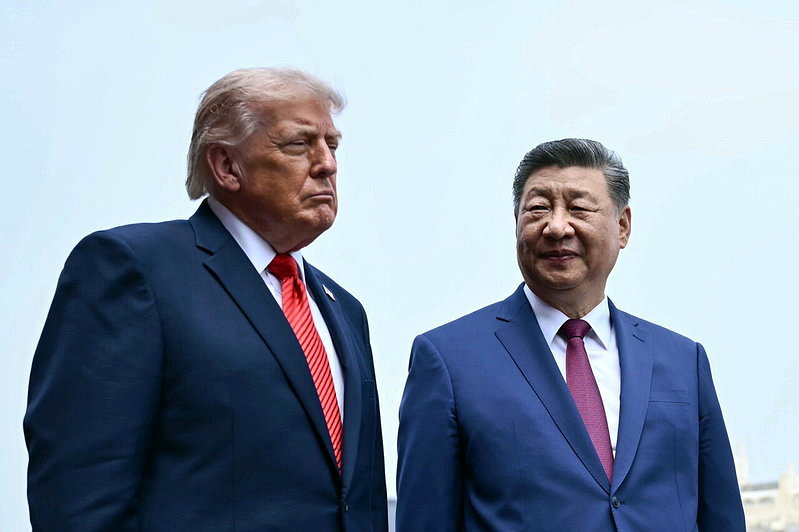
The American magazine “National Review” published an article on the call of the President of the United States on the 25thtrump reconsider the pausearms sales This decision is a warning that Beijing will interpret Trump’s move not as a concession or overture, but as a new red line, believing that China’s pressure is enough to stop US arms sales to Taiwan, and would even allow Beijing to think it has gained permanent veto power over every future arms sale to Taiwan. Not only does this move not help improve US-China relations, but it actually plays into the hands of the Chinese president.Xi Jinping no idea.
This article was co-written by Dan Blumenthal, a senior fellow at the American Enterprise Institute (AEI), and Brady Africk, an open source intelligence researcher. He stressed that arms sales, totaling about US$14 billion, mainly include interceptor missiles and air defense systems. If Beijing cannot even afford such defensive weapons, it reflects China’s genuine fear of Taiwan, whose defense capabilities are strong enough to deter attacks. Therefore, if the Trump administration hopes to have a stronger bargaining chip the next time it meets Xi Jinping, providing arms to Taiwan is the way to achieve its goal.
The article reported that the United States has continued to sell arms to Taiwan for decades. Despite repeated protests from Beijing, arms sales have continued as usual, and US-China relations may face consequential impact. This model has worked precisely because Washington has never treated China’s routine objections as a veto power.
The article reported that China is strengthening its isolation from Taiwan through political, military and diplomatic means. In the past, the balance of Taiwan Strait policies maintained by the United States worked when China’s military strength was relatively backward. However, the situation has changed with the increase of China’s military power. Washington should now speed up rather than slow down arms sales to Taiwan, especially since Taiwan is not sitting idly by and is actively strengthening its defense and implementing the “porcupine strategy.” However, if the United States cannot approve arms sales and cannot deliver weapons as planned, this strategy will still be difficult to achieve real effectiveness.
China has continued to expand its military exercises around Taiwan in recent years, and incidents such as Chinese coast guard ships ramming Philippine ships and military aircraft targeting Japanese military aircraft with radar show that Beijing continues to test various countries’ bottom line of tolerance. Moreover, satellite images show that China not only builds targets that simulate American-made military equipment used by Taiwan, Japan, and South Korea, but also practices landing operations on its southeastern coast, and even builds training facilities that simulate the area around Taiwan’s presidential palace. These operations not only have a practical military training purpose, but also convey clear political messages.
The article emphasizes that arms sales to Taiwan are not just a moral responsibility to protect democracy and a free society. Once a war breaks out in the Taiwan Strait, in addition to causing huge casualties, it will also seriously damage global trade and the semiconductor supply chain on which the US technology industry is highly dependent. Conversely, a Taiwan with adequate self-defense capabilities would force Beijing to think twice before launching an attack.
The article clearly states at the end that Trump blocking arms sales to Taiwan was not so much about maintaining bargaining chips as it was about playing into Xi Jinping’s hands and allowing Beijing to get what it is demanding without any effort. This approach will not only fail to improve US-China relations, but will also weaken the defense capabilities of key partners.
Summary FAQ
-
The author points out that Beijing will not interpret the suspension of arms sales as goodwill, but will instead regard it as a concession by the United States, further determining whether pressure is effective, and even want to obtain substantial veto power over future arms sales to Taiwan.
-
The article believes that what China really fears is that Taiwan has strong enough defense capabilities, especially missile interception and air defense systems, so that Taiwan can effectively prevent Beijing from launching attacks.
-
The author advocates that the United States should accelerate the approval and delivery of arms sales to Taiwan as planned, because strengthening Taiwan’s self-defense capabilities can not only maintain deterrence across the Taiwan Strait, but also increase Trump’s bargaining chips with Xi Jinping compared with suspending arms sales.