
AI summary
Summary of article:
Altman believes that running AI models on personal computers will waste scarce DRAM, and inference should be focused on the cloud to improve resource utilization. However, this has led to strong criticism on the Internet and questions over commercial motives.
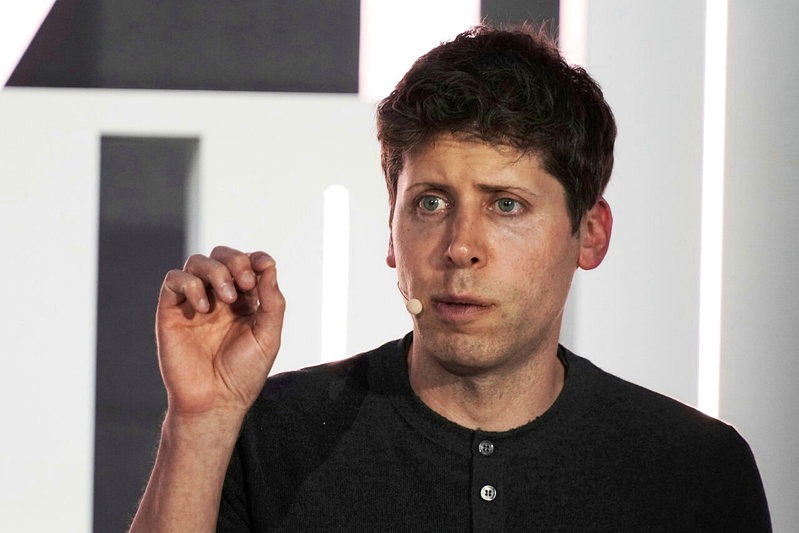
As the global memory supply tightens due to the AI boom, the CEO of OpenAI, one of the main drivers of the artificial intelligence (AI) boom,ultraman However, he believes that running AI models on people’s personal computers is a waste of limited memory resources, and advocates that it should be centralized in cloud data centers.
Ultraman recently admittedyoutube In an interview with the podcast program of the channel “Cheeky Pint”, he said that many people hope to do AI inference at the local level and believe that with the popularity of open source models, AI will be able to run directly on personal computers in the future and will no longer need to rely on data center equipment.
However, Altman believes that this approach is not conducive to effective use of limited memory resources.
Altman said: “From the perspective of global resource allocation, it is actually quite bad that everyone’s computer is equipped with a large amount of limited supply of DRAM, but is only actually using it 5% of the time. If you want to deal with this extremely tight supply environment, you should use cloud computing to maximize resource utilization. But for some reason, many people have exactly the opposite intuition.”
His comments immediately went viral in the PC gaming community, with one Reddit user saying: “What a selfish bastard. This guy is the epitome of a cult leader.” Another user said: “He doesn’t seem to understand the idea of people wanting to keep their own computers. It seems beyond his scope of cognition.”
Technology media Tom’s Hardware pointed out that although OpenAI has also launched some open source models, its core business is still a closed source model running in the data center, so Altman is actually defending the company’s business model.
At present, OpenAI is not threatened by laptops and gaming computers, but with the development of local AI, in the future, if people have enough hardware to run AI models at home, they will not have to pay such a high subscription fee to use models like GPT-6 Luna.
Furthermore, Ultraman also said that he would prefer to see the coexistence of a trillion AIs with intelligence slightly higher than that of humans, rather than the emergence of a single super AI with an intelligence as high as one trillion. He believes that despite many shortcomings, human society can still maintain resilience through mutual supervision, cooperation, and the values of pluralism and democracy. An ensemble composed of multiple AI agents may also have similar characteristics. He advocated that AI technology can develop in different directions and that multiple AI checks and balances should be actively promoted.
Summary FAQ
-
He believes that the global memory supply is tight. If each computer is equipped with a large amount of DRAM, but only uses it a few times, the overall configuration efficiency will be very poor; Conversely, concentrating it on the cloud can improve resource utilization.
-
Many netizens believe that he ignores the needs of users to control their own hardware, and even criticize him for being selfish and arrogant; Some people also question that he does not understand the value of local computing and is only protecting the company’s interests.
-
Tom’s Hardware pointed out that although OpenAI has some open source models, its core is still a closed-source service in the data center; Therefore, Altman’s opposition to local AI may be to maintain OpenAI’s existing membership and cloud business model.