
AI summary
Summary of article:
Home care workers in New York rallied to protest the state Labor Department’s move to turn unpaid wages cases from compliance orders to private arbitration, with advocates accusing the government of being backward and refusing to enforce the law and demanding a thorough investigation.
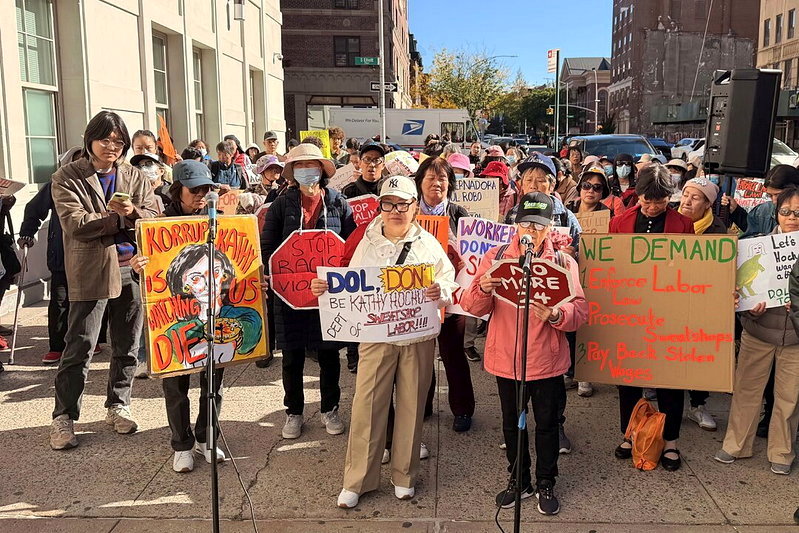
New York home caregivers and activist groups protesting the 24-hour work system met on the 22ndbrooklyn (brooklyn ) Rally in front of the New York State Department of Labor. Participants pointed out that the state labor department had sent a letter in January this year stating that it would continue to issue “Orders to Comply” to nursing companies accused of underpayment, but suddenly changed its stance on the eve of the elections and instead asked workers to recover their own wages through private arbitration. worker criticismHuo Chu (Kathy Hochul) The government went back on its word and called for a thorough investigation into the reasons behind it.
Yuheng Zhang, a staff member of the Chinese Staff and Workers Association, said the state labor department had promised in January this year to issue compliance orders to two non-union nursing facilities, Royal Care and ABI, requiring the operators to pay outstanding wages. He showed an email from the Labor Department investigator stating that instructions had been given to issue compliance orders against over 100 complainants in the Royal Care case, all of whom worked 24-hour shifts. However, the Labor Department recently informed that it will no longer issue compliance orders and workers will have to switch to private arbitration.
According to a response from the person handling the case, it was reported that the Royal Care case was recently changed from a civil lawsuit to mandatory arbitration and is currently being reviewed by the department’s legal office. In the ABI case, the amount of salary outstanding is still being recalculated based on the records provided by the employer. However, since many of the complainants in this case have participated in arbitration, they will ultimately face similar issues to the Royal Care case. However, it did not specify whether the compliance order would still be issued.
Zhang explained that a compliance order is the final step after the Labor Department completes its investigation and orders the employer to pay, but private arbitration is tantamount to leaving the employer and employee to “solve it on their own” instead of enforcing labor laws. This is inconsistent with the demands of rights groups and caregivers. “This is a blatant refusal by government agencies to enforce labor laws.”
As far as union caregivers are concerned, the state’s Superior Court of Appeals rejected the state Labor Department’s appeal on June 25, ruling that it must reopen a wage theft arbitration investigation involving some former union caregivers. Zhang said it has been almost four months since the decision was made and the employees have not yet received any notice. Zhang also criticized Huo Chu for handing over the business to the Chinese Planning Association (Huas Association) during the restructuring of the state Consumer Directed Personal Care Plan (CDPAP) and alleged that the agency was involved in massive wage arrears.
As early voting is about to begin for the November general election, Zhang stressed that the group is not calling on people to vote for any specific candidate, but it is not just a matter of one election cycle. “New Yorkers should not be held hostage by one governor year after year.”
Chen Xuezhen, who worked as a 24-hour caregiver at Kangyi Nursing Company for 11 and 10 years, also said that caring for Parkinson’s disease patients caused her mental stress for many years. She had to continue attending to the needs of patients even during scheduled vacations, which left her unable to recover for several years after leaving her job. He explained that the caregiver had been fighting for several years, but authorities had not promised compensation or enforced the law as required, making it difficult for him to easily accept mediation without clear legal documents.
According to state law, if home care workers can get eight hours of sleep and a total of three meals during a 24-hour shift, their employer can only pay them for 13 hours. Caregivers say it is almost impossible to obtain the above leave in practice, arguing that the system amounts to wage theft. Since the beginning of this year, caregivers have repeatedly used rallies, sit-ins and hunger strikes to pressure the City Council to vote on Proposition 303, proposed by Council Member Christopher Marte, which would ban shifts of more than 12 hours at a time. However, the proposal has not yet been voted on.
Summary FAQ
-
They protested that the state labor department had originally promised to issue compliance orders to nursing care companies for unpaid wages, but on the eve of the election, it changed to requiring workers to mediate trafficking, believing that the government failed to enforce labor laws.
-
The Labor Department said in January this year that it would issue compliance orders to Royal Care and ABI, requiring them to pay outstanding wages; However, it has recently informed workers to use private arbitration to recover wages.
-
Caregivers believe that arbitration only allows labor and management to resolve matters on their own, and cannot actually enforce labor laws and guarantee compensation for back wages. Therefore, they continue to demand the issuance of orders and outstanding wages as per the law, and are pushing for a bill to limit 24-hour shifts.