
AI summary
Summary of article:
The New York Times reported that the close relationship between Trump and Huang Jen-hsun has hindered the United States’ sanctions and investigation into the export of Huida chips to China. Additionally, MegaSpeed is also being investigated by the United States and New Zealand for suspicious transshipment of chips.
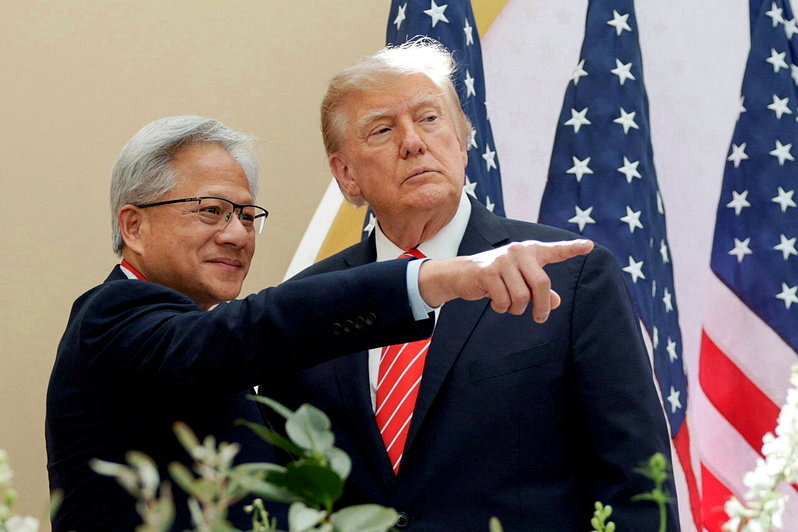
The New York Times reported that current and former US officials said,trump President vs.Jen-Hsun Huang (Jensen Huang) has obstructed the US government’s efforts to curb foreign sales of chips from chip giant Nvidia. Some investigations against China or Nvidia, as well as previously proposed trade sanctions, have been suspended within the Commerce Department, the authority responsible for monitoring chip exports.
Current and former officials reported that Huang successfully persuaded the government to relax controls on artificial intelligence (AI) companies during Trump’s second term. Sales of Huida chips to China were originally subject to strict restrictions, but were later lifted. At the same time, Huang Renxun and Trump reached an agreement that the government will charge a 25% commission on some Huida chips approved by the United States to be sold to China.
The report notes that when Trump first received an intelligence briefing on Huida last year, officials did not believe Huang knew that Chinese businesswoman Alice Huang (also known as Huang Le) was helping China gather intelligence. Officials said it was unclear whether intelligence officials subsequently updated their assessment, but some senior Trump administration officials have questioned whether Huang was actually unaware of Huang’s role in gathering intelligence for Beijing.
The report stated that it was unclear whether security considerations of surveillance operations played any role in “the decision not to inform Huang Jensen”. Informing him would let Huang Le know that he was being watched. It is currently impossible to determine the specific reasons for initiating the surveillance, as well as what intelligence Huang Le provided to Beijing and what it cost China.
As a senior executive at Singapore-based cloud services provider MegaSpeed, Huang Le’s rapid rise to prominence is somewhat mysterious. She claimed to be the CEO of MegaSpeed, but company documents have removed her from the post of CEO. After the United States launched an investigation, Huang Le curtailed MegaSpeed’s activities. In the early days of the Biden administration, the Commerce Department suspected that MegaSpeed’s Huida chip was secretly helping China circumvent a US ban to obtain computing power. According to the website of a Chinese investment fund where Huang Le once worked, he worked as a television reporter in China, but The New York Times could not find enough information to confirm this.
Huang Le’s profile on the Chinese Internet is relatively sparse. She has worked for several big Chinese banks and joined Shanghai Hexi Capital, which invests in a number of semiconductor and AI companies, according to data platform Wirescreen.
Investors in the technology sector familiar with the situation said Huang Le and his associates often boasted about their relationship with Huang Renxun and used the relationship to raise funds and promote business networks.
In June 2024, a few weeks before MegaSpeed began the purchase, photos posted on the social platform LinkedIn showed that after a technology exhibition in Taipei, Huang Renxun and Huang Le appeared to be drinking with other senior AI industry executives at a bar in Taipei.
In May 2025, they were seen together again, leaving a restaurant in Taipei after a business dinner with other AI suppliers. She stood behind Huang Renxun and waited outside the restaurant to be interviewed by the Taiwanese media.
According to online recruitment announcements and industry analysts, MegaSpeed continues to promote new data centers and recruit employees in Southeast Asia, and boasts of its close relationship with Huida.
MegaSpeed is essentially a middleman, buying HUDA chips from the US branch of Chinese server maker Inspur and then providing that computing power to Alibaba and other Chinese companies.
US officials believe MegaSpeed is part of an international effort by Chinese companies to obtain the chips needed to build and run AI. Investigators suspect that some of the Huida chips obtained by MegaSpeed are also being illegally shipped to China.
The US government is investigating MegaSpeed from 2024. At that time, an official from the Ministry of Commerce visited MegaSpeed’s data center in Malaysia and found something suspicious. The Huida device was not opened, which meant that the device had just arrived at the location and was not installed locally.