
AI summary
Summary of article:
The debate between New York’s specialized high schools and campus integration is not just about choice, but about deeper issues such as differences in resources, teachers, parent information, and students’ lack of basic academic ability.
ten years ago,new York Times Journalist Nicole Hannah-Jones sent her daughter to the hospitallow income Public elementary schools with predominantly family students hope to support educational equity with the participation of middle-class families. Ten years later, she confessed at her new work that her daughter failed to lay a good foundation for learning, and so she complained about her mother’s choices. In the end, she allowed her daughter to choose her own high school and got into a selective school. This experience has once again intensified the debate over the segregation and educational quality of New York public schools, and calls to eliminate admissions selection have once again become widespread. However, many Chinese parents, teachers and graduates interviewed pointed out that when high-quality education is still a scarce resource that requires competition, simply attacking the selection system cannot be the cause of the problem and the root behind the symptoms cannot be ignored.
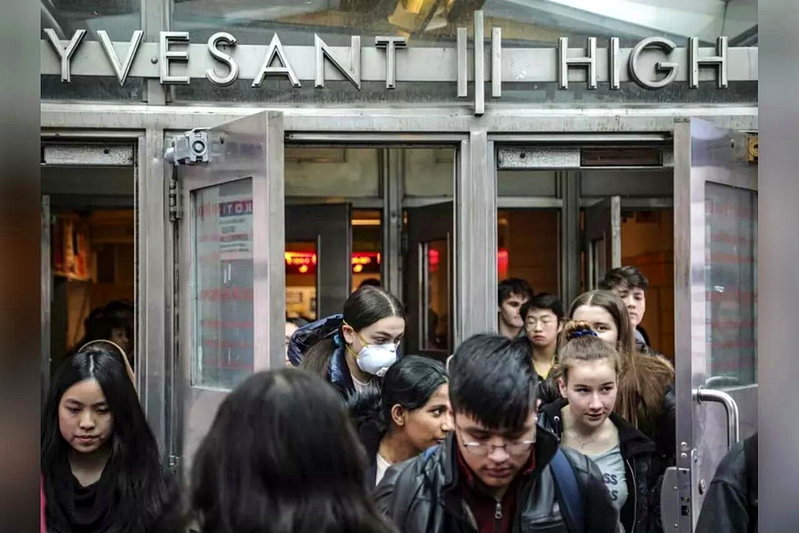
For Lu, who grew up in Flushing, studying was an easy task. As long as he follows the lectures step by step, he will remain one of the best. Her mother raised her daughter alone by working long hours at a nail salon in Long Island and did not have time to focus on her homework. It was not until the seventh grade that she was first sent to a cram school to prepare for the Special High School Admission Test (SHSAT).
Lu said, “Ever since I was young, she would remind me that if I didn’t study hard, I would also wash feet for a living like her.” For this mother and daughter, education is their hope to escape from financial crisis and this exam is a path that can change their lives.
After enrolling at Stuyvesant High School, more challenging courses forced Lou, who had always tackled her schoolwork with ease, to work hard for the first time. The excellent teammates around him also gave him a more solid vision for the future. “I want to be like them, and I also feel like I can go out into a wider world.”
Teacher Wang, who teaches at a public junior high school in Flushing, believes that the benefit of the selection system is not necessarily to select smarter children, but to bring together students with positive learning attitudes to create a more demanding learning environment. According to his observation, children in the school’s honors class are generally more willing to listen to opinions and submit to discipline; For students, the role of role models among peers is an important achievement beyond textbooks.
Vanessa Leung, co-executive director of the Coalition of Asian Children and Families (CACF), which supports school integration, believes diverse campuses can allow children to interact with people outside their life cycle and develop empathy, critical thinking and interpersonal skills. He recalled that in the CACF Student Leadership Program, there were students who gained a new understanding of themselves through exposure to peers from different backgrounds.further education Failures, no longer consider failure to get admission in the ideal university as a failure in life.
The public schools that Lu attended from elementary school to high school were dominated by Asian students, and she had limited opportunities to interact with students from other backgrounds. She agrees that a diverse environment can broaden horizons, but worries that after de-selecting, without relevant teaching support, teachers will have difficulty caring for students with different levels. “Either lower the requirements for all students, or let students who have not mastered the material still upgrade, which is obviously delaying them.”
How to enable children with different levels to progress requires not only classroom arrangements, but also family support. Teacher Wang found that some parents passed all academic responsibilities to teachers, but ignored that “each child spends less than seven hours a day in school.” He believes that study habits are largely developed outside of school, and that teachers’ methods of discipline are becoming increasingly limited. Without family support, schools are still limited in what they can do.
But parents eager to invest may not know where to start. Teacher Wang pointed out that New York’s admission system is complex and can easily create information barriers. From student scores to the school selection process, information should be clear and easy to understand. “Parents should understand this so they can be more involved.”
Zhu Yating, a parent who supported the selection, suggested that all parents need to attend a higher education orientation workshop in the spring of sixth grade to learn about high school options, examination arrangements, and preparation time. She said some families didn’t know about the opportunities until they needed to prepare for the test, leaving little time for their children to prepare. Lu also advocated making the special college entrance examination a mandatory test to prevent students from missing out on opportunities due to ignorance.
Exceeding the admission threshold does not mean that students’ needs will be met. Lu recalled that Stuyvesant had a large number of students and teachers had limited skills. When students encounter difficulties, they often have to take the initiative to ask for help.
Reducing class sizes is one of the ways New York is trying to improve teaching conditions, but manpower and space are still constraints. The city comptroller’s office estimated in late 2025 that 9,237 additional teachers would need to be hired to meet smaller class standards by the 2027–2028 school year. Public schools across the United States are also facing difficulties recruiting teachers. A survey by the federal Center for Education Statistics shows that before the start of the 2024–2025 school year, 74% of public schools have at least one teacher vacancy and qualified candidates are difficult to find.