
AI summary
Summary of article:
Financial reports from Qualcomm and Arm disappointed and the market was concerned that the construction of AI data centers was subject to political and regulatory restrictions. US technology and chip stocks fell sharply and tariffs suffered the second-largest drop in history.
There was a huge fall in the American stock market on the 5th.Qualcomm (Qualcomm) Qualcomm and Arm’s financial reports failed to meet market expectations, and investors are also worried that after the Democratic Party’s victory in the midterm elections, data center construction may be more restricted. Chip stocks were the first to bear the brunt, with the Philadelphia Semiconductor Index posting its biggest one-day decline since March 2020.Nasdaq The composite index improved.
The Dow Jones Industrial Average fell 1,833.06 points to close at 51,523.06, a decline of 3.4%, the biggest one-day decline since April 4 last year.stamp 500 The index fell 334.89 points to close at 7,353.73, a decline of 4.4%. The total value of component stocks decreased by US$3 trillion. The Nasdaq Composite Index fell 1,421.52 points to 24,315.00, down 5.5%. It was the biggest one-day drop in 19 months and more than 10% below October’s peak.
The Philadelphia Semiconductor Index fell 12.3%, the second-largest one-day decline in history. This decline exceeded the worst day since the dot-com bubble burst in 2000. The Nasdaq 100 index fell 6.4%, its biggest one-day decline since March 2020. Market value fell by US$2.3 trillion, setting a one-day record. The S&P 500 and Nasdaq Composite indexes are still up 7.4% and 4.6%, respectively, this year.
NVIDIA fell 9.3% to close at $181.60, losing hundreds of billions of dollars in market value. Qualcomm fell 9.5%. Smartphone chip sales were lower than expected in the last quarter. Rising prices of memory and other components have also reduced the profitability of the mobile phone chip business. Although the data center business grew rapidly, it was not enough to compensate. Arm’s revenue rose 27% last quarter, but its outlook fell short of some investors’ expectations and its share price fell.
TSMC ADRs fell 10.8%, but selling pressure first emerged during Asian trading hours. On the 5th, South Korea’s Kospi index fell 5.3%, and Taiwan’s weighted stock price index fell 3.2%.
Chip, server and data center stocks all fell
Data center companies IREN and Applied Digital both fell more than 14%, and CoreWave fell 9.8% to close at $43.66. CoreWeave CEO Michael Intrator said the change in the political situation is not expected to impact existing customer commitments and related undelivered orders. Dell, a major server maker that cooperates with CoreWeave to develop data centers, fell 15%. Power appliance company GE Vernova fell 7.5%, and power company Constellation Energy fell 2.5%.
Big technology stocks that originally rose on the 4th also fell back, with Meta falling by 4%, and Amazon and Alphabet both falling by 2.2%. Musk’s Tesla and SpaceX also declined.
Democrats won both houses of Congress and also won gubernatorial elections in some major data centers. Hinojosa, who advocated an immediate halt to data center development, was elected Governor of Texas, allowing investors to reevaluate construction progress. Texas was expected to surpass Virginia within the next few years and become the largest data center in the United States.
Melissa Brown, head of global investment decision research at SimCorp, said newly elected members of Congress and governors may not be able to completely stop the construction of AI infrastructure, but as long as construction is slow, it is enough to raise doubts, because market expectations for AI development largely depend on the rapid expansion of data centers. Justin Burgener, portfolio manager at Gabelli Funds, also pointed out that the longer manufacturing period could exacerbate supply constraints and weaken the pricing advantages and profit margins that memory factories and data center equipment manufacturers originally enjoyed due to insufficient supply.
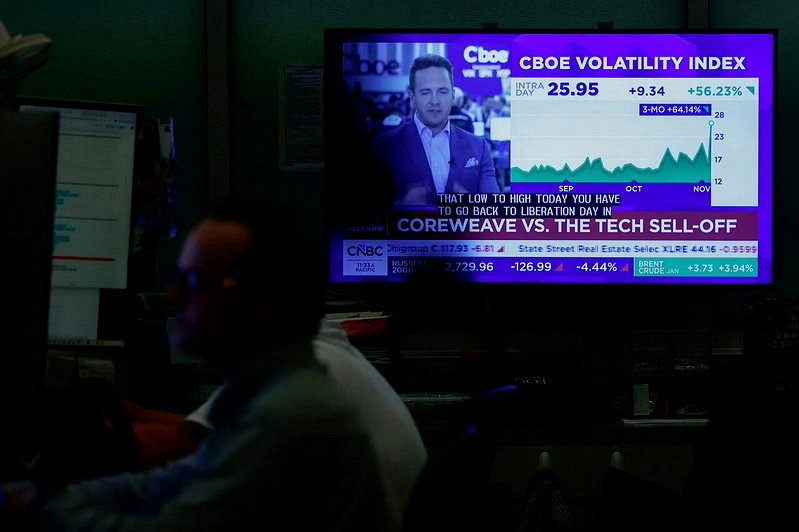
JJ Kinahan, senior vice president of global markets at Cbo, believes Qualcomm’s financial report created selling pressure and forced investors to once again ask how much revenue companies can bring in by investing large sums of money to develop AI.
Barclays estimates that as volatility increases, funds adjusting their holdings based on volatility could sell about $135 billion in US stock futures over the next 24 to 48 hours, the largest position adjustment since December 2018. JPMorgan’s equity derivatives team believes that this wave of capital flows mainly reflects position adjustment. Technology stocks are still divided among themselves, with investors favoring larger companies with smooth financing channels and computing capacity.
Oil prices surge as safe-haven buying pushes US Treasuries and gold higher
New York crude futures rose $2.40, or 2.7%, at $90.52 a barrel, recouping some recent losses and rekindling concerns about inflation. The Jets ETF, which tracks airline shares, fell 3.7%. Safe-haven purchases pushed up US Treasury bond prices, with the 2-year Treasury yield falling 10.4 basis points to 4.475%. The 10-year contract fell 5.5 basis points to 4.836%. The 30-year fell 3 basis points to 5.250%.
The dollar was almost flat against major currencies. Gold futures rose $41.40 to close at $4,102.50 per pound, or 1.0%, the highest closing price since October 21. New York copper futures closed at their lowest level since mid-July.