
AI summary
Summary of article:
A Chinese scientific research team used all-optical trap cooling technology on the space station to cool a rubidium atomic cloud down to 9.7 picokelvin, setting a new record for the coldest known man-made substance and helping advance pioneering research on quantum and cosmological science.
A Chinese scientific research team has created the coldest known artificial substance in an experimental instrument on the Chinese space station. By using all-optical trap cooling technology, it has successfully reduced the equivalent temperature of the rubidium atomic cloud in the ultra-cold nuclear experimental cabinet to 9.7 picokelvin (pK), which is lower thanGermany The team’s results in 2021 are close to “absolute zero”.
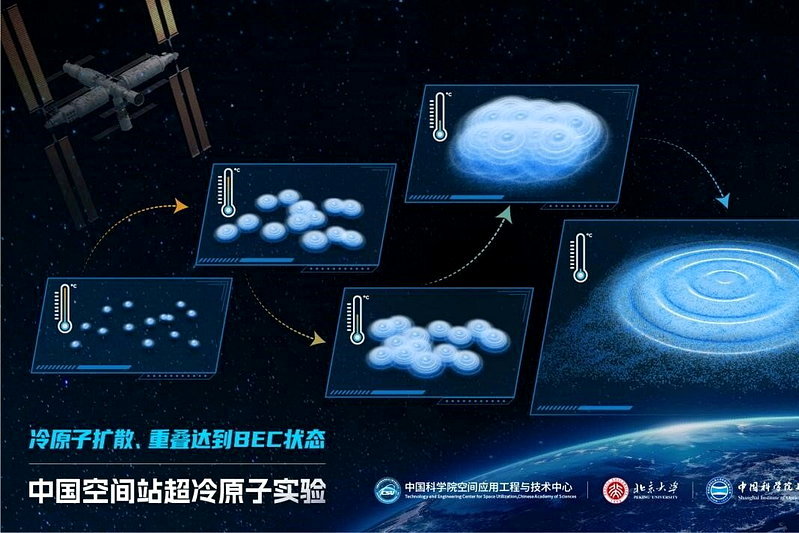
Based on reports from CCTV News, China News Service, and China Central Broadcasting Network, the Space Application Engineering and Technology Center of the Chinese Academy of Sciences released the latest scientific research results on the 6th. The scientific research team used the ultra-cold nuclear physics experiment cabinet of the Mengtian capsule of the China Space Station to create the coldest known artificial substance, which broke the record of the lowest-temperature substance in mankind and moved one step closer to “absolute zero”. The research results were published today in the international academic journal “Science”. Relevant experiments are led by the Space Application Engineering and Technology Center of the Chinese Academy of Sciences to demonstrate management integration.Peking University Jointly completed with the Shanghai Institute of Optics and Precision Mechanics, Chinese Academy of Sciences.
It is reported that in this ultra-low temperature exploration experiment, the scientific research team used all-optical trap cooling technology to successfully reduce the equivalent temperature of the rubidium atomic cloud in the ultra-cold nuclear experiment cabinet of the China Space Station to 9.7 picokelvin, which is about one hundred billionth of the temperature of the substance at room temperature, and continued to observe it for 7 seconds. This is closer to “absolute zero” than the 38 picokelvin equivalent temperature of the rubidium atomic cloud created by a German scientific research team in 2021, which is one hundred billionth of a kelvin and 14 orders of magnitude lower than room temperature.
Chen Xuzhong, a professor at the School of Electronics at Peking University and chief scientist of the scientific experiment system, said that the features of the ultra-freezer are to achieve “the lowest temperature in the universe”, achieve the fifth state of matter predicted by Einstein in 1925, and use this coldest substance in the universe to conduct scientific experiments.
He emphasized that “in terms of cooling solutions and scientific experiments, our country’s experimental cabinets differ from the CAL (Cold Atom Laboratory) of the American space station.” American CAL uses the conventional magnetic field plus radio frequency field method for evaporative cooling; China uses a “three-dimensional all-optical trap solution” for two-stage cooling, which has a lower initial temperature than the US solution and can more easily conduct various experiments such as quantum simulation.
“The US CAL was launched in May 2018, and the current reported result is 52pK. The indicator proposed by the Chinese plan is relatively conservative (better than 100pK),” said Xiong Wei, assistant researcher at the School of Electronics at Peking University and deputy chief designer of the scientific experiment system. In fact, scientists have obtained cold nuclear gas with temperatures of hundreds of pK on the ground. It is expected that the temperature in the microgravity environment of the space station will be one or two orders of magnitude lower (about 10 pK).
The report reported that the ultra-cold nuclear physics experiment cabinet of the Chinese space station was successfully developed in 2022 and was delivered to the Chinese space station with the Mengtian capsule. The Chinese team integrated and compressed the experimental system that was originally 20 cubic meters and weighed 10 tons on the ground to 0.7 cubic meters and 500 kilograms, which is equivalent to putting a room-sized experimental device into a refrigerator-sized space.
“Absolute zero” is 273.15 degrees Celsius below zero, which is the lower limit of the lowest temperature in the universe. According to the third law of thermodynamics, humans can only get infinitely closer to it, but can never actually reach it. When the temperature drops close to the lower limit of temperature, “absolute zero”, which is 0 Kelvin, the atoms will “freeze” until they are almost frozen. The lower the temperature, the slower the atoms will move. When atoms are slowed down to a certain level, many amazing physical phenomena will emerge, helping scientists to clearly see the laws of the microscopic world that are usually difficult to capture.
The report mentioned that this new breakthrough by the Chinese scientific research team will effectively promote research on cutting-edge topics such as early universe simulation and ultra-light dark matter detection. At the same time, related technologies can also be used to develop high-precision atomic interferometers, quantum sensors, and space atomic clocks for Earth microgravity measurements, inertial navigation, and testing of basic physical constants.
Summary FAQ
-
In the experimental instrument of the Chinese space station’s Mengtian capsule, they reduced the equivalent temperature of a rubidium atomic cloud to 9.7 picokelvin, setting a new record for the coldest known man-made substance and getting closer to absolute zero than previous international results.
-
The research team used an ultra-cold nuclear physics experimental cabinet and a three-dimensional all-optical trap cooling scheme to perform two-phase cooling, making it easier to cool the nuclear cloud in a microgravity environment and more suitable for subsequent quantum simulation experiments.
-
This breakthrough could boost simulations of the early universe and the detection of ultra-light dark matter, and could also be used in high-precision atomic interferometers, quantum sensors, and space atomic clocks for inertial navigation and testing basic physical constants.