
AI summary
Summary of article:
Diwali in India symbolizes the victory of light over darkness. People clean, light lamps, make sacrifices and meet relatives and friends. However, this year, Delhi’s air quality dropped to critical levels due to winter air pollution and the impact of fireworks.
India Due to its vast area, commuting time is much longer, so there are fewer opportunities to visit relatives and friends. People mostly use the Diwali period to get together with relatives and friends to celebrate this most important festival of the year.
According to the Indian epic “Ramayana”, Rama, who is considered an icon of morality, justice and an ideal king in Hinduism, defeated Satan, saved his beloved wife and returned to his hometown Ayodhya after 14 years of exile. To welcome Rama, people lit thousands of oil lamps to guide him. This became the origin of Diwali, and it also holds the meaning of returning light and hope to the world.
Today, Hindus light oil lamps (diyas) outside their homes during Diwali to symbolize the inner light that protects the soul from darkness. They also use colored powder or sand to create decorations called “Rangoli” on the floor, which symbolizes bringing warmth, happiness, prosperity and good luck to the home.
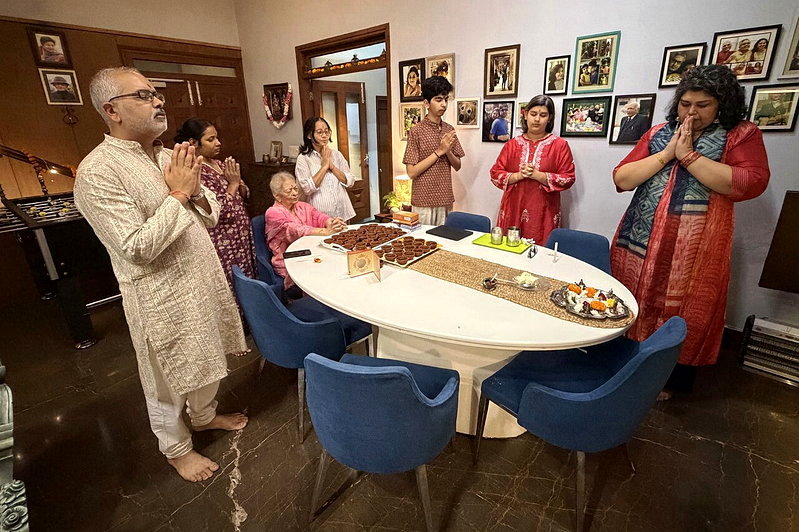
Diwali is a day for Indian people to reunite with their close relatives and friends. The Gandhi family, who lives in Delhi, also invited reporters from China Central News Agency to visit their home for interviews to find out the most authentic Diwali scene.
On Diwali the Gandhi family visited friends and neighbours. They started worshiping after sunset. After the ceremony, they lit several oil lamps and placed them around the house. The adults then went to a nearby temple to pray, while children burst crackers and fireworks to celebrate. Eventually, they gathered to eat and talk late into the night.
Vikas, the male head of the Gandhi family, said in an interview to a reporter of Central News Agency that usually everyone starts celebrating Diwali two or three weeks in advance. “We would meet up with friends, have parties, play cards and give each other gifts.” On the day of Diwali, the focus will turn towards home, especially after sunset, family sacrifices will begin. “Of course, we also get to enjoy great food.”
Gauri, the hostess of the Gandhi family, noted in an interview with a reporter from Central News Agency that the purpose of Diwali is to welcome positive energy, so the series of festivities often begins with cleaning. “By cleaning the house, we remove negative energy and prepare for good times to come.”
He told a reporter from the Central News Agency that during Diwali, everyone would gather with family and friends and exchange gifts. “We may not get a chance to meet some relatives and friends throughout the year, so we will visit especially on Diwali.”
Geli said people would decorate their homes with flowers and “rangoli” during Diwali. After sunset, they would make sacrifices at home and light oil lamps, “pray especially to gods who symbolize wisdom and prosperity.”
Indian Prime Minister Narendra Modi posted on social media today: “This festival of lights reflects our determination to defeat darkness. I wish you all a very happy Diwali. May this festival and the days ahead be filled with happiness, peace and prosperity.”
As India currently faces severe air pollution in winter, and people burst crackers and fireworks to celebrate during Diwali, Delhi was wrapped in dense smog this morning, and visibility was extremely low. Around 8 am the average air quality index (AQI) reached 483, reaching the worst “severe” level.
India’s AQI is divided into six levels to assess air pollution, with 0 to 50 considered “good”, 51 to 100 considered “satisfactory”, 101 to 200 considered “moderate”, 201 to 300 considered “poor”, 301 to 400 considered “very poor”, and 401 to 500 considered “severe”.
The basic meaning of Diwali is “to drive away darkness with light, to defeat evil with good and to defeat ignorance with knowledge.” The date is based on the Indian lunar calendar. The main festival this year falls on the 8th, but there are different activities or celebrations from the 6th to the 10th.