
AI summary
Summary of article:
Following the decline in the US stock market, the selling pressure on AI Concepts shares quickly spread to Asia. The markets of Japan, South Korea, Taiwan and Hong Kong fell simultaneously, and leveraged trading and structured commodities triggered a wave of margin calls.
US stocks Asian brokerage firms and hedge fund managers received calls Friday morning from worried clients after overnight selling. Investors are worried that the selling pressure on artificial intelligence (AI)-related holdings is far from over. from taiwanhong kong There are high-asset clients who have to pay margin because of losses in leveraged transactions. Some clients in Hong Kong have purchased the structured notes. If the stock price falls, they still have to buy the shares at the agreed price. He may lose a lot of money as soon as he takes charge.
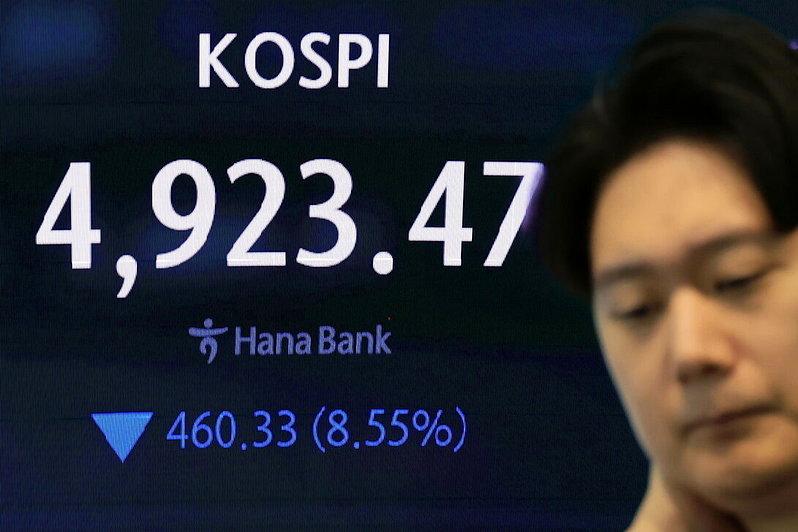
The Nasdaq 100 index fell sharply on Thursday, losing $2.3 trillion in market value, setting a one-day record. Selling pressure spread across Asia on Friday, with the MSCI Asia Pacific index falling as much as 5.3%.south korea The Kospi index once fell 8.8%, triggering the circuit breaker mechanism, and fell 6.1%; The Nikkei 225 index fell 6.4%, and the Taiwan Weighted Stock Price Index fell 1,873.08 points, or 4.5%, to close below 40,000 points.
“I’ve rarely seen anything this extreme since the dot-com bubble,” said Chris McGuire, manager of Eagle View Capital Management’s Japan Convertible Bond Arbitrage Fund. He began options trading on the Chicago Board of Trade (CBOT) in 1991. He said it appears investors have concentrated holdings of the same stocks or shares and are now pulling out at the same time, leading to a one-sided decline not seen in many years.
This wave of violent shocks has caused widespread losses across the hedge fund industry, and even hit big players like ExodusPoint Capital Management and Millennium Management. However, there are also funds that profit from shocks. McGuire estimates the fund he manages is up at least 2.5% so far this month.
Overall, Asian hedge funds performed poorly. Hong Kong-based hedge fund Aspex lost 16% last month as technology stocks tumbled, people familiar with the matter said. Valience Asset Management said in a report to investors that its Long-Short Strategy Main Fund fell 6.7% in October. China’s long-standing quantitative strategy fell more than 10% in October, wiping out all of this year’s gains, a report from China Merchants Futures showed.
Goldman Sachs’ hedge fund brokerage division estimates that funds specializing in Asian stock picking lost an average of 9.4% last month, with returns falling to 14% this year. Funds with mainland China as their main investment market fell 11% in October and their returns have fallen 16% this year.
After the Democratic Party won in both houses of Congress, investors were worried about tightening AI regulations and slowing down the construction of data centers, and they sold technology stocks one after another. In the United States, Samlin Capital, run by Rob Pohly, has downgraded almost all stocks except global financials and started laying off senior analysts. Value Aligned Research Advisors, a hedge fund focusing on AI investing, lost 33% last month.
A source at a Hong Kong brokerage said retail investors have been calling through the night with enquiries, and staff have been working overtime to reassure clients and discuss how to control risks. He said his only advice to customers was to “run if you can.” Customers who use financing should first reduce their leverage. He also said his company began urging clients a few weeks ago to increase collateral on leveraged positions in technology stocks, so the risk of a mass blackout has diminished slightly.
Hiroyuki Ueno, chief strategist at Sumitomo Mitsui Trust Asset Management in Tokyo, said: “People everywhere ask us why AI stocks have fallen. It is also difficult for brokerage clients to explain the current situation to their clients.” He said that short-term investors can react immediately, but it is not so easy for large institutional funds to accommodate.
For many investors in Asia, what they want to know most right now is how far this recession will go. Liquidity in the market has still not diminished, but confidence has disappeared. Traders try to figure out where the stock price might stop falling, but few are willing to conclude that the bottom has been reached.
Hiroshi Namioka, chief strategist and fund manager at T&D Asset Management, said: “From our morning meeting, I think the market is a bit irrational. It’s not completely panicked yet, but it’s difficult for investors to see room for upside.”
Market participants also reported increased volatility in options-related transactions after the stock price fell below key technical levels. Travis Lundy, an independent Hong Kong-based analyst who provides advisory services to hedge funds, believes the decline is likely to force investors to liquidate their positions. He said it appears the poor performance of some funds in October led to liquidation selling pressure in early November, which then led to more selling.
Summary FAQ
-
The main reason for this is that the Nasdaq 100 index fell sharply in a single day. The market has raised concerns about AI regulation, a slowdown in data center investment and a decline in technology stock valuations. Investors immediately withdrew similar stakes after the Asian markets opened.
-
Some clients use financing or purchase structured securities. After the stock price falls, leverage losses increase, and brokerage firms are required to pay margin; If they are unable to repay the amount, they may be forced to reduce their posts or their services may be terminated.
-
Most Asian hedge funds and quantitative strategies suffered significant losses, with some funds falling more than 10% in a single month. The market has also experienced volatility due to pressure from options and liquidation selling, and investors generally find it difficult to decide when to stop a decline.