
AI summary
Summary of article:
Poland’s constitutional court was stormed, where judges were suspended and the president suspended. The President immediately returned to the country for consultations. Anti-government demonstrations also took place outside the court, increasing judicial legitimacy and political party conflict.
poland In the most serious constitutional crisis in recent years, several judges of the Constitutional Court suddenly announced on the 30th that they would suspend their duties as President and Vice President, and a new judge would take charge of the court. Poland’s opposition parties and the presidential palace strongly condemned the move as an “unconstitutional coup”. On the 31st, a large number of protesters gathered outside the Constitutional Court, and Polish President Nowrotski also announced the convening of emergency political consultations.
According to reports from major Polish media, the crisis began on the evening of the 30th. Judge Anna Korwin-Piotrovska cited Article 130 of the “Ordinary Court Organization Act” that governs ordinary judges (a judge can be suspended if his or her behavior seriously harms the dignity of the court), and announced President Bogdan Swiatzkowski and Vice President Bartlomieja Sochanski would be suspended, and that she would take over the running of the court. The grounds for taking office accused the President and Vice Presidents of illegally preventing Congress-elected judges from participating in the Collegium Panel and of deliberately delaying the convening of the Plenary Session of the Justices.
However, whether Constitutional Court judges could apply general court rules in all regions to suspend the president immediately triggered a fierce confrontation in legal circles and between the government and opposition over the “legality of the application of legal provisions.” At the same time, Prosecutor General Waldemar Zurek submitted five applications to the Constitutional Court with the intention of revoking the judicial immunity of the President and Vice Presidents and pursuing criminal liability.
The root cause of this constitutional storm comes from the deep connection between the Constitutional Court and party politics under the Polish system. According to the Polish Constitution, all 15 judges of the Constitutional Court are elected by the lower house of parliament (Sejm) and require only majority approval. This means that whenever political parties change, the ruling coalition can use its majority in Congress to appoint judges with similar positions.
The former ruling party, the Law and Justice Party (PiS), controlled the National Assembly from 2015 to 2023, chose the vast majority of constitutional judges and controlled the position of president. After the current ruling coalition led by Prime Minister Donald Tusk came to power, it accused the court of becoming a political stronghold of the Law and Justice Party to block government bills, so it used its majority in Congress to elect new judges in an attempt to take power.
However, President Karol Nawrocki, from the pro-“Legal and Justice Party” camp, refused to swear in the new judge and the new judge forcibly suspended the old president with the support of Congress. The old President and the Presidential Palace argued that the oath administered by the Speaker of the National Assembly was “invalid and unconstitutional” and therefore the new judge’s position was not recognized. The new judges and the ruling coalition say Congress is the authority that elects judges on behalf of public opinion. When the President interrupts the process without cause, the oath taken by Congress is legal.
The Tusk-led ruling coalition stressed that the move was necessary to break the previous monopoly and restore the rule of law in the country; However, the opposition “Pilot Party” and the Presidential Palace criticized the government for violating constitutional law.
Navrotsky, who was originally traveling to Senegal, immediately interrupted his trip to return home. He forcibly entered the Constitutional Court at 1 pm on the 31st, during which he also physically pushed the new acting President. The Rashtrapati Bhavan office later announced at 5 am that the President would hold an emergency political consultation at Rashtrapati Bhavan.
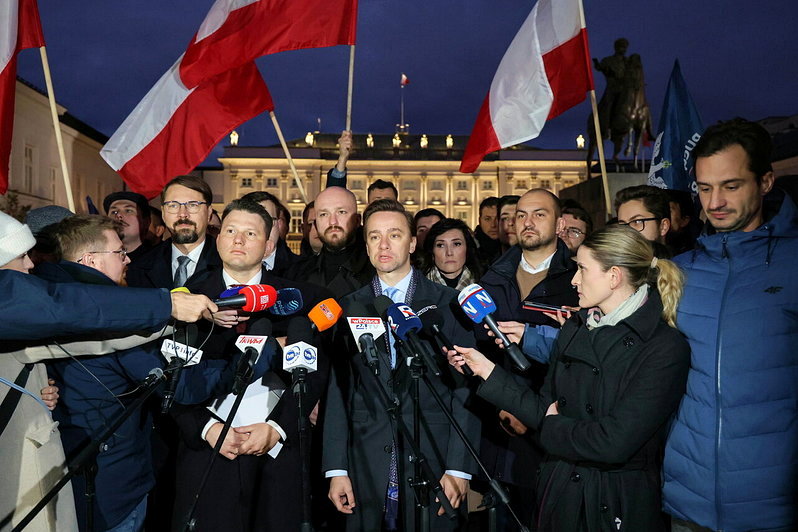
On the 31st, a large number of protesters gathered at the Constitutional Court to protest, carrying national flags and slogans such as “unconstitutional coup” (zmach staunu), “down with communism” (prz z kommuna), and accused the Tusk government of forcibly occupying the Constitutional Court, which was as authoritarian as previous communist governments. The atmosphere at the incident site was very tense.
At present the political game between the government and the opposition has shifted to Rashtrapati Bhavan. Some party leaders have called for a “political restructuring” of the Constitutional Court from the ruling and opposition parties, but the leftist camp within the ruling coalition has made clear that it refuses to participate in the consultations.
This political storm, which combines judicial and legal battles, top-level political confrontations and road safety, is severely testing Poland’s democratic system.
Summary FAQ
-
The trigger was the sudden announcement by several judges of the Constitutional Court on the evening of the 30th that they would suspend the President and Vice Presidents and let new judges take charge of the court. It was immediately criticized as an unconstitutional coup by opposition parties and the presidential office, and the conflict quickly escalated.
-
Navrotsky immediately halted his trip to Senegal and returned home. He entered the Constitutional Court on the morning of the 31st and announced an emergency political consultation at the Presidential Palace in an effort to coordinate with all parties on the crisis.
-
The main differences of opinion are over whether the new judges have legitimacy and whether a Constitutional Court judge can apply ordinary court rules to suspend the president. The ruling coalition says the congressional election is legitimate, while opposition parties and the president’s office believe the process is unconstitutional.