
AI summary
Summary of article:
During the Taipei mayoral debate, Chiang Wannan countered Shen Boyang’s aggressive issue with pragmatic municipal administration, and questioned his empty slogans and governance abilities; However, Chiang was also told that governance needed to be more detailed and a complete and implementable blueprint should be drawn up.
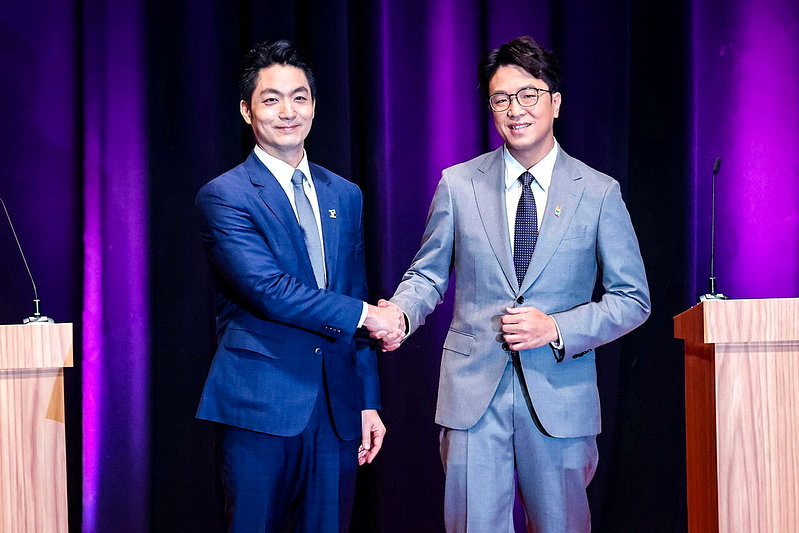
The first TV debate of the Taipei mayor election, blue and green coachesxiang wannan Andshen boyang Head-on collision. The greatest significance of this debate is not just rhetoric, but more importantly, who can truly answer the questions of Taipei citizens. This is an election based on hollow slogans and governance courage. Shen Boyang emphasized “citizenship”, Jiang Wannan emphasized “municipality priority”, and Shen was embroiled in old issues such as child abuse, tree cutting, and food security. Jiang replied, “The whole way is towards the Ming Dynasty, and there is no half step towards the sky.” One sentence brought the empty sea stream back to its original shape.
At the beginning, Shen Boyang listed child abuse, tree cutting, nutritious lunch and other issues as his top priorities in the first 100 days after taking office, emphasizing dedicated responsibilities, dedicated laws, dedicated funds, and professionalism. These are indeed issues of public concern, but raising problems does not mean solving them. Many of Shane’s ideas are out of reach if they are not implemented now. How to allocate teachers and social workers? How to strike a balance between tree conservation and urban construction? Shen Boyang shouted so loudly that Du Geng and “Two Mentors” were just a test project. No wonder Jiang Wannan had acid reflux. Shen often said, “The journey back to Mingming is complete, and there is no half step to the sky.” He talked about many empty slogans, but could not give any specific method.
After two days of soliloquy, Jiang Wannan made a clear call for counter-attack during this debate, turning passive defense into active attack. Regarding the Green camp’s criticism of “Ask A and B”, Chiang replied that Shen “read and answered haphazardly.” From general recollection, Twin Cities Forum, abolition stance, universal cash payment to dual patron policy, he examined Shen Boyang’s changes in his past and previous positions one by one. These questions seem to belong to different fields, but they point to the same origin. Is Shen able to transform from a legislator who is good at political offense and defense, into a mayor of Taipei who can rule the capital?
On the surface, the sea currents seem powerful, but Jiang Wannan “uses the ground to fight against the air force and uses practicality to expose the hollowness.” When facing municipal torture from the current mayor, Shen often does not answer the question directly, but turns one question into another, and then puts the responsibility on the system or other links. That means more questions arise and answers never emerge. You can talk endlessly in an argument, but that doesn’t mean you have the ability to solve problems. The current trend of sound is faster than that of action, which is both an advantage and a hindrance.
Ever since Shen Boyang contested elections, he has been the best at framing issues, preparing the battlefield, and turning the election campaign into a clash between ideas and values. The “ocean current” political propaganda is endless, but most of it is election gimmicks. Taipei citizens do not need political actors, let alone candidates who can only raise questions but not give answers.
The electoral dilemma Chiang Wannan now faces is that his rule over the past four years has not been careful enough. Even with achievements like Fresh Milk, Huida and Dome, the citizens of Taipei, whose standards have always been high, cannot be satisfied. The rulers cannot ask citizens to accept everything just because of the achievements they have made in four years. In addition to cracking down on the empty slogans of challengers, Jiang Wannan should also listen to citizens’ dissatisfaction and expectations and launch a complete and implementable policy blueprint.
What really stood out in this debate was not the difference in rhetoric between the two, but the distance between the politicians and the mayor of the capital. Shen Boyang wanted to use “citizenism” to prove that he is on the side of the citizens, while Jiang Wannan used “municipal priority” to remind voters that the mayor’s job is not always to stand in front of the microphone, but to solve problems. Shen Boyang immediately invited the debate for the second time, undoubtedly to gain the opportunity to “pass the exam.”
There is no shortage of political commentators in Taipei City, but there is a shortage of people implementing policies. No matter how powerful Shen Boyang’s momentum is, if he is unable to raise questions on policy details, it will only be his political voice, not his governing ability. This straightforward debate at least made it clear to voters that ocean currents can create waves, but they cannot use waves as political achievements; The capital election is not about who shouts the loudest, but who can actually walk the talk.
Summary FAQ
-
The main focus is not just a competition of oratory, but who can truly answer the governance questions of Taipei citizens. The article believes that this election campaign is a test of empty slogans and real governance abilities, especially whether the mayor can come up with implementable solutions.
-
Shen Boyang focuses on issues such as child abuse, tree cutting, nutritious lunches and dual advice, emphasizing dedicated responsibility, dedicated laws, dedicated funds and professionalism. However, the article believes that most of the ideas are either current policies or difficult to implement immediately, and remain at the level of slogans.
-
Chiang Wannan countered Shen Boyang with municipal priorities and specific examples, and questioned his stance changes and policy details, highlighting the difference between pragmatism and hollowness; However, the article also reminded that although Chiang had political achievements, he still needed to fully listen to public opinion and strengthen his policy framework.