
AI summary
Summary of article:
As the CCP strengthens political loyalty assessments, scholars are concerned that accountability pressures will cause officials to become more conservative, resulting in passive obedience and passivity, which will affect the 15th Five-Year Plan, domestic demand adjustment, and military deployment against Taiwan.
Communist Party of China The fifth plenary session of the 20th Central Committee of the Communist Party of China ended last week. Taiwanese scholar Chen Jianfu said on the 2nd that political loyalty will become an important evaluation basis for the selection and promotion of CCP cadres in the next stage. However, in the event of local financial problems and economic downturn, officials may adopt a “do more and make more mistakes, do less and make fewer mistakes” mentality. On the surface, they follow the instructions of the central government, but in reality they are inactive and passive, which may pose a challenge to the promotion of the “15th Five-Year Plan” in the future.
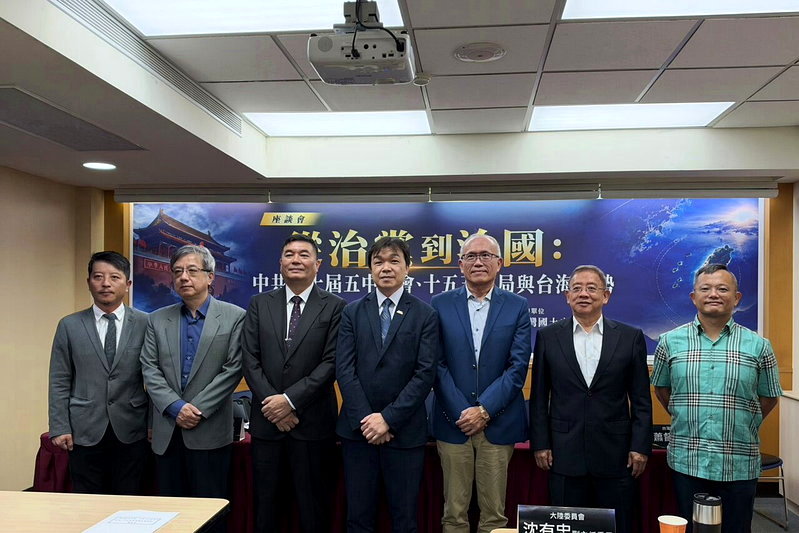
Taiwan Homeland Security Society held a symposium on the 2nd on the topic “From Party Governance to Country Governance: The Fifth Plenary Session of the 20th Central Committee of the Communist Party of China, the 15th Five-Year Plan and the Situation in the Taiwan Strait”, inviting many experts and scholars to discuss it.
Chen Jianfu, director of the Center for Mainland China Studies at Tamkang University, said,Xi Jinping Since assuming office 14 years ago, he has continuously emphasized anti-corruption. This Fifth Plenary Session of the Central Committee of the Communist Party of China also took the “two-faced people” within the Party as an important target of criticism. He believes that some central and local officials superficially follow the instructions of the central government, but do not actively implement them. Continued attention should be paid to how political loyalty will form the basis of evaluation for cadre selection and promotion in the future.
Chen Jianfu said that in the face of local financial problems and economic downturn, local officials may appear to be “active and obedient on the surface, but passive and inactive in reality.” He said that while Xi Jinping is trying his best to consolidate power, his governance ability is facing a big test. In the future, whether middle and lower-level officials will not actively promote policies to avoid responsibility will be the long-term test of the highly centralized political system.
Xiao Duquan, an adjunct assistant professor of the Department of Political Science at Culture University, said that according to data from the Central Commission for Discipline Inspection, a total of 119,418 cases of “irresponsibility, inaction, random acts and false acts” were investigated and dealt with in 2025, accounting for 84.7% of the problems caused by formalism and bureaucracy were investigated and dealt with. He believes that as central supervision and accountability become more strict, middle and lower-level officials may adopt more avoidance strategies to avoid responsibility.
Xiao Duhuan said that this kind of “passive obedience” will become an important institutional obstacle in the policy planning of the 15th Five-Year Plan in the future. Whether it is self-reliance in science and technology, new productivity or expanding domestic demand, local authorities need to exercise professional judgment and policy flexibility and take some risks. He described the governance paradox that comes with administering the party comprehensively and strictly, saying, “It can be controlled, but can it be organized?” The key point is whether appropriate institutional incentives can be established.
Liu Mengjun, director of the First Institute of the Chinese Academy of Economics, noted that the party’s strict rule this time emphasizes discipline, but “it is using the whip and not the carrot.” He explained that under the pressure of accountability, cadres may choose to “ask for instructions on everything and defer decision making”. Banks and state-owned enterprises also select investment projects that are easy to explain and consistent with central strategic goals. They lack real cost assessment and are prone to duplication of investment.
Liu Mengjun further said that the most important issue in mainland China is the rebalancing of domestic demand, but policies still focus on the supply side and industrial upgrading. With unstable employment, aging population and uncertainty about future income, people increase savings and the pace of consumption remains inadequate. The imbalance in domestic demand has further translated into global economic and trade problems. His view on whether internal and external economic imbalances can be improved during the 15th Five-Year Plan period is relatively pessimistic.
Guo Ruihua, a special researcher of “Prospect and Exploration” magazine, believes that the focus of this Fifth Plenary Session should not only be on the personnel crisis, but also make a decision on how to operate the Party comprehensively and strictly. He pointed out that the CCP is transforming the previous “campaign-style purification” into a normalized and institutionalized political loyalty evaluation system with a campaign nature.
Regarding the purification of the People’s Liberation Army, Guo Ruihua said that political credibility may prevail over military professionalism, resulting in the phenomenon of “more red than professional”, resulting in “more and more modern equipment, but increasingly deprofessional command levels.” He believes that the People’s Liberation Army’s large-scale cross-sea joint landing operation capability may be affected by the purge, but led by political loyalty, low-range gray zone operations against Taiwan can be more intensive.
Wu Sezhi, an assistant professor at Taipei University of Marine Science and Technology, also said that Xi Jinping’s continued purge of the military shows that his sense of security in the military is still being rebuilt. The contradiction between political loyalty and military professionalism may further affect the quality of the PLA’s overall operations and strategic decision-making. He stressed that just because the CCP continues internal purges does not mean Beijing will focus on internal affairs and reduce the military threat to Taiwan. What really needs to be seen is how Xi Jinping’s concentration of power affects military strategy and policies towards Taiwan.
Summary FAQ
-
The report notes that the CCP will place greater emphasis on political loyalty in the next phase, and will include anti-corruption and the identification of “two-faced people” as key evaluation criteria for cadre selection and promotion, suggesting that loyalty is being institutionalized.
-
Because local fiscal pressure is high and the economy continues to decline, officials may choose to be obedient on the surface and conservative in behavior under high-pressure accountability to avoid taking risks, which ultimately reduces the efficiency of policy implementation.
-
Scholars believe that lack of proper incentives may hamper the dissemination of the 15th Five Year Plan policy; In the military, there may be a situation where red is more important than professional, and professional is more suppressed by loyalty, which will affect the quality of operations, and gray zone operations will become more common.