
AI summary
Summary of article:
Suu Kyi pointed out on the Cross-Strait Peace Initiative that there is a heightened sense of urgency for reunification in Beijing, and that the United States is having difficulty intervening in Taiwan due to internal strife. Therefore, he advocated resumption of talks between the two sides to avoid war.
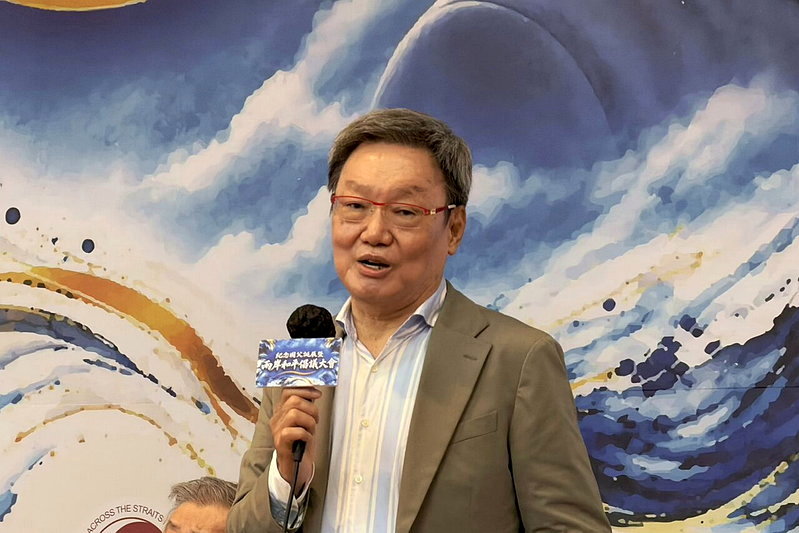
Su Qi, former Secretary-General of Taiwan’s National Security Council, said on the 12th that he learned from the President of Mainland ChinaXi Jinping During the conversation in August this year, I felt Beijing’s “increasing sense of urgency” on the reunification issue. On whether the mainland will use force against Taiwan in 2027 or 2028, he admitted that he does not know, but he believes that the internal political conflict in the United States will intensify and “the United States will definitely not be able to control Taiwan in the next two years.”
The “Cross-Strait Peace Initiative” jointly promoted by former examination dean Guan Zhong and former legislator Ding Shaozhong held a Cross-Strait Peace Initiative conference in Taipei on the morning of the 12th in celebration of the Father of the Nation’s birthday, and invited the former Legislative Yuan.Wang Jinping Former acting chairman Chen Chong and several former national security and diplomatic officials attended.
Su Qi said at the meeting that he had written an article as early as 2014 and pointed out that Taiwan had only three choices: “Fight, pull, and peace.” Among them, “fighting and dragging out are both dead ends” because “‘procrastination’ will always drag on until it can no longer be delayed, and ‘peace’ is the only way to survive.” He said that he was like a crow at that time, who was continuously warning, but still could not convince many people.
When talking about whether the United States would help defend Taiwan, Suu Kyi used the recent war in Iran as an example to question the US military’s combat capabilities and military production capacity. He believes that Iran is only a medium-sized country that the United States can no longer confront. If it faces mainland China, which is much stronger than Iran in East Asia, the United States will not be able to easily intervene. He said the Taiwanese people’s expectations of the United States sending troops to assist in defense should be adjusted, “so everyone should no longer take the American factor to heart.”
As for whether mainland China can use force against Taiwan? Su Qi noted that Jiang Zemin’s discussion of “reunification of the motherland” and “national rejuvenation” was quoted in Xi Jinping’s speech at a meeting to commemorate Jiang Zemin’s 100th birthday on August 17 this year. He pointed out that in the past, the mainland had emphasized reunification in the process of national rejuvenation, but he believed that the message conveyed in this dialogue was different, “unification first, rejuvenation later.”
Su Qi insisted, “This is completely different from before.” This is the first time since the mainland’s reform and opening-up in 1978 that reunification of the motherland has been placed before national rejuvenation. “This sense of urgency is very clear.”
Su Qi further pointed out that the current members of the Standing Committee of the Political Bureau of the Communist Party of China are a group of people who know Taiwan best in history, including Li Qiang, Cai Qi and Wang Huning. They have all been to Taiwan. Cai Qi also wrote a diary after returning to the mainland and left a very good impression of Taiwan. But he believes that because these people understand Taiwan, they have more responsibility and pressure on Taiwan policy.
He said if the DPP wins consecutively in this year’s local elections and the 2028 presidential election, internal pressure on Beijing’s leadership could increase further. With the recent addition of the Japanese factor, “One United States is not enough, and now the Japanese factor has been added,” Beijing’s sense of urgency regarding the Taiwan issue is increasing.
On the other hand, Su Qi believes that the internal political conflict in the United States is increasing, and in the future both the Democratic and Republican parties will face competition for political power. “The United States will definitely not be able to control Taiwan in the next two years.” He described, “Not only are the legs of the big brother of the United States weak, but his eyes have not even seen you in Taiwan.”
Su Qi finally emphasized that launching the Cross-Strait Peace Initiative is to let the Taiwanese people and the international community understand the dangers of the current situation. He reiterated that “Internal and external fighting is a stalemate, and only internal and external peace is the way to survive and save Taiwan.” He called on both sides of the Taiwan Strait to resume dialogue and avoid conflict.
Summary FAQ
-
He interpreted the new order of “unification first, rejuvenation later” from Xi Jinping’s speech in August. He believed this was different from previous discussions and showed that Beijing puts unification more at the forefront and exerts more pronounced policy pressure on Taiwan.
-
He believes that the internal political conflict between the Democratic and Republican parties in the United States will continue to increase, weakening its ability to pay attention to and take action on the outside world. Therefore, the United States will be almost unable to deal with the Taiwan issue in the next two years.
-
He stressed that amid Taiwan’s “struggle, delay and peace”, only “peace” is the way to survive, and called on both sides of the Taiwan Strait to resume dialogue, de-escalate confrontation, and avoid conflict under external pressure and internal confrontation.