
AI summary
Summary of article:
China’s Lijian-2 Yao-2 rocket was successfully launched, sending 18 satellites into predetermined orbits and carrying out large-scale satellite network construction, demonstrating the separation mechanism, mass production and recovery technology layout for the first time.
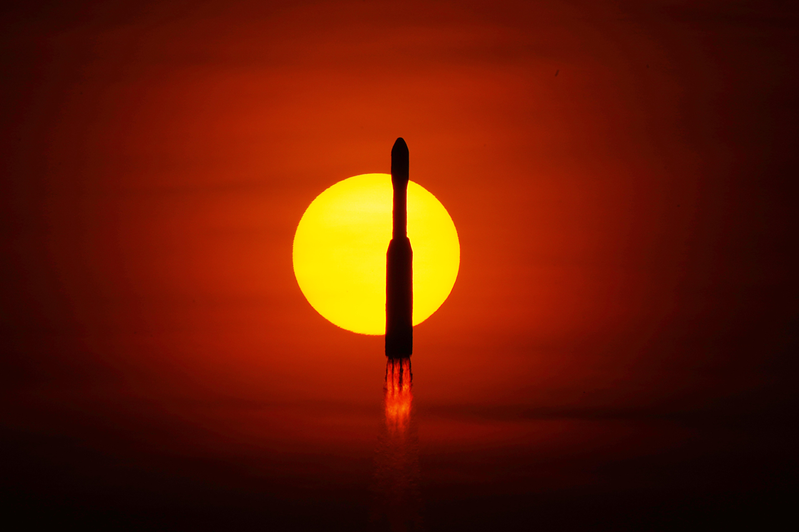
China’s Lijian-2 launches Yao-2rocket The launch on the 3rd was successful, with 18 satellites successfully sent into predetermined orbits. This was also the first time that Legion 2 carried out a large-scale satellite network mission.
According to China AerospaceWeChat According to public account news, the Lijian-2 Yao-2 carrier rocket was launched from the Dongfeng Commercial Aerospace Innovation Test Zone at 8:15 am on the 3rd, and successfully sent a total of 18 satellites from the Qianfan Polar Orbiter Group 21 into the predetermined orbit. The flight test mission was successful.
China Aerospace Science and Technology Corporation reported that Legion-2 is its independently developed liquid launch vehicle and China’s first launch vehicle to adopt the “universal booster core” configuration. It has a payload capacity of 8 tonnes to a 500 km Sun-synchronous orbit and 12 tonnes to a 200 km low-Earth orbit. In this mission, for the first time, the multi-star rocket inter-satellite separation mechanism unlocking device developed by China Aerospace was applied to Legion 2, which successfully completed the systematic and accurate separation of multiple satellites.
China Science and Technology Aerospace noted that the device has completed more than ten flight verifications on multiple types of launch vehicles and has the advantages of stable performance and easy operation. At the same time, through the mass production of all-rocket products and the rolling backup mode, the single-engine rocket product preparation cycle is shortened by one-third, and through the launch site process optimization, the rocket test and launch cycle is shortened by one-fourth.
Zhang Yanrui, deputy chief designer of the Lijian-2 launch vehicle, said that according to the traditional separation method, the 18 satellites would have to be unlocked one by one and then bounced off one by one. The feature of this separation device is that 18 satellites are placed together, and all satellites only need to be unlocked once. He explained that the original separation was equivalent to throwing a shot put 18 times, but now it is throwing 18 hammer balls at a time. Its advantage is that it has less mechanism, less links and light weight.
China Aerospace Science and Technology Corporation said that Legion 2 is currently promoting cluster recovery technology research. According to a report by China Business News, China Aerospace Corporation plans to use the Lihong 2 reusable launch vehicle to conduct suborbital 100-kilometer recovery verification in the first quarter of 2027, and then apply relevant technologies to Lihong 2 to boost the rocket’s recycling and reuse capabilities.
Summary FAQ
-
The Lijian-2 Yao-2 launch vehicle took off from the Dongfeng Commercial Aerospace Innovation Test Zone at 8:15 am on the 3rd, and successfully sent 18 Qianfan Polar Orbit 21 satellites into the predetermined orbit, and the flight test mission was successfully completed.
-
This is because this is the first time that Legion 2 has carried out a large-scale satellite network networking mission, and it is also the first time to use the multi-star rocket inter-satellite separation mechanism unlocking device, so that multiple satellites can be unlocked at one time and accurately separated in sequence.
-
China Aerospace Corporation said it is promoting cluster recovery technology research and plans to first conduct a suborbital 100-kilometer-scale recovery verification on Lihong 2 in the first quarter of 2027, and then gradually apply relevant technologies to Lijian 2.