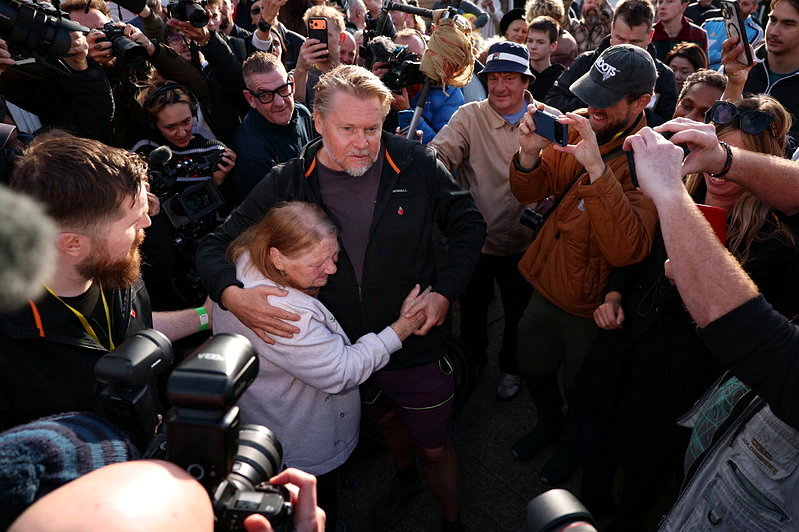

On November 2, local time, British explorer Carl Bushby returned to his hometown of Hull, and officially ended his 28-year round-the-world expedition, bringing an end to this ultra-long journey.
Bushby in 1998chile At the beginning of the journey, we adhered to the principle of zero motorized transport throughout the journey and relied only on walking and swimming to pursue the journey, with a total mileage of 31,000 miles. Reuters reported that the trip spanned South America, North America, Asia and Europe. He passed through forests, deserts and polar ice sheets, stepped on the ice of the Bering Strait, and successively crossed the Caspian Sea and the English Channel, completing the transcontinental and cross-border journey by pure human means.
Bushby, 57, once served in the British Airborne Corps. He originally planned to complete the entire process in ten years, but it was significantly delayed due to various emergencies. During the trip he faced dangerous conditions such as gun threats and short-term detention abroad. Due to several hurdles like cumbersome visa approvals, financial crisis and the COVID-19 pandemic, the journey was halted several times. Over the course of 28 years, he actually traveled on foot for about 15 years, and the remaining time was mainly used to complete procedures, move supplies, and coordinate cross-border passage.
British media commented that the expedition was not only an extreme challenge to the natural environment, but also consumed too much energy to deal with complex geo-administrative and cross-border traffic problems.
On the same day, hundreds of people gathered in the streets of Hull to welcome Bushby’s return and witness the end of this rare long-term personal global exploration.