
AI summary
Summary of article:
Selling pressure in global stock markets eased slightly, and US stock futures and Korean equities rose. However, concerns about AI investment have not gone away, and the market will still face many tests such as the US midterm elections, corporate financial reports, and employment data.
Selling pressure on global stock markets eased slightly in early trading on Monday, with Asian shares falling compared with last Friday.US stocks Modestly, US stock futures also improved. However, concerns about the slowdown of the tech giant industry and the increase in AI spending have not gone away. This week, United Statesmidterm elections Corporate financial reports and employment data will still test market confidence.
S&P 500 and Nasdaq 100 futures both rose at least 0.4% on Monday. Japanese and Australian stock markets fell,south korea The composite stock price index recovered its early losses and gained 1.4%. The Nasdaq 100 index fell 3.5% last Friday, its biggest one-day decline since June, and the Philadelphia Semiconductor Index fell even more, 7.2%.
Last Friday, the Chicago Board Options Exchange Volatility Index (VIX) reached its highest intraday level since April. The demand for puts to prevent further decline in stock prices also increased significantly, and individual stock trends became more consistent, reflecting increasing market uneasiness. However, these indicators are still well below the levels following the US and Israeli attacks on Iran in March.
Some investors have also started looking for buying points. Mike Wilson, chief strategist for US equities at Morgan Stanley, believes the stock market could temporarily fall due to the next few events. Once the risks become clear one by one, they will bring opportunities to increase investment.
Florian Ilpo, general research director of Longao Investment Management, believes that this wave of trends is more like the rotation of funds in a bull market, which is more likely to lead to a decline in valuations, rather than a decline in the overall market.
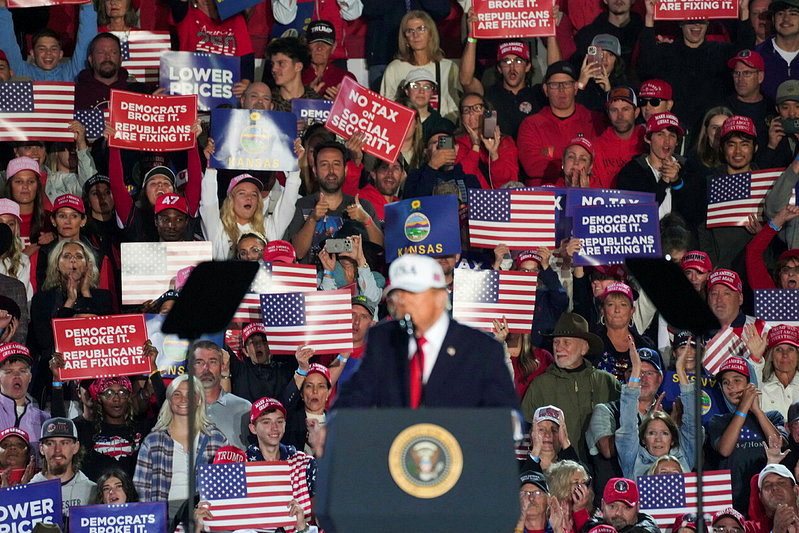
The United States holds midterm elections on Tuesday, and the results will affect Trump’s ability to push bills through the second half of his term. This could also create a situation where the White House and Congress would be controlled by different parties, making it difficult to advance policies.
Steve Englander, co-head of foreign exchange research and head of North American holistic strategy at Standard Chartered Bank, believes the market may be happiest seeing this stalemate. He told that the Democratic Party has a chance to easily win the House of Representatives and the Senate elections are very close. When he updated the report over the weekend, he said the prediction market believed the chances of the Democratic Party winning both houses at the same time reached 70% or more.
He believes that if the Democrats win big, especially if their policies are clearly left-leaning, it could dampen economic growth expectations and weaken the US dollar; If Republicans unexpectedly retain both houses, it could send government bond yields and the US dollar higher.
Data from the University of Florida Elections Lab showed that as of Sunday afternoon, more than 54.3 million people had voted early, 8.4 million more than in the 2022 midterm elections.
Brent crude oil fell 1.5% to about $111.71 a barrel on Monday, despite reports of another attack on ships near the Strait of Hormuz; West Texas crude fell about 1.5% to $102.40 Sunday night.
Gold prices rose 0.7% to about $3,900 an ounce after Friday’s close fell to the lowest level in more than a year. Bitcoin has risen for three consecutive days, slowly recovering from the fall caused by the Binance hack. Binance saw a net outflow of $3.6 billion from crypto assets after withdrawals resumed on Sunday, but the company said outflows had slowed after an initial peak.
Summary FAQ
-
Although US stock futures and some Asian stock markets have risen, concerns about the slowdown of technology giants’ own industries and increased AI spending still remain, and the Nasdaq 100 and Fees fell sharply last Friday, indicating that risk-on sentiment has not yet been fully restored.
-
Markets generally prefer a stalemate in which the government and Congress are from different parties, as it is difficult to significantly advance policies. Democratic victory could weigh on growth expectations and the US dollar; If Republicans unexpectedly retain both houses, it could send yields and the US dollar higher.
-
Corporate financial reports and employment data will be released this week. Additionally, fluctuations in oil prices, gold prices and crypto assets also reflect risk aversion. These factors can influence the market’s judgment on economic prospects and risky assets.