
AI summary
Summary of article:
Egg pancake has become a common breakfast in Taiwan due to the pasta culture brought by post-war immigrants after 1949 and the development of Taiwan’s pasta industry with American aid of wheat and flour after the Korean War.
Egg pancakes are now common in TaiwanBreakfast But there’s a paragraph behind itmigrant History related to Cold War. After 1949, immigrants brought pasta culture. After the outbreak of the Korean War, the United States provided flour and wheat aid, which boosted Taiwan’s flour industry and the popularity of pasta and changed Taiwan’s eating habits.
National Public Radio (NPR) reported that Chen Yuzhen, a food historian at Normal University, said that wheat-based dishes such as egg pancakes were very popular in China in 1949, when the Kuomintang lost the civil war between the Kuomintang and the Communist Party.Communist Party Before the retreat in Taiwan, it was actually not common in Taiwan.
At that time, about 2 million people crossed the sea from mainland China to Taiwan, bringing with them a completely different food tradition from Taiwan.
Chen Yuzhen pointed out: “They are good at making pasta. It was this group of post-war immigrants who gradually popularized pasta such as egg pancake.”
But historically speaking, due to climate and other factors, Taiwan’s wheat production is actually not large. But Chen Yihong, a researcher at the National Taiwan Museum of History, said the key to changing all this was the Cold War.
As the Communist Party took over mainland China and the Korean War broke out in 1950, Washington suddenly regarded Taiwan as an outpost to prevent the spread of communism. The US military immediately moved in and delivered large quantities of aid supplies to Taiwan, including sacks of wheat and flour.
Chen Yihong said: “At the beginning, Taiwan first received flour aided by the United States, and then wheat, resulting in the domestic flour grinding industry.”
The scale of American aid supplies at that time was so large that some bags of flour were even turned into clothing. The museum displays shirts and underwear sewn for children using leftover fabric from these flour bags distributed throughout Taiwan.
Standing in front of the exhibition, Chen Yihong said: “Taiwan’s situation has become more critical. In order to maintain the so-called anti-communist system, Taiwan’s political, economic and military situation must remain stable, so assistance is needed.”
Taiwan has also jointly established with the United States the Taiwan Noodle Food Promotion Executive Committee, dedicated to informing and promoting the preparation methods of various noodle dishes to the Taiwanese public.
With the popularity of new noodle dishes, Taiwan has been able to resell the rice it used to supply the domestic population to the international market. On the other hand, the United States also reduces the problem of domestic wheat overproduction by exporting wheat to Taiwan.
Caught between competing interests between the United States and China, the island has long been shaped by a history of immigration and power politics. And all of this is reflected in Taiwan’s favorite local dish, the egg pancake.
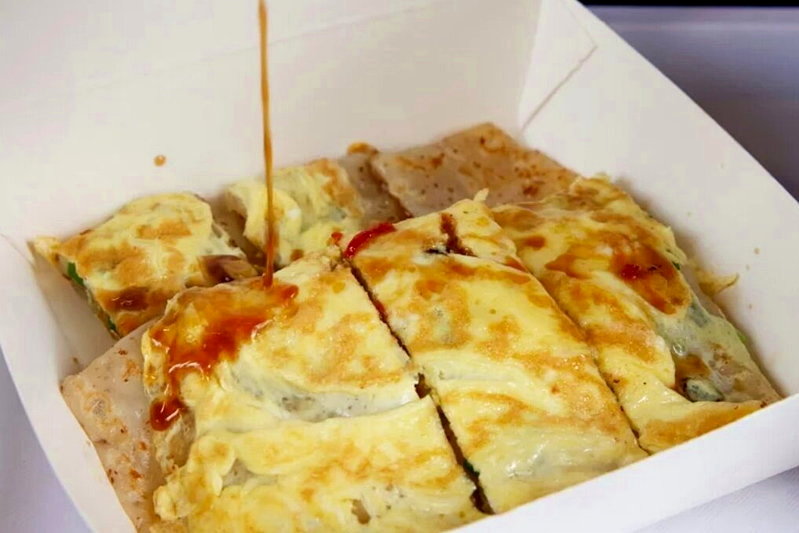
Nowadays, egg pancake has become a common dish on Taiwanese breakfast tables.
Summary FAQ
-
Because Taiwanese immigrants brought pasta-making technology to Taiwan in 1949, and after the war, large amounts of American-aided flour and wheat entered Taiwan, causing pasta to gradually transform from a minority dish into a national breakfast.
-
After the Communist Party occupied mainland China and the outbreak of the Korean War, the United States regarded Taiwan as an anti-Communist outpost, and immediately imported large amounts of wheat and flour, and promoted the beginning of the domestic flour milling industry.
-
Taiwan and the United States jointly established the Taiwan Noodle Food Promotion Executive Committee to promote noodles among the public, make different types of noodles more popular, and indirectly change Taiwan’s dietary structure.