
AI summary
Summary of article:
TVBS’s post-debate polls show that the race for mayor of Taipei has entered a fierce battle, with Chiang Wannan currently on top with 46% support, but Shen Boyang gaining more recognition among the debate show and viewing community.
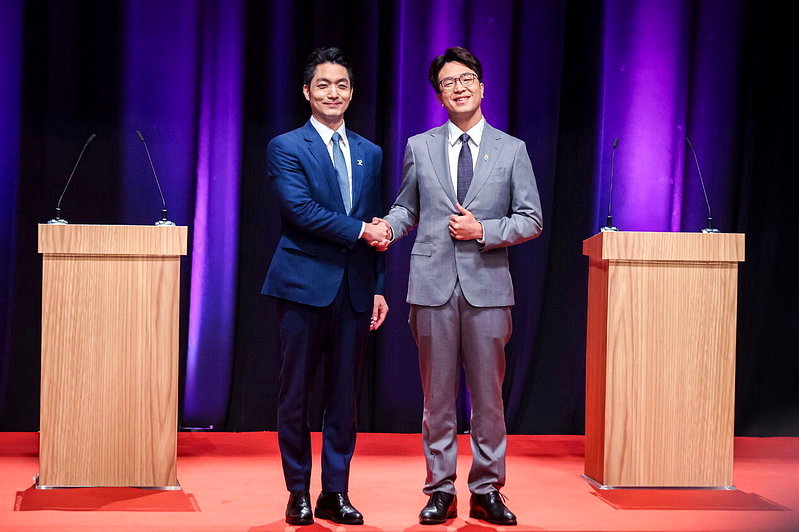
TVBS, one of the organizers, televised the debate of the Taipei mayoral candidates on the 31stvoting The Center released a survey immediately after the debate, asking whether they had watched the debate on TV or not, who would they vote for tomorrow? Citizens of Taipei who wish to vote,xiang wannan Got 46% support,shen boyang It was 42%. The gap between the two sides narrowed from 8 percentage points in early October to 4 percentage points. The fight was quite fierce. For debate performance evaluation, Shen Boyang received more recognition.
According to TVBS, the latest survey results show that 93% of Taipei citizens said they will vote, of which 80% will definitely and 13% will probably vote. Only 5% said they would not vote. After the debate the desire to vote increased further. Among Taipei citizens willing to vote, Chiang Wannan’s support is at 46%, and Shen Boyang’s support is at 42%. The gap between the two parties has shrunk to 4 percentage points from 28 percentage points at the end of May and 8 percentage points at the beginning of October. Another 12% have not yet decided whom to support. The election situation has reached a very tense state.
The survey also showed that cross-analysis showed that the TV debate would have a significant impact on voters’ voting intentions: among voters who watched the TV debate, Shen Boyang’s support reached 52%, higher than Jiang Wanyan’s 41%. The gap between the two sides was 11 percentage points, and only 7% were undecided. Among voters who did not watch, Jiang Wanyan’s support reached 54%, significantly higher than Shen Boyang’s 27%, and 20% were undecided.
In addition, regarding the performance evaluation of the TV debate, 47% of Taipei citizens thought Shen Boyang’s performance was better, 40% thought Jiang Wannan’s performance was better, and Shen Boyang was slightly higher by 7 percentage points, and 13% said they did not know or had no opinion. Compared with the survey before the debate (October 12), the proportion of those who believed Jiang Wannan would perform better increased by 10 percentage points (from 30% to 40%), and the proportion of those who believed Shen Boyang would perform better also increased by 6 percentage points (from 41% to 47%). The rate of not expressing an opinion dropped sharply from 30% to 13%, indicating that the majority of citizens made a clear assessment after watching the debate.
In terms of political party orientation, 90% of those who identify with the Kuomintang believe that Jiang Wannan has performed well, 88% of those who identify with the Democratic Progressive Party endorse Shen Boyang, and 82% of those who identify with the People’s Party believe that Jiang Wannan has performed well. It is worth noting that among neutral voters, 44% believe that Shen Boyang has performed well, which is higher than Jiang Wannan’s 24%, and 32% have no opinion.
In the latest support structure, among young voters aged 20 to 29, Shen Boyang leads Jiang Wannan with 48% and 40%; Jiang Wannan, aged 30 to 39, has the support of 51% and Shen Boyang has the support of 42%; Jiang Wannan, aged 40 to 49, has the support of 42%. 46% and Shen Boyang 43%; 50 to 59 year olds Jiang Wannan 50% and Shen Boyang 42%; Jiang Wannan, aged 60 to 69, is ahead of Shen Boyang with 48% and 42%; There is even more of a pull among those over 70, 40% versus 39%.
Furthermore, in terms of candidate preference, both candidates’ preference increased after the debate. Liking of Jiang Wanyan increased from 49% to 55% in early October, while dislike decreased slightly to 31%, and 14% had no opinion. Shen Boyang’s liking also increased by 5 percentage points, from 44% to 49%, dislike decreased slightly to 35%, and 16% had no opinion. The favorability ratings of both parties remain positive and the gap is not large, indicating that this direct debate will make the image and characteristics of both parties more distinct in the minds of voters.
According to TVBS, the polling station mobilized 98 interviewers to conduct interviews immediately after the debate. As of 6 p.m., a total of 1,747 valid samples from Taipei citizens had been completed. At the 95% confidence level, the sampling error was within ±2.3 percentage points.
Summary FAQ
-
Among Taipei citizens willing to vote, Chiang Wan’an’s support is at 46%, while Shen Boyang’s is at 42%, the difference narrowing to 4 percentage points. Compared to 8 percentage points in early October, the election is clearly closer.
-
47% of Taipei citizens think Shen Boyang has performed better, 40% think Jiang Wannan is better, and 13% have no opinion. Compared with before the debate, positive and negative evaluations of both sides have increased, indicating that most people have formed clear opinions.
-
Among voters who watched the debate, Shen Boyang led Jiang Wanyan with 52% and 41%; Among voters who did not watch, Jiang Wanyan led with 54% and Shen Boyang with 27%. This shows that debate has a clear impact on voting intentions.