
AI summary
Summary of article:
A Spanish high-speed train suffered a control error after a safety system failure, resulting in a train collision that killed at least 69 people. The Transport Minister said that the control center failed to take action within 17 minutes.
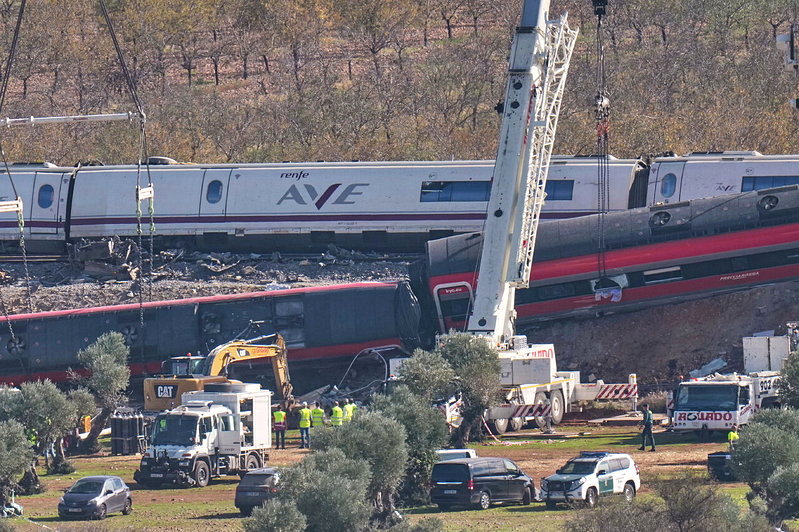
Spain happened on the 28thhigh speed rail The train collision killed at least 69 people and shook Spanish people’s confidence in the railway system. Spanish Transport Minister Oscar Puente said on the 30th that the accident was caused by several “unexplained” errors made by railway traffic controllers, including allowing a train traveling at about 160 kilometers per hour to yield to another stopped train despite technical problems.
new York Times According to reports, Puente gave the most detailed account yet of the cause of the accident at a press conference. The Spanish government said that the old LZB automatic protection system, which is usually responsible for controlling railway signals, malfunctioned in some areas of central China at 8:31 am on the 28th, causing all trains in the vicinity to automatically stop. Signal control was then handed over to the backup automation system and Madrid Traffic Control Center personnel, who maintained contact with the train driver.
Puente explained that in this case, if a certain track section is already occupied by a train, other trains are not allowed to enter. However, both trains became stuck on the same stretch of track south of Toledo in central Spain when the main automatic system failed.
He said that railway rules state that “the train behind should not move until the train in front has passed.” However, traffic control personnel still instructed the previous train, operated by state-owned railway company Renfe, to resume operations at 8:36 am. The rules also clearly stipulate that in such cases, the speed of the train should not exceed approximately 40 kilometers per hour, so that the driver can stop in time if he finds any obstacle on the track ahead. However, the controller instead instructed the driver to return to normal speed, and the normal driving speed on this section of road can reach a maximum speed of about 200 kilometers per hour.
Puente said that at 8:41 a.m., traffic control personnel allowed the train ahead, operated by Ireo Co., to move and turned the signal ahead of the train to green. However, the train could not start again. At 8:48 am the driver informed the control center that he could not proceed further. “The control center received the message but took no action.”
He said that because the signal at the front of the Iryo train turned green, the signal at the rear also turned green, indicating that the track was clear, but the Iryo train was actually still standing in place. Before the collision, the trailing Renfe train crossed the green signal at high speed.
Puente said that for 17 minutes, Madrid traffic control center personnel could see through “screens and systems” that one train was moving while another was stopped. “Control center personnel were fully aware of what was happening at the time,” but they took no measures to prevent the accident. He asked, “If there was a way to take action and a time to do it, why was nothing done? I have no idea.” He said it would be up to independent investigators and judges to clarify why the accident happened.
Puente said that although the Railway Employees Union has raised questions about the lack of manpower and funds, the traffic control center still has adequate manpower and funds. Nevertheless, the government is preparing to introduce “a set of urgent measures” to reduce risks and provide operators with the “most advanced technology” to avoid a recurrence of the failures. Furthermore, it is Spain’s second fatal train accident in less than a year, and Puente has stated that he has no intention of resigning despite mounting pressure to step down.
Summary FAQ
-
The accident killed at least 69 people and seriously affected the confidence of the Spanish people in the railway system. It also exposed the government to strong doubts about security management and responsibility.
-
Despite the technical failure, the controller nevertheless allowed the rear train to return to normal speed and failed to intervene in time when the front train failed to restart, resulting in the two trains eventually colliding at high speed in the same track section.
-
Puente said the control center apparently had 17 minutes to observe and take action, but did nothing. He believed that the cause of the accident still needed to be clarified by an independent investigation and a judge, and stressed that he had no intention of resigning.