
AI summary
Summary of article:
A court temporarily banned construction outside normal working hours at Manhattan’s Chinatown Jail. Community groups said years of struggle had paid off; The city government warned that the suspension would increase costs and delay the completion of the project.
Extension of construction time at Manhattan’s Chinatown jail sparks community lawsuitnew York State Supreme Court Justice Kathy J. King signed a temporary restraining order on the 26th, prohibiting the city government and contractors from completing prison construction projects outside normal working hours until the court rules on the preliminary injunction application. According to the order, night construction that was scheduled to last until midnight must be suspended, but work can still continue during normal hours; Community groups welcomed the decision, calling it an early victory in years of struggle.
According to court documents, the judge asked the defendants to suspend unusual work hours based on overtime construction permits or other arrangements, and scheduled a hearing in a Manhattan court for December 1. Generally, normal construction hours are allowed from 7 am to 6 pm. Monday to Friday. The new arrangement, implemented by the city government in October, will extend construction work hours to 6 am to 12 noon on weekdays and 9 am to 5 pm on Saturdays. There is also a provision to deliver construction material to the construction site in the morning.
The case was filed on the 21st by “Neighborhood Alliance South of Canal Road” (NUBC), “Welcome to Chinatown” and several Chinatown elders. The plaintiffs pointed out that the city’s 2019 environmental impact report primarily assessed daytime construction and only occasionally considered overtime work at night. However, it now plans to extend the working hours by about six years. It issued the permit without conducting a supplemental environmental review. It is suspected of violating relevant laws and regulations and needs to revoke permits and ban long-term night and weekend construction.
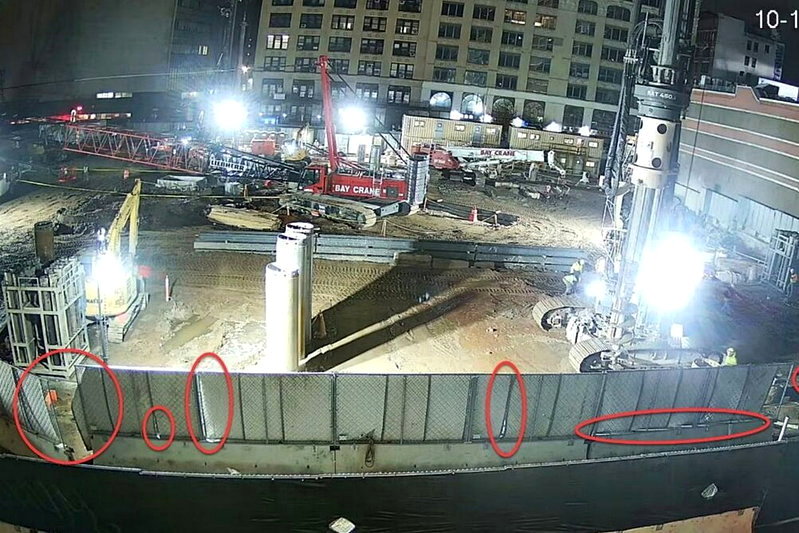
The plaintiffs’ complaint mentions the Chung Pak Building, which is adjacent to the construction site, and residences in the Baxter St. area. Betty Lee, 77, who lives across the street from the construction site, said the bright lights, mechanical noise and vibrations had disrupted the couple’s sleep; Ping Ai Mei, 88, said she was forced to change units in the Songbai Building because of dust from the demolition project.
“Welcome to Chinatown” co-founder and CEO Victoria Lee released a statement saying that the court’s injunction responded to the Chinatown community’s long-standing concerns about the dangers of nighttime drilling and construction. “We are grateful to the court for seeking an immediate halt to this inhumane construction program.” He said the construction site is adjacent to senior housing, and is also surrounded by small businesses, older apartments and day care centers. The group will continue to fight for the community’s rights and ensure that the city properly closes Rikers Island Jail.
NUBC leader Jan Lee said, “We have won,” believing that the court has finally addressed the community’s concerns about nighttime construction and health impacts over many years. He said about a third of Chinatown’s residents live below the poverty line. Many people live in old buildings just a few feet away from the construction site, but have to endure drilling at night and trucks weighing 30 tonnes passing through narrow streets. “This is more than just an inconvenience, it’s a threat to the health and well-being of the entire community,” he said. He stressed that residents should not have to pay the price for the city’s construction program.
The city government had previously strongly opposed the plaintiffs’ emergency application. The office of City Legal Counsel Steven Banks submitted documents to the court on the 23rd, arguing that the project contract signed in March 2025 specified the second shift and Saturday construction, and community groups were already aware of related arrangements, but they did not file a lawsuit until October this year. The City believes that the plaintiffs’ environmental review challenge to the expanded construction program exceeds the generally applicable four-month filing period under Section 78 of the New York State Code of Civil Procedure.
The city government also warned that if the second shift of construction was stopped, the cost could rise to about 3 million yuan per week; If the overall extended working hours arrangement is cancelled, the project may be postponed from 2032 to 2034, which will increase expenses by approximately 340 million yuan. The City believes that further delay in construction of the city jail would hinder it from fulfilling its legal and moral responsibility to close the Rikers Island jail.
Regarding construction noise, Mayor Zohran Mamdani’s office previously told this newspaper that the construction site is equipped with sound insulation blankets, equipment silencing devices and noise, dust and vibration monitoring systems. Only finishing and preparation work will be done after 10 pm. The city government also says that the extension of permitted working hours is in line with the public interests and the conditions applicable to municipal projects involving special construction difficulties.
Summary FAQ
-
Judge King signed a temporary restraining order prohibiting the city government and contractors from conducting prison construction outside of normal working hours, including scheduled night construction until midnight and other irregular work hours, but normal construction could still continue during the day.
-
The case was filed by NUBC, Welcome to Chinatown, and several Chinatown elders, arguing that the city government had extended construction to nights and weekends for several years, but failed to conduct supplemental environmental impact assessments for the major changes, which is suspected of violating regulations and affecting the health of residents.
-
The city government said the second shift and Saturday construction were already written into the contract, and the community’s complaint had passed the four-month deadline; If work is stopped, costs may increase by approximately 3 million yuan per week, and the completion time may be extended from 2032 to 2034.