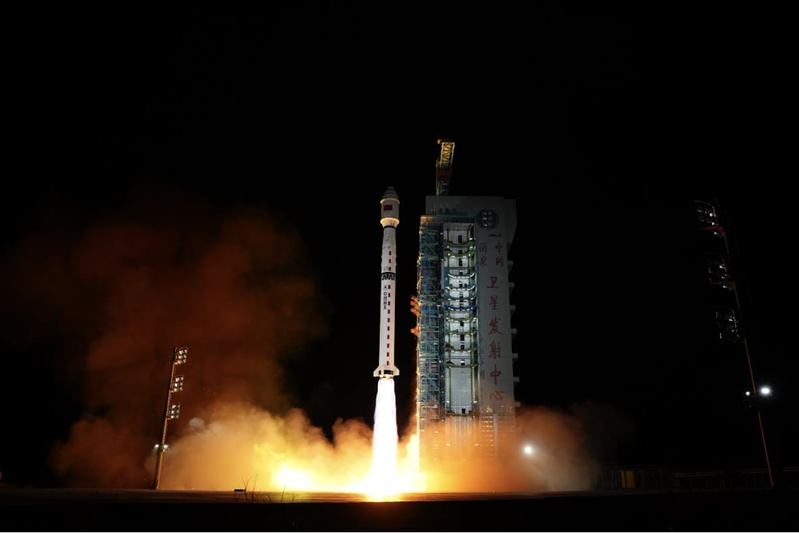

On the 24th, at 3:25 am Beijing time, China used Long March 4B to carry the satellite to Jiuquan Satellite Launch Center.rocket Six remote sensing satellites were successfully launched in the “six satellites with one stone” method. The satellites successfully entered the predetermined orbit and completed the 673rd flight mission of the Long March series of launch vehicles. This mission is to accelerate constellation networking of low-orbit satellites.
According to Xinhua News Agency, the launch mission was carried out at Jiuquan Satellite Launch Center at 3:25 am on the 24th. The rocket successfully launched a total of six satellites Yaogan 53 07-09 and Yaogan 56 19-21 into the predetermined orbit. This batch of remote sensing satellites are mainly used in fields such as scientific experiments, land and resources census, agricultural product production estimation, and disaster prevention and reduction. They can significantly reduce the interval between observation and reassessment and provide high-resolution data support for disaster prevention and reduction.
The Long March 4B carrying out this mission is a room-temperature liquid three-stage launch vehicle developed by the Eighth Academy of Sciences. It has strong multi-satellite launch capabilities. Chinese experts pointed out that the batch launch of multiple satellites shows that China’s remote sensing satellites are rapidly moving towards a new normal of large-scale “constellation networking” deployment. This launch is also the 673rd flight of the Long March series of launch vehicles.
According to reports, the Long March 4B launch vehicle was developed by the Commercial Rocket Company, a subsidiary of China Aerospace Science and Technology Corporation, and has a carrying capacity of 3.3 tons to a sun-synchronous circular orbit.