
AI summary
Summary of article:
The State Council announced the immigration schedule for November 2026. Most categories of family-based immigrants have improved significantly in a year. For employment-based immigrants, only EB-1 and EB-3 improved slightly, while EB-2 and EB-5 remained unchanged.
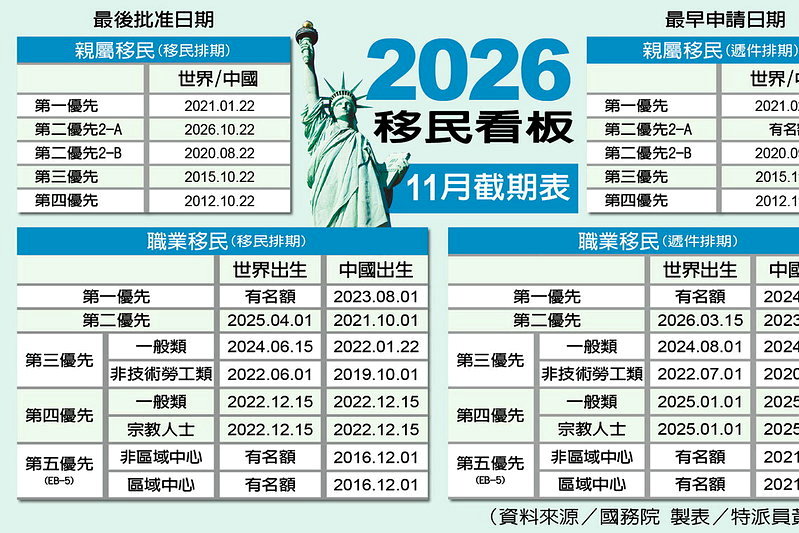
state Council Announced on November 22, 2026migrant Visa Bulletin (Visa Bulletin), significant progress has been made in many categories of relative immigration, and applicants of Chinese origin have been removedgreen card Except for the holder’s spouse and unmarried children under 21 (F2A) category, which is advanced only 30 days, other categories are advanced by one year compared to October; In terms of employment immigration, the EB-1 Excellent Talent category for applicants of Chinese origin has been moved forward by one month, the EB-3 Technical and Professional Worker category has also been moved forward slightly, and the EB-2 Highly Educated and Special Professional Talent and EB-5 Investment Immigration Non-Reserved categories remain unchanged.
According to the latest Table A released by the State Council, which is the final action dates, November saw significant progress in relative immigration. The F1 category, i.e., unmarried children of U.S. citizens over the age of 21, Table A applicable to applicants born in mainland China, will be extended for a full year from January 22, 2020 to January 22, 2021.
The F2A category will be moved forward by one month from September 22 to October 22, 2026. F2B for unmarried children of green card holders above 21 years of age has also been extended from August 22, 2019 to August 22, 2020, and this has also been extended by one year.
The F3 category, i.e. married children of US citizens, advanced from October 22, 2014 to October 22, 2015; The F4 category, i.e. siblings of adult US citizens, advanced from October 22, 2011 to October 22, 2012. Both have also advanced by one year.
In terms of employment immigration, the EB-1 schedule for applicants born in mainland China has been moved up one month from July 1, 2023, to August 1, 2023; EB-2 remains in effect as of October 1, 2021, without any changes. The EB-3 Skilled and Professional Workers schedule will be moved up 14 days from January 8, 2022, to January 22, 2022; EB-3 other worker categories will remain in place October 1, 2019.
Regarding investment immigration EB-5, the November Form A for Chinese applicants will continue on December 1, 2016.
As for State Department Form B, which lists the dates when applicants can begin submitting relevant documentation, November for Mainland China-born applicants includes July 1, 2024 for EB-1, January 1, 2023 for EB-2, and April 1, 2024 for EB-3, all of which are the same as October.
Summary FAQ
-
The overall progress of relative immigration is clear. Except for F2A, which is only 30 days ahead for Chinese-born applicants, F1, F2B, F3, and F4 are all a year ahead from October, showing that the scheduling of many family immigration categories has improved significantly.
-
In terms of employment-based immigration, EB-1 will be moved forward one month to August 1, 2023, and EB-3 technical and professional workers will be moved forward 14 days to January 22, 2022; The EB-2 and EB-5 non-reserved categories remain unchanged.
-
Table A shows the final approval date, which affects the timing of green card issuance; Table B shows the dates when applications can be submitted in advance. Form B for Chinese applicants EB-1, EB-2 and EB-3 in November are the same as in October, which means the delivery schedule has not changed.