
AI summary
Summary of article:
If the Democratic Party nets three seats in the midterm elections, Jefferies would become the first African-American Speaker of the House of Representatives in the United States, but a fragile majority and his ability to unify the more divided caucus in a coordinated style are being tested.
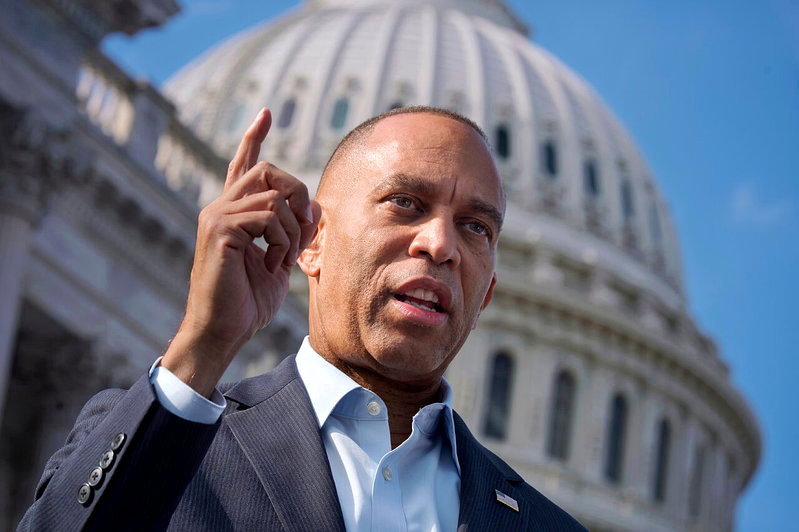
democratic party If a net gain of three seats in the midterm elections can lead to a majority in the House of Representatives, 56-year-old Minority Leader Hakeem Jeffries will become the first African-American in US history.Lok Sabha Speaker.Washington Post According to the 22nd’s analysis, Jefferies’ leadership style is facing scrutiny, particularly whether the conciliatory style that helped him rise to the position of minority party leader will be enough to unify a Democratic Party group that is becoming harder to control and whose aspirations are more divergent.
Former Democratic House Speaker Nancy Pelosi’s leadership style was a combination of authority and versatility. Current Republican House Speaker Mike Johnson trusts President Trump to help deal with the unruly Republican group with only a slight majority.
More than 20 members of Congress, people close to Jeffries and other former partners said Jeffries was a careful strategist and an affable leader who was good at convincing others through discussions. However, colleagues in Congress say Jeffries’ caution has sometimes gone too far.
Elise said Jefferies has shown a tough side at key moments. For example, during the government shutdown in 2025, he allowed the divided Democratic caucus to focus their demands on health care issues. When the Republican Party launched a redistricting offensive in Texas, they launched redistricting in Democratic-controlled states as a counteroffensive. At the time, Jeffries declared a “full declaration of war”, but the results of the electoral district redrawing were mixed.
Congressional aides say strong-fisted governance is not Jeffries’ style, and facing Trump could complicate any Democratic agenda over the next two years. The success of the speech depended on how Jeffries managed the majority which could be quite fragile, as well as some new members of Congress who are more liberal in their political stances and have not expressed loyalty to the caucus leader.
Jefferies declined to be interviewed, saying only through a spokesperson that it was too early to talk about becoming speaker. Some Democrats warned that the Democratic Party should not be too optimistic about the election. The increase in seats on election day may not be as promising as the surveys show.
Jeffries was born in 1970 and grew up in Crown Heights, Brooklyn, New York. His parents were social workers and substance abuse counselors. He studied political science at Binghamton University and was elected fraternity president during his sophomore year. While in school, Jeffries met his future wife, Kennisandra Arciniegas-Jeffries, and they had two children. Kenneth is a social worker like Sandra Jeffries’ mother. Jeffries is very protective of his family and never posts photos of his family on his website.
After graduating from college, Jeffries received a master’s degree in public policy from Georgetown University and attended NYU Law School. Jeffries once worked for the renowned law firm Paul Weiss. He ran for the New York State Assembly for the first time in 2000. After three failures, he was elected in 2006. Since 2013, he has served as the Democratic United States Representative for New York State’s 8th district.
Summary FAQ
-
If the Democratic Party gets a net gain of 3 seats in the midterm elections and gets a majority in the House of Representatives, 56-year-old Minority Leader Jeffries will become the first African-American Speaker of the House of Representatives in US history.
-
Because he has been good at reconciliation, persuasion, and negotiation in the past, but in the future he may face a more fragile majority and new Democratic Party members with more divergent positions and undecided loyalties.
-
During the government shutdown, he focused on the Democratic Party’s demands on health care. When Texas districts faced aggressive attack, he promoted countermeasures in Democratic-controlled states and announced in a high-profile manner that he would declare full-scale war.