
AI summary
Summary of article:
Doctors said that women with breast augmentation do not need to worry too much about the rupture of the prosthesis while undergoing mammogram. As long as they are informed in advance and cooperate with the implant displacement technique, most of them can be screened safely, and breast cancer should be routinely screened according to age.
Can I still do a mammogram after breast augmentation? If the breast is squeezed during the examination, will the “prosthesis” be crushed? Many women who undergo breast augmentation surgery are hesitant to have breast enlargement surgery because they worry that the prostheses will be damaged or that the exam will be inaccurate.breast cancer Screening. Doctors remind that breast enlargement is not a contraindication to breast photography. As long as the medical staff is informed in advance and proper photography techniques are used, most women can safely undergo the test. Don’t ignore the risk of breast cancer because of your love for beauty.
Prostheses, also known as prostheses or artificial implants, are used to replace body parts that are missing or functionally impaired due to disease, trauma, or congenital disorders. In breast augmentation surgery, prostheses refer to artificial breast implants or breast implants. According to a 2024 global survey by the International Society for Aesthetic Plastic Surgery (ISAPS), an estimated 27,822 breast augmentation surgeries are performed each year in Taiwan, accounting for approximately 10.8% of cosmetic surgeries and ranking third. As breast augmentation is becoming more and more popular, breast health management after the operation has also become a concern for women.
Liao Wenyi, a breast imaging expert at MJ Health Management Institution, said that women with breast enlargement often face questions in clinical practice. If breast photography requires clamping of the breasts, is it possible that the prostheses may rupture? In fact, mammography uses moderate compression to flatten breast tissue and reduce image overlap, thereby helping to detect smaller lesions. Under normal circumstances, the risk of the prostheses rupturing due to testing is very low, so there is no need to worry too much.
Liao Wenyi explained that when a woman undergoes mammography, about 10 to 20 pounds of pressure is applied to her breasts; Prostheses further reduce pressure on the breasts. With the advancement of artificial materials and technology, the new generation of silicone prostheses has excellent elasticity and pressure resistance, and can withstand about 300 pounds (about 136 kilograms) of pressure, so there is no need to worry too much about the damage caused by mammography.
However, prostheses are not permanently damaged. Liao Wenyi explained that prostheses can gradually become obsolete over time. If there is capsular contracture, deformity, or suspected rupture, careful evaluation should be performed before examination. It is recommended that women take the initiative to inform the timing of breast enlargement, the type of prostheses and the implant location, so that the medical staff can adjust the examination method to reduce unnecessary risks.
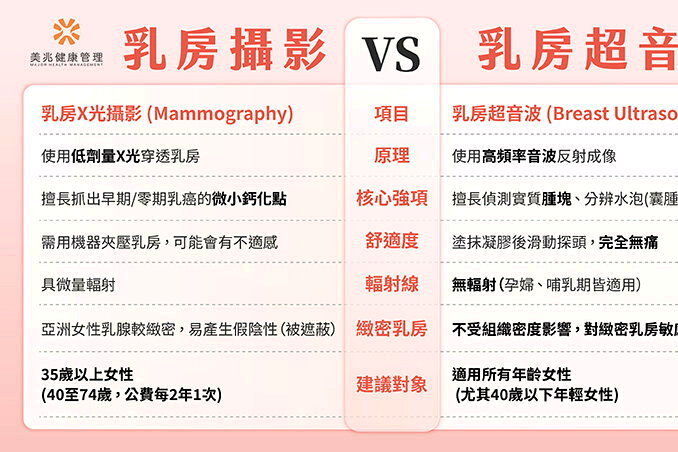
Some women are afraid of the pain of mammography and think they can have an ultrasound instead. Liao Wenyi emphasized that both types of examinations have their own advantages and cannot completely replace each other. Mammography is good at detecting small calcifications, which is helpful in early detection of breast cancer; Breast ultrasound can inspect masses and differentiate cysts from solid lesions, which is especially helpful for women with dense breasts.
Such as whether the prostheses covering the breast tissue affect the diagnosis of breast cancer? Liao Wenyi explained that radiologists can use “implant displacement photography technology” to push the prosthesis backward and pull the breast tissue forward to increase the observable range. If necessary, the number of photographs taken will also be increased to improve the completeness of the examination. However, the effect of prostheses shielding cannot be completely eliminated.
Taiwan currently provides publicly funded mammograms every two years for women aged 40 to 74. Women with breast engorgement should also have regular checkups depending on their age and individual risk. Liao Wenyi reminded that if you notice breast lumps, abnormal nipple discharge, depression in the breast skin or changes in appearance, you should seek medical treatment as soon as possible and not wait until the next screening test. Regular checkups are the key to protecting your health.
Summary FAQ
-
The risk is usually low. The pressure during mammography is usually between 10 and 20 pounds. The new generation of silicone implants can bear a load of about 300 pounds and usually will not break during examination.
-
It is recommended to actively inform the timing of breast enlargement, type of prosthesis, implant location, and whether there is capsular contracture or deformation, etc., so that the medical staff can adjust the shooting method to reduce the risk and improve the interpretation accuracy.
-
Mammography is good at detecting small calcifications, which helps in early detection of breast cancer; Ultrasound is better at inspecting masses and differentiating cysts from solid lesions. Both complement each other and cannot replace each other completely.