
AI summary
Summary of article:
A wife from Xiamen secretly installed surveillance cameras in her bedroom to gather evidence of her husband’s suspicious affair and property transfers. However, the court found that the evidence violated privacy and could not verify the original video, so the video was thrown out. He has appealed.
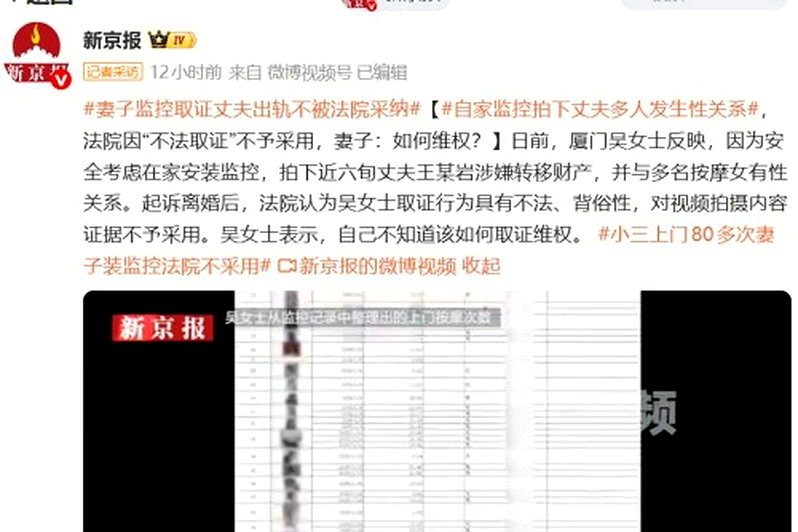
A woman in Xiamen suspected her husband was cheating on her during their marriage, so she secretly installed surveillance cameras in the bedroom of the couple’s shared residence. In just two months, she was photographed bringing many strange women to her home with her husband more than 80 times. It was also suspected that the transfer involved the couple’s joint property. However, when the court heard the divorce case, it threw out all the surveillance videos on the grounds that the evidence collection method violated privacy and violated public order and good customs. Furthermore, since the original surveillance equipment was confiscated by the police, the original footage could not be verified. The woman refused to accept the prima facie decision and filed an appeal.
According to the client, Ms. Wu (pseudonym), she had been married to her husband for more than 20 years and had long suspected that her husband had extramarital affairs and inappropriate relationships, so she quietly installed a camera on the TV line socket in the bedroom. Surveillance footage from December 2024 to March 2025 revealed that several strange women came in and out of the residence a total of more than 80 times. Ms Wu said the videos showed her husband having sex with multiple masseuses, and also recorded suspicious transfers of the couple’s joint property.
Ms Wu filed a divorce suit in August 2025 at Huli District Court in Xiamen city, hoping to use the video to prove her husband had marital defects and seeking protection during the division of property. However, the husband discovered the hidden camera and called the police. The original surveillance device that stored the video was confiscated by the police station, and the court was unable to obtain the original carrier for verification.
In July 2026, the court of first instance ruled that the two should divorce and divide their marital property, but did not adopt all the surveillance videos. The court said that the relationship between husband and wife does not mean that one party can violate the privacy rights of the other party. The bedroom is a very private place. Secret filming without the other party’s consent is deliberate voyeurism, which seriously violates the legitimate rights and interests of others and violates public order and good customs. Even if the content of the video is true, the authenticity of the results cannot prove the validity of the evidence collection methods.
According to Article 106 of the “Interpretation of the Supreme People’s Court on the Application of Civil Procedure Law”, evidence obtained in a manner that seriously violates the legitimate rights and interests of others or seriously violates public order and good customs shall not be used as a basis for determining the facts of the case. The Civil Code also protects the privacy rights of natural persons, and private spaces and private activities are not subject to illegal spying, filming or voyeurism.
After the matter was exposed, netizens started a polarized discussion between for and against. Those who support Ms. Wu believe that the joint home between husband and wife is also their home. If even videos that directly record marital abuse cannot be accepted, it will become more difficult for ordinary people to protect their rights and interests. Some people also question whether the right to privacy should not override the spouses’ duty of loyalty.
The other side believes that getting married does not mean giving up the right to privacy. If covert filming is allowed as long as the content of the video is authentic, it may encourage the installation of pinhole cameras in bedrooms to monitor partners. Furthermore, the lack of native monitoring tools also makes it impossible to verify whether the film has been edited or tampered with.
Lawyers suggest that if there is fraud or property transfer in the marriage, you can give priority to saving chat records, transfer vouchers, consumption records and legally obtained recordings; If any illegal behavior occurs, you can call the police and keep the police transcript and police records, or you can apply to the court for investigation and evidence collection during litigation. Never secretly install cameras in private places such as bedrooms and bathrooms, or distribute secretly filmed videos to others.
The police also began investigating clues in the film that suspected it to be related to prostitution. However, because the relevant behavior had exceeded the six-month limit for public security penalties at the time of the investigation, even if it is proven true, public security penalties such as detention or fines can no longer be imposed.
The lawyer pointed out that the exclusion of the surveillance video does not mean that Ms. Wu is completely unable to assert her rights. She can still present other evidence during the appeal process to prove her husband’s marital fault and property transfer. This case once again highlights the legal boundary between the duty of marital fidelity and individual privacy rights.
Summary FAQ
-
Because she had long suspected her husband of cheating during their marriage, she installed a hidden camera in the bedroom of the couple’s shared home. As a result, he filmed several strange women coming in and out more than 80 times over two months. She also claimed that the footage showed her husband having sex with the woman and also suspicious property transfers.
-
The court held that the bedroom is a highly private space, and the secret filming without consent was deliberate voyeurism, which seriously violated privacy and violated public order and good customs. Even if the content is true, the evidence collection method cannot be considered legal just because the results are true.
-
She may still submit other legal evidence in the appeal, such as chat records, transfer and consumption vouchers, legal recordings, or apply to the court for investigation and evidence collection; However, if the original carrier of a secretly filmed private video cannot be verified, it will still be difficult to become effective evidence.