
AI summary
Summary of article:
Lachman pointed out that many crises, such as Russia and Ukraine, the United States and Iran, and the Taiwan Strait, are interconnected. If a powerful country misjudges its rival’s security commitments, the world could slide into large-scale conflict, and the deterrent power of the Taiwan Relations Act will become a key variable.
Gideon Rachman, chief foreign affairs commentator of the Financial Times, wrote “Are we sleepwalking into World War III?” Wrote an article titled. On the 17th, it was warned that the Third World War has turned from an unimaginable disaster into a crisis that leaders of various countries frequently discuss openly. As the US-Iraq war is increasing and China is increasing military pressure on Taiwan, Russia, China.iran As relations with North Korea become closer, fundamentally separate regional conflicts could influence each other, leading to further expansion of the war.
Although the threshold for world war has not yet been reached, history shows that if a great power misjudges its opponent’s determination to meet its security commitments, it could lead to large-scale conflict. President of ChinaXi Jinping We must decide whether the United States opposes the use of force against TaiwanTaiwan Relations Act “Whether it still has sufficient significance, Russian President Vladimir Putin should also evaluate whether NATO’s mutual defense commitment is credible. World peace may depend on the answers to these questions.”
Lachmann recalled that on the eve of Russia’s invasion of Ukraine in 2022, it was still difficult for many Europeans to believe that large-scale war would break out again in the 21st century. Now the situation has changed. US President Trump once accused Ukrainian President Zelensky of “taking World War III as a bet” and believed that Western aid to Ukraine could draw the United States into a war with Russia. Zelensky believed that failure to stop Russian aggression was the real threat. The two sides have very different judgments on the risks of war, but both view the three world wars as threats that must be faced head-on.
Concerns about great power conflict are not limited to Europe. Asia also faces risks. Xi Jinping has repeatedly warned that the United States and China could fall into a “Thucydides trap” where existing powers and rising powers would go to war. But Lachman said Xi Jinping’s own policies have also increased tensions. China is aggressively expanding its army. The number of naval ships exceeds that of the United States. It has continued to exert pressure on Taiwan and has threatened not to shy away from using force if necessary.
However, does this mean that the world is heading towards World War III? Lachman explained that two conditions must be met for a world war: first, the world’s major powers are directly at war, and second, the war has spread to several countries. No one has crossed the border yet, but the risk is always there.
North Korea has sent troops to aid Russia, and the US–Iraq war is also linked to the Russia–Ukraine war. The West is particularly concerned about the “axis of hostility” formed by Russia, China, Iran and North Korea. NATO Secretary General Rutte has even warned that China and Russia could launch coordinated attacks in Europe and Asia at the same time. According to data from the International Crisis Group, there are currently 65 conflicts ongoing around the world, a new high since World War II.
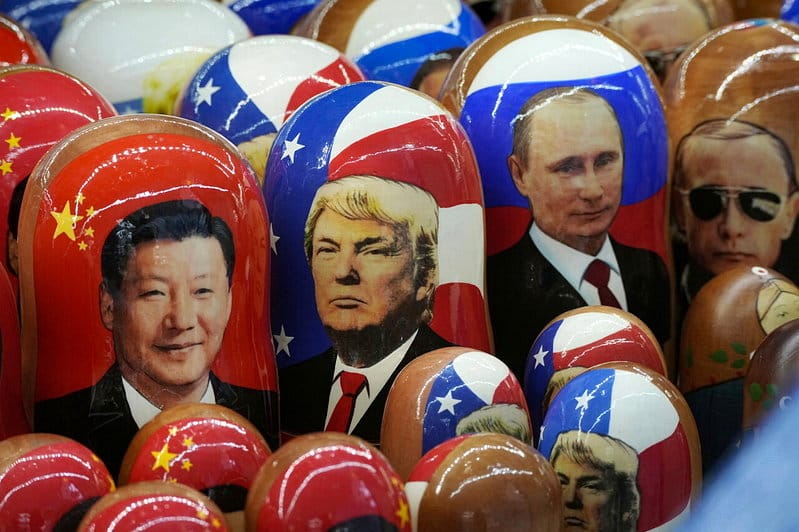
As for why conflicts are increasing, Lachman points to the changing international balance of power as one reason. In 1989, the Group of Seven major industrialized countries (G7) accounted for about 2/3 of global economic output. This has fallen to 43% in 2022. The relative decline of Western power has made powers dissatisfied with the existing system more emboldened to take risks. In addition, the rise of strongman leaders such as Putin, Xi Jinping, Trump, and Israeli Prime Minister Netanyahu have also contributed to a “might makes right” worldview and increased the risk of international conflicts.
However, can peace be maintained by allowing powerful powers to control surrounding areas? Lachman explained that behind some of the claims by Trump, Putin and Xi Jinping is the “sphere of influence” theory, which holds that major powers should dominate neighboring regions, while smaller countries such as Ukraine and Taiwan should accept dominance. As long as powers respect each other’s sphere of influence, conflicts can be avoided.
But Lachman believes there are two major problems with this theory. Firstly, it ignores the rights and autonomy of small countries. Will Canada have to obey Trump and is democratic Taiwan destined to succumb to China’s one-party dictatorship? Secondly, even if only the interests of the great powers are taken into account, dividing spheres of influence cannot guarantee peace because the strategic interests of different countries may overlap with each other. He pointed out that Taiwan’s semiconductor industry is of great strategic importance to the United States. As long as Taiwan still controls 90% of the world’s most advanced semiconductor production capacity, Washington is unlikely to accept Taiwan’s annexation by China.
Lachman pointed out that since dividing spheres of influence cannot guarantee peace, military deterrence is particularly important. However, Trump’s attitude towards allies’ security commitments is raising questions about the credibility of the deterrence mechanism. Before the outbreak of the two world wars in history, Germany bemoaned the determination of other powers to meet its security commitments. Now, similar uncertainties could lead to another war.
Summary FAQ
-
He believes that conflicts between Russia and Ukraine, the United States and Iran, and the Taiwan Strait are no longer isolated, and that regional wars may influence each other due to the increasingly close ties between Russia, China, Iran, and North Korea. If powers misjudge each other’s security commitments, local crises could escalate into major wars.
-
Because Xi Jinping must decide whether the United States’ commitment to oppose the use of force against Taiwan is credible. The author believes that Taiwan is not only a geopolitical focus, but also has strategic importance as it controls the world’s top semiconductor production capacity. It is difficult for Washington to sit back and watch it take over.
-
He pointed out that although allowing powerful powers to take control of their environment may seem to be a way to avoid war, it does not respect the autonomy of smaller countries and cannot eliminate overlapping interests. Issues such as Taiwan and Ukraine show that conflicts of strategic interests can still lead to war between great powers.