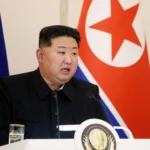


Seoul | Tuesday — North Korea fired an unidentified projectile toward the sea on Tuesday, South Korea’s military confirmed, raising fresh security concerns on the Korean Peninsula as Pyongyang prepares for a major political gathering of its ruling party.
South Korea’s Ministry of National Defense said the launch originated from North Korea’s east coast. Officials did not immediately disclose further details, including the type of weapon involved, its range, or whether it was classified as a missile or artillery system. Military authorities in South Korea and the United States are continuing to analyze the launch.
The latest launch comes amid a sharp rise in tensions between the two Koreas, driven by recent accusations from Pyongyang that South Korea conducted surveillance drone operations across the border. North Korea has warned of retaliation, calling the alleged drone flights a direct violation of its sovereignty.
South Korea has strongly denied the claims, stating that it did not deploy any military drones during the periods cited by the North. Seoul has indicated it is investigating whether civilian groups or non-government actors may have been responsible for any unauthorized drone activity near the border.
Launch Linked to Political Timing, Analysts Say
Security experts say the timing of Tuesday’s launch is significant, as North Korea is preparing for a highly anticipated Workers’ Party congress, expected to take place in late January or early February. The meeting will be the first major party congress in nearly five years and is widely seen as a key moment for leader Kim Jong Un to outline future policy direction.
Analysts believe North Korea’s recent military actions and rhetoric are designed to stir nationalist sentiment domestically ahead of the congress. Pyongyang may also seek to justify tougher policies toward South Korea by framing the South as a hostile adversary.
One issue expected to feature prominently at the congress is Kim Jong Un’s declaration of a “two-state” system on the Korean Peninsula. The proposal signals a major shift in North Korea’s long-standing stance on reunification and would formally define South Korea as a separate and hostile state. Experts say the concept could be written into the ruling party’s constitution, marking a historic policy change.
Series of Weapons Tests Raises Alarm
Tuesday’s launch follows a string of recent weapons tests by North Korea. Earlier this month, Pyongyang announced successful test flights of hypersonic missiles, a sophisticated weapons technology designed to travel at extreme speeds while evading missile defense systems.
According to North Korea’s state media, Kim Jong Un personally observed the hypersonic missile tests and emphasized the need to strengthen the country’s nuclear deterrence. He reportedly described the weapons program as essential to countering what the North views as growing military threats from the United States and its allies.
In December, North Korea also test-fired what it called long-range strategic cruise missiles and newly developed anti-aircraft missiles. Around the same time, state media released images showing what appeared to be the construction of the country’s first nuclear-powered submarine—an asset that could significantly enhance its nuclear strike capabilities if completed.
Military analysts say these demonstrations are likely intended to showcase progress in weapons development ahead of the ruling party congress, reinforcing Kim Jong Un’s authority while sending a clear signal to regional rivals.
Regional and Global Implications
The latest projectile launch underscores ongoing instability in Northeast Asia at a time when diplomatic efforts to denuclearize North Korea remain stalled. While Pyongyang has framed its actions as defensive, South Korea and its allies view the repeated tests as destabilizing and provocative.
Although no immediate damage or casualties have been reported, regional militaries remain on high alert. Observers warn that additional launches or weapons tests could follow in the coming weeks as North Korea approaches its key political meeting.
As investigations continue into the nature of Tuesday’s projectile, the launch adds to mounting concerns that tensions on the Korean Peninsula could escalate further in early 2026.