
AI summary
Summary of article:
Spain launched a nationwide 24-hour strike just weeks before the election to protest the housing crisis, which has disrupted transportation and industrial operations. Unions said there was enthusiastic participation, while the business community said the impact was limited.
Spain launches national campaign today to focus on chronic housing crisisstrike Just weeks before general elections at the end of the month, protesters blocked traffic and disrupted morning commutes for hundreds of thousands of people.
It was Spain’s first nationwide 24-hour strike since 2012, and pay and public service issues were also central to the demands, Agence France-Presse reported. Unions say initial participation has been overwhelming, with “huge numbers” of people responding, but business leaders have downplayed the level of participation.
On the 29th, demonstrations are going to be held in the capital Madrid and the second largest city Barcelona.vote Indicator of former public dissatisfaction. Outsiders predict that the right-wing opposition camp will win the elections.
Spain is the fourth largest economy in the European Union. The impact of this strike on industrial and service industries will also be closely monitored. Strikes have been arranged at logistics centers, industrial areas and highways across the country.
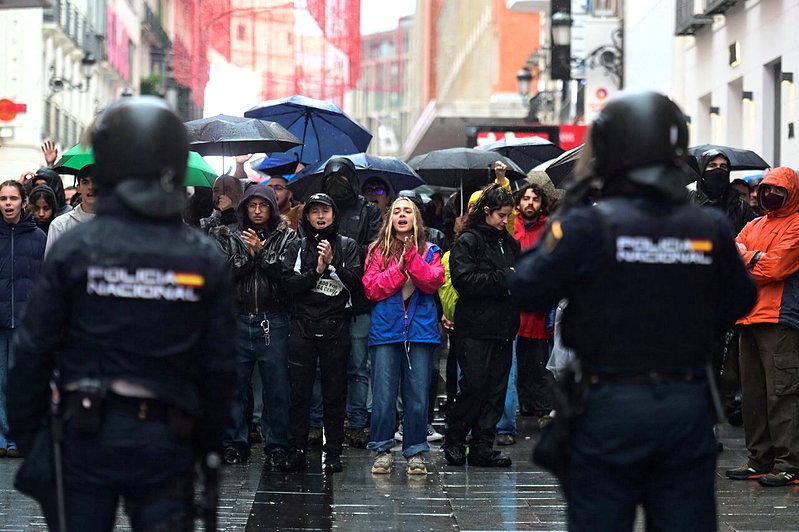
In Madrid, dozens of protesters blocked the main road leading to the city center despite the rain, causing traffic jams, but many shops remained open as usual.
In Barcelona, the metro and bus systems provided minimal service during the morning rush hour before resuming service in the evening.
In comparison, Madrid Metro said 93% of trains were running normally in the early morning, but passenger numbers were down by almost half.
Pepe Álvarez, leader of the Spanish General Union of Trade Unions (UGT), told the Spanish Radio and Television Corporation (RTVE) that the strike was a “great success”, attended by a “huge number” of people and a “complete” shutdown in some sectors.
However, Rafael Espartero, spokesman for the Federation of Trade Unions, acknowledged that the degree of participation of different industries “varies”, with large numbers responding in the automotive manufacturing, petrochemical and meat industries, as well as in coastal areas where housing problems are particularly severe.
The Spanish Federation of Enterprise Organizations (CEO), which represents business leaders, said in a statement that the impact of the strike varied by region and industry, with “participation rates low” in most industries.
Summary FAQ
-
The strike focuses on the long-term housing crisis, but also includes issues such as wages and public services. The union hopes to use the nationwide mobilization to highlight people’s dissatisfaction with the cost of living and housing pressures.
-
Protesters blocked roads and staged sit-ins at transport hubs, disrupting morning commute at many places and affecting hundreds of thousands of people. Barcelona’s metro and buses were at one point providing only minimal services, while Madrid experienced traffic jams.
-
Trade unions said that in many places large numbers of people participated and some industries almost completely shut down; However, the business community believes that participation rates are low in most industries. Since the strike is close to the general elections, its scale is also considered an important indicator of public discontent and electoral sentiment.