
AI summary
Summary of article:
Marvell announces the acquisition of Lumentum. Management emphasized that the move focuses on AI data center interconnect upgrades rather than supply constraints, and is optimistic about the long-term growth brought by scale-up and scale-in.
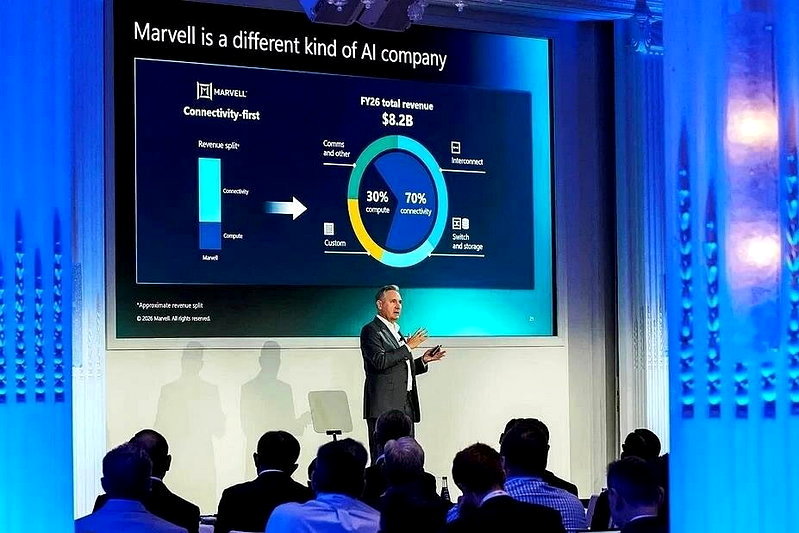
Marvell officially announced that it will acquire Lumentum, a leading optical communications company. The boards of directors of both companies approved the transaction on November 2. CEO Matt. Murphy explained that the main reason for this acquisition is not the tight supply as predicted by the market, but the optimism that scale-up and scale-in will bring rapid growth. The combination of the two will bring about a chemical reaction where one and one are greater than two.
Regarding this acquisition, the market raised questions whether it would buy at a higher valuation. Murphy first compared Inphi’s acquisition in 2016, pointing out that at the time it also appeared to pay a high valuation, but the business has grown more than 10x since the transaction was announced. Michael, CEO of Lumentum. Halston said Lumentum’s business is growing rapidly, and the merger of the two companies will create multiplier effects, and the opportunities for vertical expansion and in-package expansion (scale-in) are far greater than going alone.
Management has repeatedly emphasized that as the scale of AI clusters increases, the interconnections within racks, trays, and even packages still rely on copper connections. However, the transmission distance of copper is rapidly deteriorating, creating the so-called “copper wall”. Optical interconnections must continue to move closer to computing engines. The transmission bandwidth of scale-out is already 10 times that of traditional cross-data center transmission. Scale-up will next increase by 10 times, and scale-in is expected to increase by another order of magnitude. Therefore, Murphy said, “the networks of the next decade will be defined by optics, just as electrical sardines defined the last era.”
Summary FAQ
-
Marvell said that the main idea of this transaction is the rapid growth of interconnection demand under the expansion of AI clusters, especially the market capacity of scale-up and scale-in, rather than the tight supply issue anticipated by the outside world.
-
Management on both sides believe the merger could create multiplier effects in vertical expansion and in-package expansion, bringing optical interconnections closer to computing engines, creating growth momentum where one plus one is more than two.
-
The article points out that as the scale of AI clusters continues to expand, the transmission distance of copper connections is becoming increasingly limited. The networks of the future will be defined by optics, and optical interconnections will gradually replace traditional copper connections.